It is 2008, and the sampling revolution has hit a wall of its own: MCMC is exact in the limit but the limit never arrives when the model has millions of latent variables and the corpus has billions of words — the chain would need geological time. Trade exactness for reach: recast posterior inference as optimization, fitting the closest tractable distribution to the true posterior and bounding what the approximation gives up. Make it stream, so the fit updates from minibatches without revisiting the archive. Then be honest about the known sin — variational approximations understate uncertainty. Get it wrong and every large-scale probabilistic model reports intervals systematically too narrow, a whole literature of overconfidence dressed in Bayesian clothing.
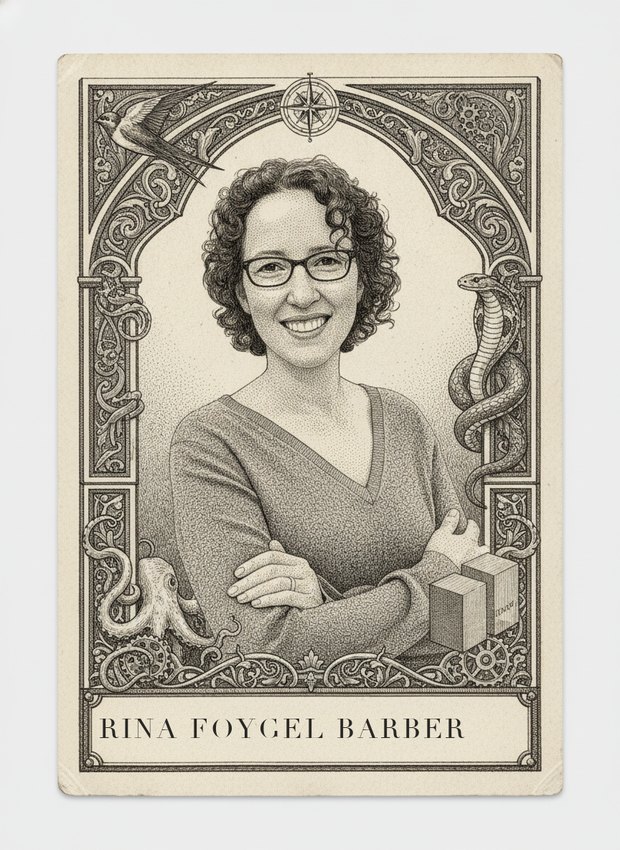
Barber's work on conformal prediction and inference after model selection, developed from the 2010s onward, provides rigorous, distribution-free ways to quantify uncertainty around a statistical estimate, which speaks directly to the honesty-about-approximation the problem demands, correcting exactly the kind of overconfident, too-narrow intervals that variational methods are known to produce. Her methodological instinct for honest error bars is philosophically well matched to the problem's core warning. But Barber's actual research targets high-dimensional variable selection and post-selection inference for modern statistical and machine learning models developed after the original 2008 web-scale posterior revival, with no direct engagement in constructing the variational inference machinery itself. The connection here is best described as thematic proximity rather than any substantive technical or historical bridge to the actual 2008 web-scale posterior problem.

Blei is the central figure the problem is describing. His work through the 2000s, especially latent Dirichlet allocation with Ng and Jordan in 2003 and his subsequent development of stochastic variational inference around 2008-2013, is precisely the move the problem asks for: recast posterior inference as optimization, fitting the closest tractable distribution to the true posterior rather than sampling it, and make the fit update from minibatches without revisiting the full corpus. His papers are explicit about the honest cost, variational approximations understate posterior uncertainty, and he spent much of his career characterizing and partially correcting that bias. This is not adjacent expertise applied sideways; it is the actual named contribution, streaming variational Bayes for web-scale text corpora, which is why the score sits at the ceiling.
Battle #113 · 8/10/2026, 11:38:35 AM · this result is deterministic: the same two personas on this problem always resolve the same way.