It is 2021 in San Francisco, and the standard vision recipe has a hidden invoice: every new task begins with a curated labeled dataset, so recognition is forever gated on annotation budgets and frozen category lists. The alternative uses supervision nobody had to buy — four hundred million image-text pairs scraped from the web — and trains two encoders to agree: image and caption pulled together, mismatched pairs pushed apart. The test is the radical part: classify standard benchmarks zero-shot, by asking which caption fits, matching supervised baselines without seeing one training label. Then audit what web-scale text smuggles in — its stereotypes ship with its supervision. Get it right and vision uncouples from the labeled dataset; the category list becomes a sentence anyone can rewrite.
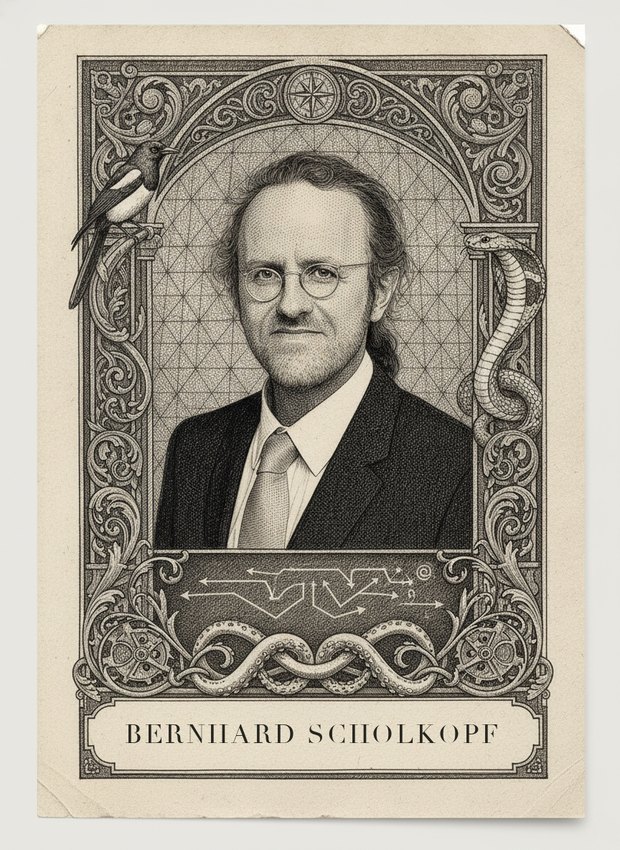
Scholkopf's systematization of kernel methods gives him a rigorous, general framework for thinking about embedding data into a space where similarity is meaningful and geometrically structured, conceptually related to what CLIP's contrastive training accomplishes by construction rather than a fixed kernel. His later work on causal machine learning also gives him a principled vocabulary for interrogating whether a model's zero-shot generalization reflects genuine understanding or spurious statistical shortcuts, directly relevant to auditing CLIP's biases. But his own signature contributions are pre-deep-learning kernel methods and causal representation learning theory, not contrastive vision-language pretraining itself, so his relevance is a strong theoretical lens applied from outside rather than direct engagement with this problem's system.
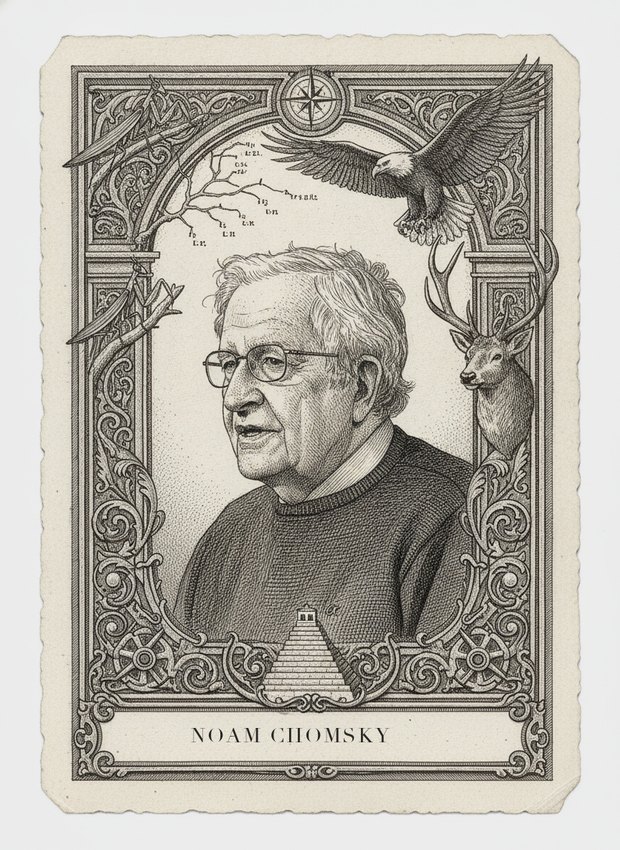
Chomsky's formal-grammar hierarchy and his career-long critique of purely statistical approaches to language put him in direct philosophical tension with CLIP's premise: that meaning and category structure can emerge from statistical co-occurrence in web-scraped text and images rather than innate structured rules. His own technical contributions concern the mathematics of formal languages and syntax, with no overlap in contrastive learning, embedding spaces, or transformer architectures. A sophisticated reader might invoke him precisely as the skeptical counterpoint to CLIP's statistical philosophy, but that is an argumentative role rather than a technical contribution, so his direct relevance to this problem's actual system is minimal. Grad students should treat the comparison as instructively adversarial rather than as evidence of any actual technical contribution.
Battle #121 · 8/10/2026, 11:38:52 AM · this result is deterministic: the same two personas on this problem always resolve the same way.