It is the 2000s, and labels have become the bottleneck of machine learning: an expert must hand-annotate each one, and experts are slow and expensive, while raw unlabeled data pours in for free. You have thirty labeled points and thirty thousand unlabeled ones. The unlabeled data, though it carries no answers, reveals the shape — the manifold — on which the data lives, and that geometry can pin down the decision boundary far better than thirty labels ever could alone. Exploit it. Get it wrong and you either pay for thousands of labels you didn't need, or ignore the free geometric structure and learn a boundary that slices right through a natural cluster — in a labels-are-money world, the unlabeled cloud is the resource you cannot afford to waste.

Chose The adaptive-adversary audit — wrong. The physical-world adversarial attack was the one that fit.
Song's adversarial and security perspective touches this problem only at its failure modes. Graph-based semi-supervised learning is notoriously fragile: because labels propagate over the similarity graph, a few poisoned unlabeled points can bend the decision boundary far from where thirty clean labels would put it — a data-poisoning surface her community later studied carefully, and her 2010s work on adversarial machine learning is the right lens for auditing it. But that is criticism of the method, not the method. Her research program — software security, then attacks and defenses for learned systems — contains no manifold estimation, no spectral machinery, and no semi-supervised algorithm of her own; in the 2000s setting she was doing systems security, not learning theory. She would harden or break the winning solution rather than produce it.
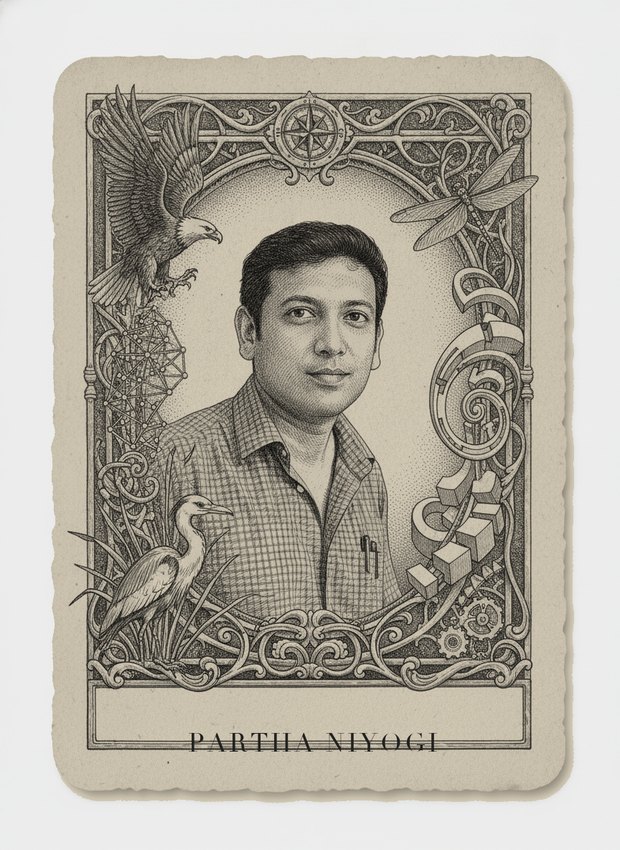
This problem is Niyogi's life's work stated as an exam question. With Belkin he created Laplacian eigenmaps (2001–03), showing that the eigenvectors of a graph Laplacian built on unlabeled points recover the data manifold's intrinsic geometry, with convergence results tying the graph Laplacian to the Laplace-Beltrami operator — the theorem that makes 'the unlabeled cloud reveals the manifold' a mathematical fact rather than a slogan. Manifold regularization (Belkin, Niyogi, Sindhwani, JMLR 2006) then delivered the exact algorithm this scenario calls for: kernel classifiers penalized by the Laplacian so the boundary respects geometry, with a representer theorem, using precisely a-handful-of-labels-plus-thousands-unlabeled experiments. He also studied when unlabeled data provably helps, keeping the claims honest. Era, scale, formulation, and guarantees all match. The problem's own win-list names him first, and the history agrees.
Battle #163 · 8/10/2026, 11:41:23 AM · this result is deterministic: the same two personas on this problem always resolve the same way.