It is the 1990s, and a startling theoretical question has just been answered yes: can a bunch of rules that are each only slightly better than a coin flip be combined into a single strong, accurate classifier? You hold exactly such weak learners. Combine hundreds of them into one powerful predictor — and, crucially, explain with theory why the combination keeps improving on test data even after it has driven training error to zero, defying the naive expectation that it must overfit. The margin explanation is the deep part. Get it wrong and you either dismiss weak rules as useless, or trust an ensemble you cannot justify — boosting's legacy is that it worked, spectacularly, for reasons that demanded new theory to understand.
Chose The graphical model — right call.
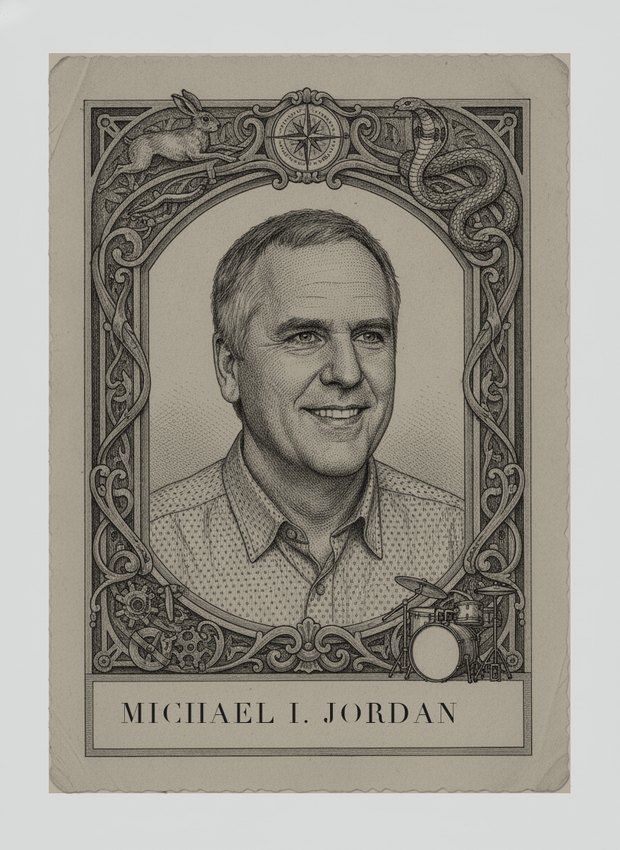
Jordan is era-perfect and adjacent-expert: his 1991-1994 work with Jacobs on mixtures of experts and hierarchical mixtures is the decade's other principled scheme for combining many simple learners, complete with EM-based training and a statistical rationale. Through the 1990s he drove the graphical-models synthesis and mentored the generation (including students who became learning theorists) that connected statistics to computational learning. He could build the committee several ways and discourse fluently on bias-variance, model combination, and later convex-analytic views of boosting his circle produced. What keeps him below the winners: mixtures-of-experts is cooperative gating, not adversarial reweighting; the weak-learnability theorem and the 1998 margin bounds are not his results; and his own theoretical signature in that decade was variational inference, not distribution-free generalization. A strong neighbor to the answer rather than its author.

Bengio spent the 1990s in machine learning proper — neural language models brewing, time-series and speech work at AT&T and Montreal — so he is era-correct, and unlike most deep-learning peers he has engaged ensembles analytically: his group published on why boosted and bagged predictors behave as they do (including work on boosting's connection to margins and on decision-tree ensembles), and his convex neural networks paper (with Le Roux and others, 2005) explicitly connects training neural nets one-hidden-unit-at-a-time to boosting's stagewise logic. He could build the committee expertly and discuss both explanations with sophistication. But his contributions here are commentary and connection rather than origination: the weak-learnability theorem, AdaBoost, and the margin bounds are all others' results, and distribution-free generalization theory was never his research signature. An informed neighbor, a rung above the pure deep-learning cohort.
Battle #44 · 8/9/2026, 7:19:36 PM · this result is deterministic: the same two personas on this problem always resolve the same way.