It is 2017, and autonomous vehicles are on public roads in Pittsburgh and Phoenix with safety drivers whose attention is the only backstop. Perceive and predict everything around the car — vehicles, cyclists, the pedestrian stepping off the curb mid-block — in rain, at night, against low sun, with a perception stack whose benchmark numbers were earned in daylight. The technical crux is the tail of the distribution: the jaywalker with a bicycle at 10 p.m. that appears in no training set, the distribution shift between the mapped test city and everywhere else. Ninety-nine percent accuracy is a fatality every few weeks at fleet scale. Within a year, a pedestrian in Tempe, Arizona will be killed by exactly this failure. Build the stack as if you know that.
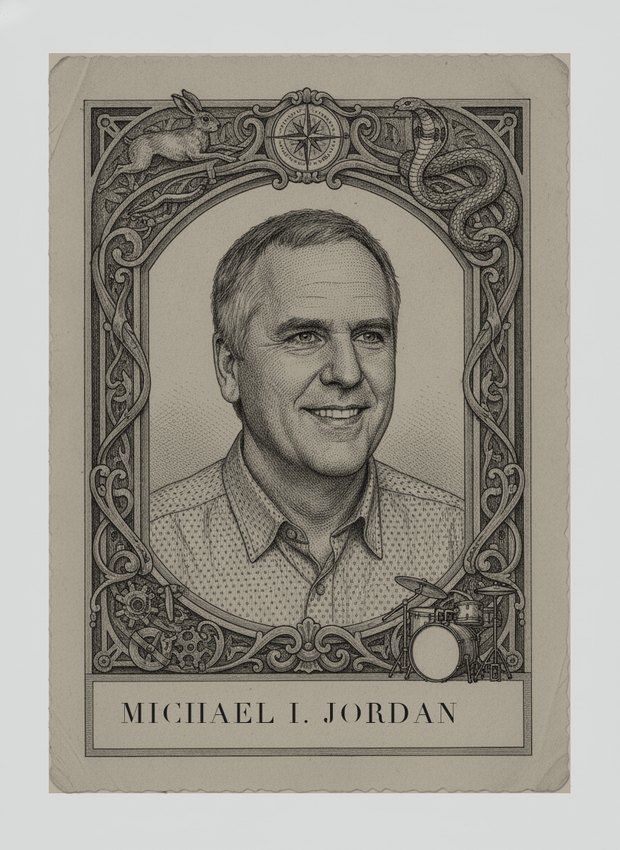
Jordan's graphical-models synthesis and general influence over probabilistic ML give him broad conceptual purchase on uncertainty quantification, which matters for a safety-critical system that must know what it doesn't know. His own research is not automotive perception, and by 2017 his emphasis had moved toward statistics-ML unification generally rather than deployed vision systems, so this is background theoretical relevance rather than applied fit. Jordan's recognized contribution — graphical models to modern ml; mentor of a generation — sits adjacent to this problem's core demands rather than inside them, which is why the fit reads as partial credit: real intellectual kinship, no applied instrument for the task at hand. Placed in the roster's stat-learning tranche under ml, the surrounding record gives no further grounds to move this score: the specific instruments this problem asks for are outside the body of work that made Jordan notable.
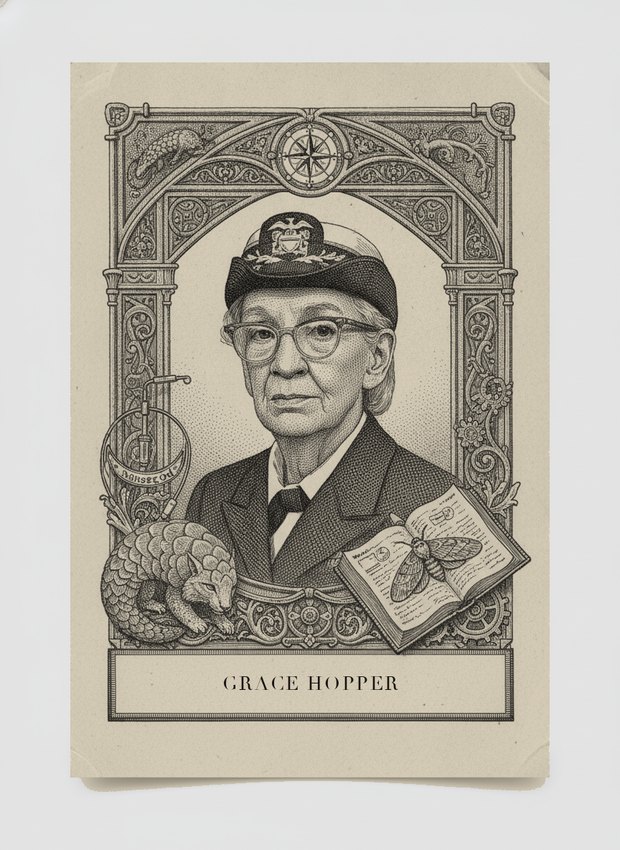
Hopper's compiler work and insistence on machine-independent, verifiable software are relevant in spirit to the safety-critical software discipline this problem names, though her applied domain (COBOL, business data processing) is far from real-time perception or deep learning; credit here is for software-engineering rigor by analogy rather than direct technical fit. Hopper's recognized contribution — compilers; cobol; machine-independent programming — simply never intersects the perception-and-prediction machinery this problem demands, which is why this cell is scored as an honest floor rather than a plausible contender. Placed in the roster's midcentury tranche under systems, the surrounding record gives no further grounds to move this score: the specific instruments this problem asks for are outside the body of work that made Hopper notable.
Battle #52 · 8/9/2026, 8:41:27 PM · this result is deterministic: the same two personas on this problem always resolve the same way.