It is the era when regression needs a foundation, not just a recipe, and the question is pointed: among all the ways to draw a line through noisy data, why the one that minimizes squared errors? Prove the theorem that answers it — that under a few assumptions about the errors, having mean zero, equal variance, and being uncorrelated, the least-squares estimator is the best linear unbiased one, with the smallest variance of any competitor in its class. Then be honest about the fine print: what happens when those assumptions fail, when errors are heteroscedastic or correlated. Get it wrong and you either treat least squares as sacred where its assumptions are violated, or abandon it where it is provably optimal — the theorem is what makes the default defensible.
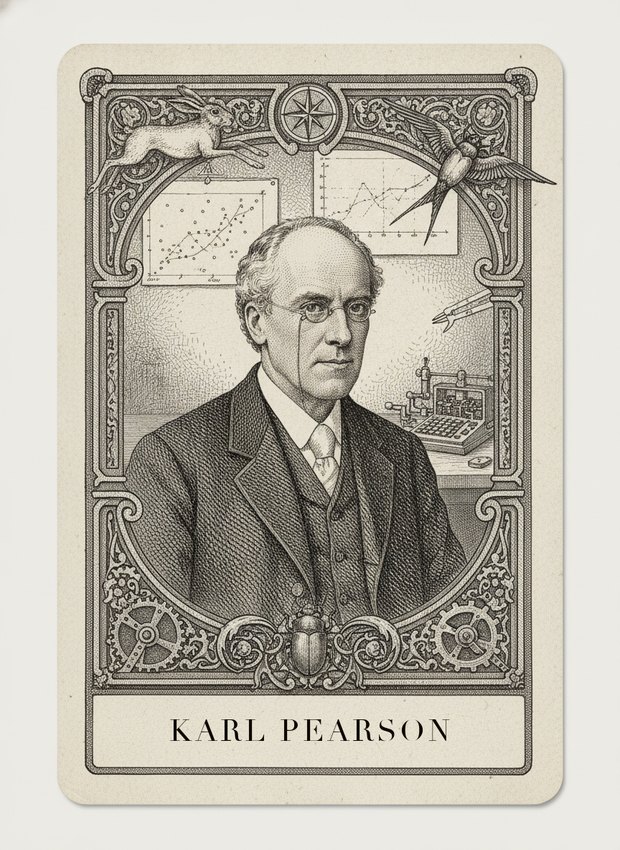
Pearson's foundational work establishing mathematical statistics from the 1890s onward, including correlation and regression toward the mean, built much of the applied apparatus that made least-squares regression a standard tool of empirical science, and his chi-squared test gave a way to check whether a fitted model's errors actually behave as assumed. His practical, computationally minded approach to fitting curves to biological and social data shows real sympathy with defending a default method. But he did not state or prove the Gauss-Markov optimality theorem itself, and his interests ran more toward description and goodness-of-fit than toward the abstract best-linear-unbiased-estimator argument this problem is centrally testing. Karl Pearson would recognize the failure mode quickly and reason about it well, even while importing tools built by others for this exact correction.

Tenenbaum's work on probabilistic programs as models of the mind, developed from the 2000s onward, treats human inference as approximately Bayesian, a philosophical stance with loose relevance to justifying an estimator's optimality from first principles. His broader cognitive-science framing of learning under uncertainty gives him some abstract sophistication about estimation generally. But nothing in his primary published research addresses proving or extending the classical Gauss-Markov theorem, and his applied domain, cognitive modeling, sits well outside the classical linear-regression statistics this problem is specifically testing. Josh Tenenbaum would be starting close to scratch on this problem's specific statistical content, however formidable the surrounding general expertise may be. The honest verdict is that Josh Tenenbaum's real contributions sit in a genuinely separate technical tradition from the classical errors-in-variables literature this problem is built around.
Battle #64 · 8/10/2026, 11:35:36 AM · this result is deterministic: the same two personas on this problem always resolve the same way.