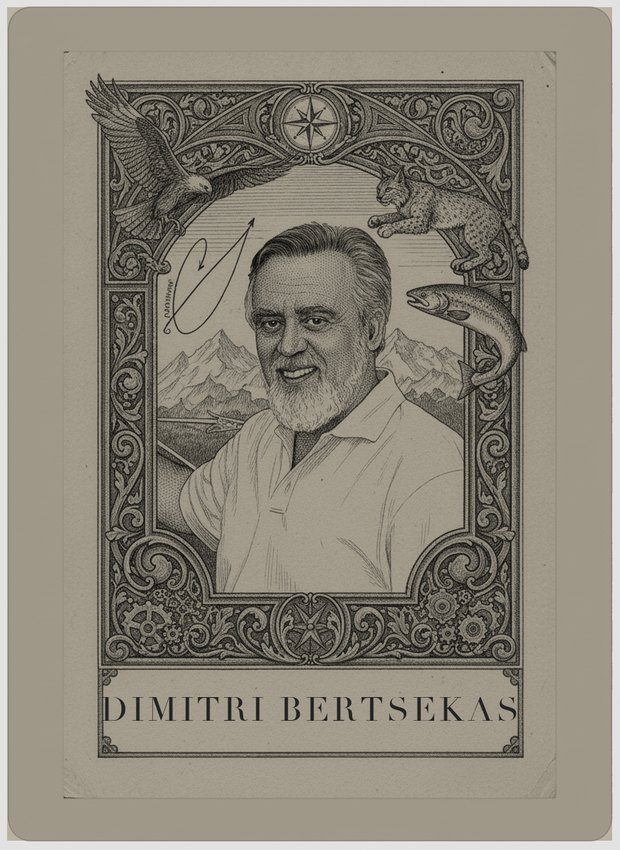
Dimitri Bertsekas
Dynamic programming and optimal control; neuro-dynamic programming; the optimization texts
Strongest on
In the mind map
The same ideas, as concepts rather than history — in John's ML knowledge map.
Life and career
Somewhere on nearly every optimization researcher's shelf there is a run of thick books with plain covers and the same author's name. Dimitri P. Bertsekas has written roughly twenty textbooks and monographs, and between them they cover nonlinear programming, convex analysis, network optimization, dynamic programming and optimal control, parallel and distributed computation, data networks, probability, and reinforcement learning. He also founded and runs the press that publishes them, Athena Scientific, having decided at some point that the standard academic publishing arrangement was not serving his readers.
He was born in Athens in 1942 and took his engineering diploma at the National Technical University of Athens, then came to the United States for graduate work — a master's at George Washington University and a PhD at MIT in 1971 in system science. He taught briefly at Stanford, then at the University of Illinois at Urbana-Champaign, and in 1979 returned to MIT, where he spent four decades in the Department of Electrical Engineering and Computer Science and the Laboratory for Information and Decision Systems, eventually as McAfee Professor of Engineering. Since 2019 he has also held a position at Arizona State University as Fulton Professor of Computational Decision Making, and he has continued producing books at a rate that suggests retirement is not a concept he engages with.
His intellectual home is control theory, and this shapes everything about how he approaches learning problems. The control tradition asks a specific kind of question: given a system evolving over time, a cost you want to minimize, and imperfect information, what should you do at each step — and can you *prove* the resulting scheme converges? That last clause is the tell. Bertsekas's career is an extended argument that sequential decision-making deserves the same rigor as static optimization, and much of his most influential work consists of taking a heuristic that practitioners already used and establishing exactly when it works.
His long collaboration with John Tsitsiklis is central. Their 1989 *Parallel and Distributed Computation* laid out the theory of asynchronous iterative algorithms, where processors update on their own schedules with stale information — the mathematical foundation for distributed optimization decades before anyone needed it for a datacenter. Their 1996 *Neuro-Dynamic Programming* is the book that gave reinforcement learning an optimization-theoretic backbone, appearing the same year as Sutton and Barto's very differently flavored text. The two books together are why RL has both an empirical and an analytical tradition.
He has received the Richard E. Bellman Control Heritage Award, the INFORMS John von Neumann Theory Prize (shared with Tsitsiklis), and election to the National Academy of Engineering.
Key contributions
**Dynamic programming, rigorously.** Bertsekas's two-volume *Dynamic Programming and Optimal Control* is the reference treatment of finite- and infinite-horizon problems, discounted and average cost, deterministic and stochastic, perfect and imperfect state information. The mathematical spine is contraction-mapping analysis: the Bellman operator T defined by (TJ)(x) = min_u E[g(x,u,w) + αJ(f(x,u,w))] is a sup-norm contraction with modulus α < 1, so value iteration converges geometrically to the unique fixed point J*, and policy iteration converges finitely for finite state spaces. What distinguishes his treatment is the care taken with the cases where this comfortable picture breaks — undiscounted problems, unbounded costs, semicontractive models — which occupied a large portion of his later monographs.
**Neuro-dynamic programming and approximate DP.** The curse of dimensionality means J* cannot be stored for realistic state spaces. The rescue is to represent it approximately, J(x) ≈ Φr for a feature matrix Φ and weight vector r, and solve a *projected* Bellman equation Φr = ΠT(Φr), where Π projects onto the span of the features under a suitable norm. Bertsekas and Tsitsiklis developed the analysis: when the composed operator ΠT is a contraction (which depends critically on the norm and hence on the sampling distribution — the on-policy versus off-policy distinction), the iteration converges, and the error is bounded by the best achievable approximation error inflated by a factor involving 1/(1−α). Their convergence and divergence results for temporal-difference learning with linear function approximation, including explicit counterexamples where off-policy TD diverges, are the reason RL practitioners know that bootstrapping plus function approximation plus off-policy sampling is a dangerous combination. They also analyzed approximate policy iteration, showing it oscillates within a bounded region rather than converging, and developed **rollout** — use a heuristic base policy, evaluate one-step lookahead by simulation, and act greedily; the resulting policy is provably no worse than the base policy, a guarantee that makes rollout unusually safe to deploy.
**The auction algorithm.** For the classical assignment problem — match n agents to n tasks minimizing total cost — Bertsekas devised an algorithm that mimics an economic auction: unassigned agents bid for their most profitable object, prices rise by an increment ε, and the process terminates with a solution within nε of optimal. It is naturally parallelizable and, for many problem instances, competitive with or faster than the classical Hungarian and network-simplex methods. It is a rare instance of a genuinely new combinatorial algorithm coming out of the control literature.
**Constrained optimization and multiplier methods.** His 1982 book on constrained optimization and Lagrange multiplier methods is the standard treatment of augmented Lagrangian techniques, which stabilize the classical multiplier method by adding a quadratic penalty and which underlie ADMM and much of modern large-scale constrained optimization. His work on projected Newton methods, incremental gradient and incremental subgradient methods, and proximal algorithms is directly upstream of the stochastic optimization used to train modern models.
**Distributed and asynchronous computation.** With Tsitsiklis, the totally asynchronous convergence theorem: for iterations driven by a maximum-norm contraction, convergence holds under arbitrary communication delays and update orders, provided every component is updated infinitely often and old information is eventually discarded. This is the theoretical license for the asynchronous parameter-server designs used in large-scale training.
In battle
Bertsekas's computed profile makes him one of the strongest and broadest personas in the game: mean 49.8 over 100 problems, **nineteen dominant scores at 80 or above**, thirty at 70 or above, and only seventeen problems at 20 or below. He is the roster's sequential-decision heavyweight.
The category structure is unmistakable. Reinforcement learning sits at **71.6 across eighteen problems** and optimization at **65.3 across seventeen** — those are the two largest well-scored categories anyone on this roster carries, which means he is not a lucky specialist but a genuine domain owner. Games (76.5) and search (52.1 across sixteen) follow, since game-tree evaluation and heuristic search are dynamic programming under different names.
His peak is **P067 — Dynamic programming's curse** (93). The judge's phrasing is worth quoting in spirit: he is the person who turned Bellman's complaint into a rigorous engineering discipline, supplying the state-counting arguments *and* the rescue — parametric value function approximation, projected Bellman equations, and error bounds quantifying what optimality you gave up, which is the part practitioners usually wave away. **P068 — When to replace the engine** (92) is optimal stopping and replacement, a textbook chapter of his. **P221 — How much stock to hold** (90) is inventory control, where the optimality of (s, S) policies is classical DP. **P043 — The assignment in the sky** (90) is the assignment problem, and he wrote an algorithm for it. **P185 — Optimize across the datacenter** (90) is distributed and asynchronous optimization, his 1989 book with Tsitsiklis arriving three decades before the application. **P042 — Prove the descent** (88) is convergence analysis of iterative methods — his signature move. **P178 — The variables that must be whole** (88) is integer programming, where Lagrangian relaxation and network structure are his tools. **P192 — Plan when you cannot see** (88) is partially observed control, the imperfect-state-information half of his DP volumes.
The losses reveal his boundary precisely. He scores 7 on **P246 — Small tools, loosely joined**, the 1971 Unix design problem: the word "optimization" does not translate between control theory and operating-system architecture, and the judge is explicit that even later optimization-flavored compiler and scheduling work came from others. **P248 — The machine that overdosed** (9) is concurrency verification — note the irony that he wrote the book on asynchronous computation, but asynchronous *convergence* theory says nothing about a race condition producing a wrong control output. **P265 — A recognizer for a language of ten speakers** (10) is speech recognition; his NLP average is 12, and perception sits at 26.5 — pattern recognition from raw signals is not his tradition. **P169 — The scratch on the disc** (12) is error-correcting codes, **P154 — The truth it cannot prove** (12) is Gödel, and **P284 — Unroll the swiss roll** (14) is manifold learning, a statistics/geometry problem with no cost-to-go function anywhere in it. His regression average of 21 and small-sample average of 26.5 confirm the shape: he is a decision theorist, not an estimator.
The strategic summary matches his battle identity. Play Bertsekas on anything sequential, anything with a cost to minimize over time, anything asking whether an iterative scheme converges. He will lose to model-free empiricists on problems where practice ran ahead of analysis, and he will lose badly on inference, perception, and systems engineering.