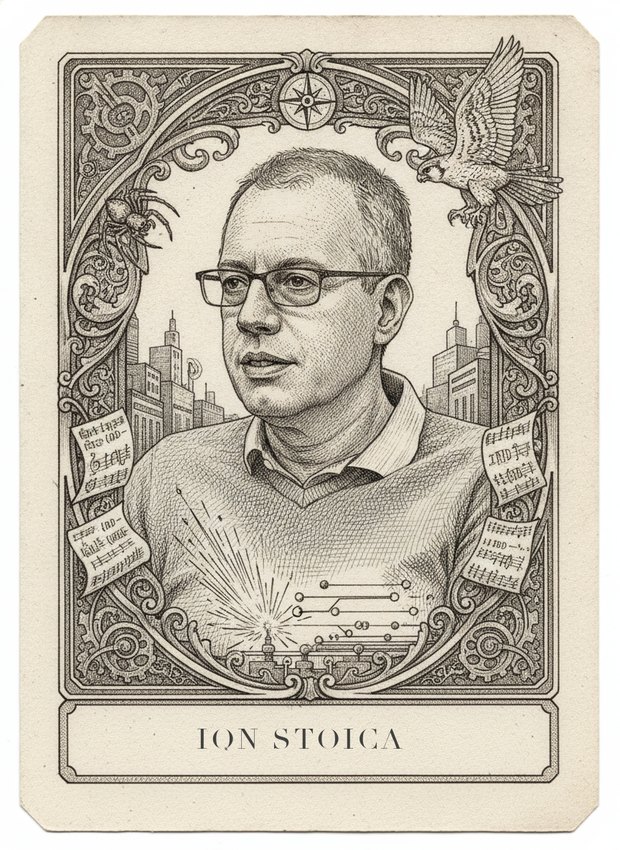
Ion Stoica
Spark and Ray: the compute substrate of modern ML
Strongest on
In the mind map
The same ideas, as concepts rather than history — in John's ML knowledge map.
Life and career
Most of the people on this roster invented a method. Ion Stoica built the machinery the methods run on, which is a different kind of contribution and, for the last fifteen years, arguably a more binding one.
Stoica grew up in Romania and studied at the Politehnica University of Bucharest before coming to the United States for a PhD at Carnegie Mellon, which he completed in 2000 in computer networking. His thesis work was on quality of service in the Internet, and it had a distinctive shape that would recur throughout his career: the classical way to give different flows different service guarantees required routers to maintain per-flow state, which does not scale to the core of the Internet. Stoica's answer, with Scott Shenker and Hui Zhang, was to push the state into the packets themselves — core-stateless fair queueing, in which edge routers label packets with rate estimates and core routers make fair-allocation decisions from the labels alone, holding no per-flow state at all. Get the abstraction right and the scaling problem dissolves.
He joined the Berkeley faculty in 2000 and immediately co-authored Chord, one of the most influential systems papers of the decade: a distributed hash table in which each of N nodes maintains only O(log N) routing entries and any key can be located in O(log N) hops, with consistent hashing ensuring that node arrivals and departures move only a small fraction of the keys. Chord and its contemporaries became the intellectual basis for a generation of decentralized storage and key-value systems.
The work he is best known for came out of Berkeley's succession of large collaborative labs — the AMPLab, then RISELab, then the Sky Computing Lab — which he co-directed and which operate on an unusual model: five-year projects, industrial sponsorship, open-source release, and a strong expectation that the artifact will be used by real companies rather than merely cited. From the AMPLab came Apache Spark, built by his student Matei Zaharia; the Mesos cluster manager; and Alluxio. From RISELab came Ray. Stoica co-founded Databricks around Spark in 2013 and Anyscale around Ray in 2019, both of which became major companies, and he had earlier co-founded Conviva around video delivery optimization. In the LLM era his lab has continued the pattern, producing widely used inference infrastructure and the public model-comparison arena that became a de facto evaluation venue.
The through-line is that Stoica repeatedly identified the layer at which the field's next bottleneck would sit — Internet service guarantees, then peer-to-peer lookup, then iterative cluster computation, then heterogeneous distributed ML, then LLM serving — and built the general-purpose abstraction for it before most people had named the problem.
Key contributions
**Resilient distributed datasets and Spark.** MapReduce made cluster computing accessible but imposed a punishing structure: every stage's output had to be written to distributed storage before the next stage could read it. For a single pass over data this is fine. For iterative algorithms — which is to say, essentially all machine learning, since gradient descent is a loop over the same data — it means paying the full cost of a distributed disk write and read on every iteration. Spark's RDD abstraction fixed this with a specific and elegant fault-tolerance argument. An RDD is an immutable, partitioned collection defined by a *lineage*: the sequence of deterministic transformations that produced it from data in stable storage. Because it is immutable and its derivation is recorded, a lost partition need not be replicated in advance — it can simply be recomputed from its lineage. That means working sets can be held in memory across iterations while still tolerating node failure, which is the property that made iterative ML on clusters practical. It is a good example of a systems result that is fundamentally about *what to remember*: keep the recipe, not the copies.
**Ray.** Spark's model — bulk synchronous, coarse-grained, deterministic transformations over partitioned collections — fits data processing but fits modern ML workloads poorly. Reinforcement learning, hyperparameter search, simulation, and model serving all involve enormous numbers of small, heterogeneous, dynamically created tasks with irregular dependencies, some stateful. Ray provides a general distributed execution framework built on remote task invocation and stateful actors, with a distributed scheduler and an object store designed for millisecond-scale task dispatch. It is deliberately lower-level and more general than Spark, and it became the substrate for a large fraction of distributed training, tuning and RL infrastructure.
**Chord and consistent hashing in practice.** Distributed lookup with logarithmic state and logarithmic hops, with the churn properties that make it survivable in a network where nodes join and leave constantly.
**Stateless-core network architecture.** Dynamic packet state: carry the information needed for a per-flow decision inside the packet, so that routers can approximate stateful fair queueing without maintaining flow state. The general lesson — trade state for computation and metadata to buy scalability — recurs in his later work.
**The lab model itself.** It is fair to count as a contribution the demonstration that an academic systems lab can produce production-grade open-source infrastructure adopted at industrial scale, and can do it repeatedly.
In battle
Stoica's sheet is a systems specialist's, drawn about as sharply as the game allows: mean 26.3, median 18, fifty-five problems at or below 20, and a perfect 100 at the top.
That 100 — the only one on his sheet, and rare anywhere in the game — is "The cluster that iterates." The explanation says there is no daylight between the man and the machine: Spark was built in his lab specifically to fix the disk-thrashing that MapReduce inflicted on iterative machine learning, and the RDD lineage abstraction is his co-design. He *is* the answer, not an analogy to it. Around it sit the rest of the infrastructure problems: "Train across a thousand GPUs" (95), distributed training coordination; "Index the entire web" (85), large-scale distributed data processing; "Train on the phones, keep the secrets" (80), federated learning, where the difficulty is orchestration across unreliable heterogeneous nodes rather than the learning algorithm; "X-ray the network from its edges" (75), inference about network internals from endpoint measurements, which is his doctoral subject; "The model is five percent of the system" (72), the observation that a deployed ML system is mostly plumbing; and "The router's memory is smaller than its traffic" (65), streaming and sketching under memory constraints. His systems average of 47.2 across eighteen problems and networks average of 47.3 are the top of his sheet, and unlike most specialists his strength there is broad rather than concentrated in one or two items.
The losses are among the most extreme in the game, and they are a single, clean statement: Stoica's toolkit contains no statistics. His worst categories are information (3.0), classification (4.8), regression (5.3), and small-sample (5.3). "The first randomized trial" at 2 is his floor, and the game's explanation is exactly right about the shape of the mismatch — he is the person you call to process the trial's data at scale, not to design or justify the randomization. "Three species of iris" (3), "The spam in the inbox" (3), and "The floor no estimator beats" (3) all fail the same way: they are small, self-contained inference problems that fit comfortably on a laptop, and everything Stoica knows is about what happens when things do not fit. "What is a bit, exactly?" (3) is information theory and "The certificate of optimality" (3) is convex duality — mathematical foundations he uses at one remove and has never contributed to.
The instructive point for students is that his profile inverts almost everyone else's. Most figures here fail on scale and succeed on method; Stoica fails on method and succeeds on scale. In a game where problems are drawn from across the history of statistics and AI, that leaves him below the median overall — and makes him the strongest possible play on the small set of problems where the entire difficulty is that the computation must actually run.