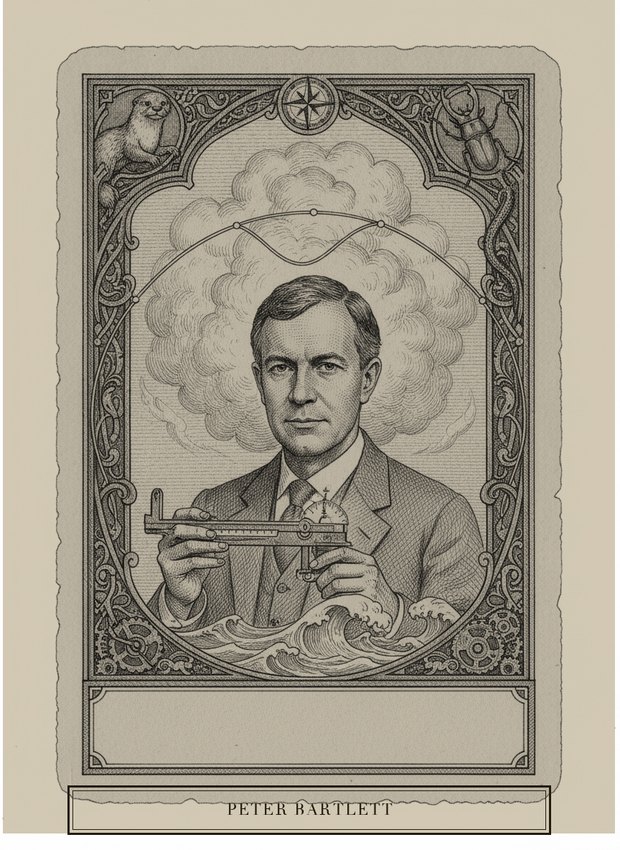
Peter Bartlett
Statistical learning theory; margins and generalization
Strongest on
In the mind map
The same ideas, as concepts rather than history — in John's ML knowledge map.
Life and career
When deep learning started working and nobody could say why, one of the small number of people whose earlier theorems turned out to have anticipated the puzzle was Peter Bartlett. He had spent the 1990s arguing that the right measure of a neural network's capacity was not how many parameters it had but how large its weights were — a claim that sounded like a technical refinement at the time and reads, twenty-five years later, like a warning nobody heeded.
Bartlett is Australian, and did his doctoral work at the University of Queensland before joining the Australian National University in Canberra, where he spent the first substantial phase of his career. ANU's research school in information sciences and engineering was, in the 1990s, an unlikely but genuine world center for statistical learning theory — a small group working on the mathematical foundations of neural networks at a moment when the neural network community itself had largely moved on. Out of that period came his book with Martin Anthony, *Neural Network Learning: Theoretical Foundations*, still the reference for VC-dimension and pseudo-dimension results for networks, and the margin-based generalization bounds that made his name.
In the early 2000s he moved to the University of California, Berkeley, where he holds a joint appointment in the Department of Statistics and in Electrical Engineering and Computer Sciences, and where he has been closely involved with the Simons Institute for the Theory of Computing as an associate director. Berkeley put him at the center of the statistics-machine learning interface, alongside Michael Jordan, Martin Wainwright, and Bin Yu, and much of his subsequent work bears the mark of that environment: statistical decision theory applied to the objects computer scientists actually build.
He has also spent time inside industrial research, including a period associated with Google DeepMind — a move that reads as characteristic rather than opportunistic. Bartlett's interest has always been in the algorithms people run, not in a sanitized abstraction of them. He has been recognized with fellowships and medals from the statistical and Australian scientific establishments, but his standing in the field rests on a simpler fact: when the deep learning era produced a phenomenon that classical theory said should not happen, he was one of the people who produced the theorem explaining it.
Key contributions
**Margins, not parameter counts.** The classical VC-dimension bound for a neural network scales with the number of weights, which for any interesting network is astronomically larger than the training set — the bound is vacuous. Bartlett's mid-1990s result reframed the question: for a network with bounded weight magnitudes, the relevant complexity measure is the **fat-shattering dimension** at the margin scale, and it depends on the size of the weights rather than their number. The generalization bound then depends on the margin achieved on the training data and on the norm of the weights, and can be non-vacuous for networks with far more parameters than examples. The title of the paper — that the size of the weights matters more than the size of the network — is the whole thesis.
He returned to this with Foster and Telgarsky in 2017, deriving **spectrally normalized margin bounds** for modern deep networks: the complexity term is a product of the spectral norms of the layer weight matrices, adjusted by a distance-to-initialization term, divided by the margin. These are the bounds that people actually compute when they want to know whether a trained network's generalization is explicable.
**Rademacher complexity.** With Shahar Mendelson, Bartlett developed the modern machinery of **Rademacher and Gaussian complexity** for risk bounds. The idea: measure a function class's richness by how well its members can correlate with random sign noise on the actual sample. Unlike VC dimension, this is data-dependent, it is estimable, and it composes cleanly through the operations one performs on function classes — Lipschitz maps, convex hulls, compositions. Their structural results turned Rademacher complexity from a tool into a calculus, and it is now the default apparatus for generalization arguments in learning theory. The follow-up with Bousquet and Mendelson on **local Rademacher complexities** sharpened rates by restricting attention to the small-variance neighborhood of the optimum, recovering fast O(1/n) rates in favorable conditions instead of the pessimistic O(1/√n).
**Convex surrogates and classification calibration.** With Michael Jordan and Jon McAuliffe, Bartlett answered a question that everyone had been ignoring: we minimize hinge loss, logistic loss, or exponential loss because 0-1 loss is not convex, but does minimizing the surrogate actually minimize classification error? The answer is a precise condition — **classification calibration** — on the surrogate loss, together with a quantitative transfer function bounding the excess 0-1 risk in terms of the excess surrogate risk. It tells you which convex losses are safe, and how much you lose by using them.
**VC dimension of piecewise-linear networks.** With Harvey, Liaw, and Mehrabian, he established nearly matching upper and lower bounds on the VC dimension of ReLU networks in terms of depth and parameter count — the definitive answer to a question that had been open in various forms for decades.
**Reinforcement learning.** With Jonathan Baxter, Bartlett developed **GPOMDP**, an infinite-horizon policy-gradient estimator for partially observable Markov decision processes, with a bias-variance tradeoff controlled by a discount-like parameter and convergence analysis. This is one of the foundational analyses in the policy-gradient literature, well before policy gradient methods became the standard tool in deep RL.
**Benign overfitting.** The modern capstone. With Philip Long, Gábor Lugosi, and Alexander Tsigler, Bartlett proved in 2020 exactly when a linear regression estimator that **interpolates** — fits every training point exactly, including the noise — nonetheless generalizes. The answer is spectral: it depends on the eigenvalue profile of the data covariance, summarized by two "effective ranks." You need enough directions of small, slowly decaying variance for the noise to be absorbed harmlessly across many dimensions, while the signal directions remain well estimated. Too few such directions and interpolation is catastrophic; too many and you lose signal. The paper gave the field a precise mathematical object for a phenomenon that had until then been discussed with hand-waving and pictures of double-descent curves, and it clarified what classical uniform-convergence theory had and had not claimed.
In battle
Bartlett's profile is the most balanced of the learning theorists here: mean 38.0, six dominant problems, and — unusually — a top category of `computability` at 61.0, reflecting the fact that his foundational work is in the computational-learning-theory tradition rather than the applied-statistics one.
**P286 — The interpolator that should have failed** at 96 is his defining win, and it is a *modern* win, which is rare on this roster. He is a primary author of the technical resolution: the spectral conditions separating benign from catastrophic interpolation, and the honest accounting of what the old uniform-convergence theory silently assumed. Anyone else you play on this problem is playing a commentator.
**P026 — A committee of weak learners** at 91 places him third behind Schapire and Freund — correct, since the margins explanation of boosting is co-authored by him and is the deepest layer of the answer, but the algorithm and theorem are theirs. **P023 — The line between two clouds** at 90 is margin-based linear classification, essentially his native problem. **P032 — What can be learned at all?** (84) is PAC learnability and VC theory. **P110 — Fifty examples in the test set** (80) is finite-sample generalization assessment, where Rademacher machinery gives you data-dependent bounds instead of asymptotics. **P150 — Learn from the stream, one at a time** (80) is online learning and regret. **P042 — Prove the descent** (76) is convergence analysis for gradient methods, and **P063 — The two slot machines** (74) plus `rl` at 54.5 come from the policy-gradient work with Baxter — a genuinely high RL score for a learning theorist, and one that players often do not expect.
The category spread — `classification` 52.9, `high-dim` 45.2, `optimization` 38.4, `games` 36.5 — makes him a reasonable second choice across a wide band of theory problems without ever being the obvious first choice outside his top few.
His weaknesses have a common cause: he is a theorist of *guarantees*, and guarantees do not transfer to problems whose difficulty is construction, engineering, or a different branch of mathematics. **P183 — Cool it slowly** (8) is simulated annealing — statistical-mechanics-inspired combinatorial metaheuristics, rigorous but about entirely different objects than generalization bounds. **P143 — The coefficient that flips sign** (8) is causal confounding, the near-universal blind spot of this cohort. **P185 — Optimize across the datacenter** (12) and **P254 — The wall around the data structure** (12) are systems and programming-language design; `systems` at 12.0 is his floor. **P165 — The optimal codebook** (10) is source coding and **P255 — Translate Russian by machine** (10) is machine translation, with `nlp` at 24.6 and `experimental-design` at 20.0 marking territory he has never worked.
His battle identity is precise: he wins generalization-bound arguments and their post-hoc autopsies, and loses ground where practice outruns any bound. That is a real and interesting weakness. On problems where the honest state of knowledge is "it works and nobody knows why," Bartlett is the person most likely to eventually produce the theorem — which is worth a great deal in the game, and would have been worth nothing at the time.