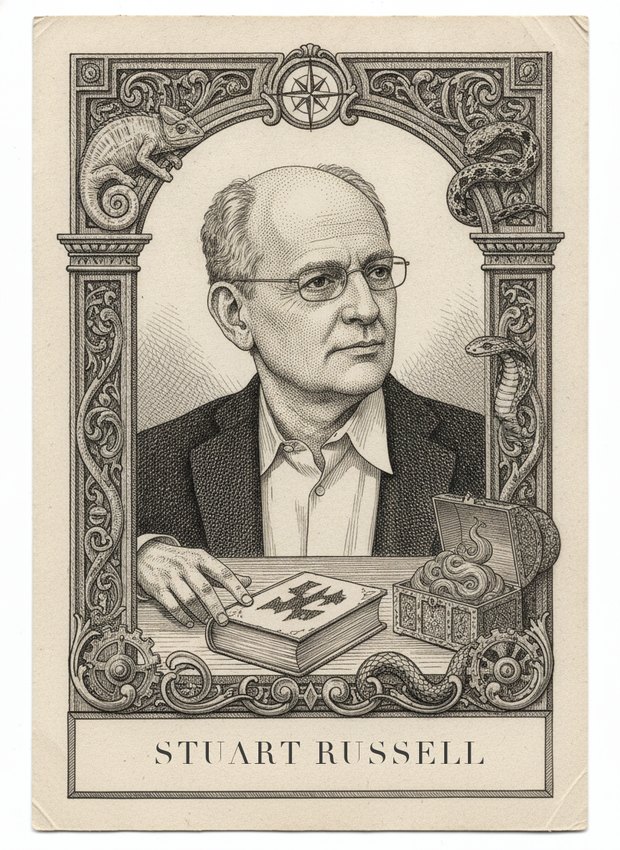
Stuart Russell
AI: A Modern Approach; provably beneficial AI
Strongest on
In the mind map
The same ideas, as concepts rather than history — in John's ML knowledge map.
Life and career
Stuart Russell read physics at Oxford before crossing the Atlantic for a computer science doctorate at Stanford in the mid-1980s, where he worked on analogy and inductive reasoning — how a system can justify a generalization from prior knowledge rather than merely pattern-match. He joined the Berkeley faculty in 1986, at twenty-four, and has been there ever since, now holding a named chair in engineering and directing the Center for Human-Compatible AI, which he founded to work on the problem that has come to define his public life.
The through-line of his research is easy to miss because his most visible output is a textbook and his most visible argument is about existential risk. But it is there from the beginning, and it is a single question: what should a *rational agent with limited resources* do? Classical decision theory says maximize expected utility, which is fine advice for an agent with infinite computation and no clock. Real agents must decide how long to think, and thinking has a cost. Russell's early work with Eric Wefald on rational metareasoning made this precise — treat computation itself as an action, estimate the expected value of continuing to deliberate versus acting now, and stop when the marginal value of further thought falls below its cost. Their book on limited rationality proposed *bounded optimality* as the right normative standard for AI: not the agent that behaves perfectly, which is uncomputable, but the agent whose program is the best possible program for the machine it runs on. That reframing is more radical than it sounds, and it has aged extremely well in an era where inference-time compute budgets are a live engineering variable.
He and Peter Norvig published *Artificial Intelligence: A Modern Approach* in 1995, and it became the standard textbook essentially everywhere, through multiple editions and dozens of translations. Its organizing move — build the whole field around rational agents, and treat probability and decision theory as the foundation rather than as one technique among many — was contested at the time and is now simply how the field thinks.
Russell has also been unusually willing to spend his standing on public argument. He has campaigned for years against lethal autonomous weapons, working through the United Nations process and producing the widely circulated "Slaughterbots" film; he has served on technical work related to the nuclear test-ban treaty's seismic monitoring; and in 2019 he published *Human Compatible*, which lays out the case that the standard model of AI — build a machine that optimizes a fixed objective we specify — is the wrong foundation, and proposes replacing it. He delivered the BBC's Reith Lectures on the subject. Among his honors are the IJCAI Computers and Thought Award, given early in his career, and later recognition for sustained research excellence.
Key contributions
**Bounded rationality and metareasoning.** The formal machinery: given an anytime algorithm whose answer improves with computation, and a *performance profile* describing how quality grows with time, one can compute the expected value of an additional increment of computation and compare it to the cost of delay. Russell and Wefald applied this to game-tree search, deriving expansion policies that select the node whose evaluation is most likely to change the decision at the root — a decision-theoretic replacement for fixed-depth minimax. Bounded optimality then generalizes: rather than asking for the agent that acts optimally, ask for the program, drawn from those the hardware can run, that maximizes expected utility. This makes "AI as an optimization problem over programs given a machine" a well-posed research goal.
**Inverse reinforcement learning.** With Andrew Ng in 2000, Russell posed the inverse of the standard RL problem: given observed behavior assumed to be (near-)optimal, recover the reward function that explains it. The immediate difficulty is that the problem is badly ill-posed — many reward functions, including the trivial zero reward, are consistent with any policy — so the contribution is the formal characterization of the solution set via linear constraints on the value function, plus criteria (margin maximization, later maximum entropy in others' hands) that select among them. IRL matters because reward specification is the actual bottleneck in applied RL: it is far easier to demonstrate driving than to write down the utility function of a good driver. The whole apprenticeship-learning and preference-learning literature, including the reward modeling used in modern RLHF pipelines, descends from this framing.
**Cooperative IRL and the off-switch.** With Dylan Hadfield-Menell, Anca Dragan and Pieter Abbeel, Russell formalized the alignment problem as a two-player cooperative game in which the human knows the reward function and the robot does not, but both are rewarded by the human's true objective. The consequences are technically sharp: the robot's optimal behavior is no longer to optimize a point estimate but to act under uncertainty about the objective, which generates active preference-querying, informative teaching behavior on the human's side, and — most importantly — a positive incentive to be switched off. The off-switch analysis proves the conditions under which a rational agent *prefers* to allow shutdown: precisely when it retains uncertainty about the true objective and treats the human's intervention as evidence about it. An agent certain of its objective has an instrumental reason to disable its own off-switch; an agent uncertain does not. That is the technical core of *Human Compatible*'s proposal to replace the standard model with three principles — the machine's only objective is to realize human preferences, it is initially uncertain what they are, and human behavior is its evidence.
**Probabilistic programming and structured inference.** With Brian Milch and others, Russell developed BLOG, a language for probabilistic models with *unknown objects* — settings where the number of entities and the correspondence between observations and entities are themselves uncertain, as in multi-target tracking or seismic event detection. Standard graphical models assume a fixed set of random variables; open-universe models do not. He has also contributed to hierarchical reinforcement learning, including languages for expressing partial programs with choice points that RL fills in.
In battle
Russell has the strongest all-round sheet of the classical-AI carriers: mean 41.0 across 103 problems, median 40, four dominant, and only fourteen problems at or below 20 — an unusually high floor. The textbook is doing real work here; there is very little in the field he cannot speak competently about.
His summit is "The objective is not what you meant" (97), which is his research program stated as a problem: corrigibility under objective misspecification, an agent that defers to correction, and a proof of the incentive conditions that make it do so. Nobody on the roster is closer. "The agent that games its reward" (93) is reward hacking, the empirical shadow of the same argument, and "The reward is a human preference" (76) is IRL and preference learning directly. "Best answer before the buzzer" (92) is the metareasoning problem — an anytime system that must decide when to stop deliberating and commit — and it is the best illustration in the game of why his early bounded-rationality work still matters. "The imitation game, scored" (75) is the Turing test operationalized, where his textbook's treatment of what it would mean to evaluate machine intelligence is directly on point.
Below that he is a strong generalist rather than an owner. "Shortest path through the map" (82), "Color the map, meet the constraints" (78) and "Sequence the robot's actions" (75) are the search-and-planning bench, where his search average of 62.1 across sixteen problems is the highest of anyone here — he did not invent A* or arc consistency, but he can execute all of them and knows which to reach for. RL at 61.6 across seven and fairness at 68.2 across four round out a profile with unusual breadth for someone with such a distinctive specialty.
The weaknesses are narrow but complete, and they are all statistical. "When the predictors move together" (9) is multicollinearity, "Calculus for a jagged path" (9) is Itô, "How high must the dike be?" (10) is extreme-value theory, "Roll the dice at Los Alamos" (12) is the invention of Monte Carlo, "The therapy the trial reversed" (13) is causal inference from trials, and "How big must the study be?" (14) is power analysis and sample-size determination. His regression average is 17.5 and high-dimensional problems 20.5. Russell's probability is decision-theoretic and agent-centric; the practice of designing a study, fitting a model to observational data, and defending an estimate against confounding is a different discipline, and he has not worked in it.
There is also a losing pattern the packet names well: he loses to gradient descent's indifference to foundations. Against problems whose winning answer is "train a large network on a large dataset," Russell's careful agent-theoretic framing is not what the matrix rewards, and his classification (32.4) and perception (31.3) averages reflect that. He is the carrier to field when the question is *what should this system be trying to do, and how would we know* — and the wrong one when the question is *what gets the best number on the benchmark*.