classification
The tilted scan
It is the era of computer-aided diagnosis, and ten thousand mammograms cross your system — but only about half a percent hide a genuine malignancy, and the costs of the two errors could not be more lopsided. Flag which scans warrant a radiologist's second read. A naive classifier maximizing accuracy will simply call everything benign and be 99.5% right while missing every cancer; meanwhile each false alarm spends a radiologist's scarce attention and, repeated, burns the trust that keeps them using the tool at all. Balance sensitivity against false alarms with the real asymmetric costs baked in. Get it wrong and you either miss the tumors the system exists to catch, or cry wolf so often the radiologists switch it off — extreme imbalance is the whole difficulty.
Who this problem belongs to
The two figures whose methods fit it best, out of 71 in contention.

Breiman is the strongest fit on this roster, and on his own published record. CART (1984, with Friedman, Olshen, Stone) treats class priors and misclassification-cost matrices as core inputs — altering the 0.5% prior and penalizing a missed malignancy hundreds of times a false alarm is built into the splitting and pruning criteria, not retrofitted. Random forests (2001) added class-weighted and stratified-sampling variants aimed at exactly this skew, plus out-of-bag estimates for honest error assessment with few positives. His years as a freelance statistical consultant taught him messy, asymmetric real-world problems, and 'Statistical Modeling: The Two Cultures' (2001) is precisely an argument for judging models by predictive performance on the decision that matters rather than by fit. Feature engineering from images aside, this problem is nearly a Breiman worked example.
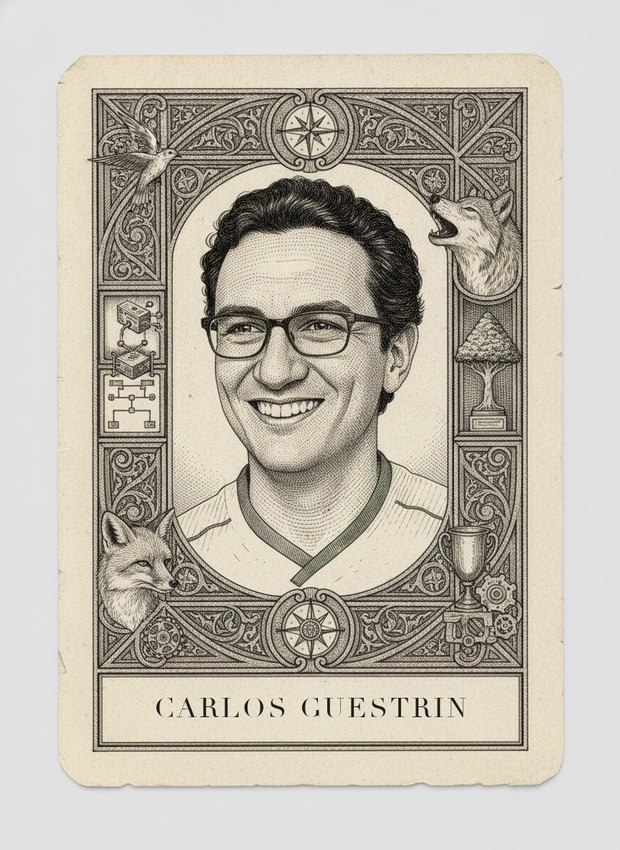
Guestrin's lab produced XGBoost, the gradient-boosted tree system that dominated applied tabular classification in the 2010s — and whose design includes an explicit positive-class weighting parameter for exactly this skewed-cost, skewed-prevalence regime. Boosted trees on radiologist-meaningful features were, for years, the strongest practical answer to problems shaped like CAD triage. His second signature, LIME, attacks the other half of the problem statement: interpretability as the currency of clinician trust. The scenario explicitly says false alarms burn the trust that keeps radiologists using the tool; Guestrin is one of the few people on this roster whose own research treats that trust as a first-class technical object, explaining individual flags in human terms. Scalable cost-weighted learning plus deployed-system interpretability makes this very nearly his home turf.
Fought here
In the mind map
The same ideas, as concepts rather than history — in John's ML knowledge map.
71 figures are scored on this problem. Draw it in a battle to see where you land.