causality
Correlation is not enough
It is 1993, and statistics has spent a century policing the sentence "correlation is not causation" without ever formalizing what causation is. Ice cream sales correlate with drownings; nobody proposes banning ice cream. But when the correlation is smoking and lung cancer — a question on which Fisher himself, statistics' greatest mind, took the tobacco-friendly side — the ambiguity kills people. Formalize exactly what additional knowledge licenses a causal claim: what must be true of the graph of mechanisms, what "intervening" means as a mathematical operator distinct from observing, and compute the effect of an intervention from observational data when it can be done at all. Get this calculus wrong and epidemiology remains permanently hostage to the phrase "mere correlation."
Who this problem belongs to
The two figures whose methods fit it best, out of 61 in contention.
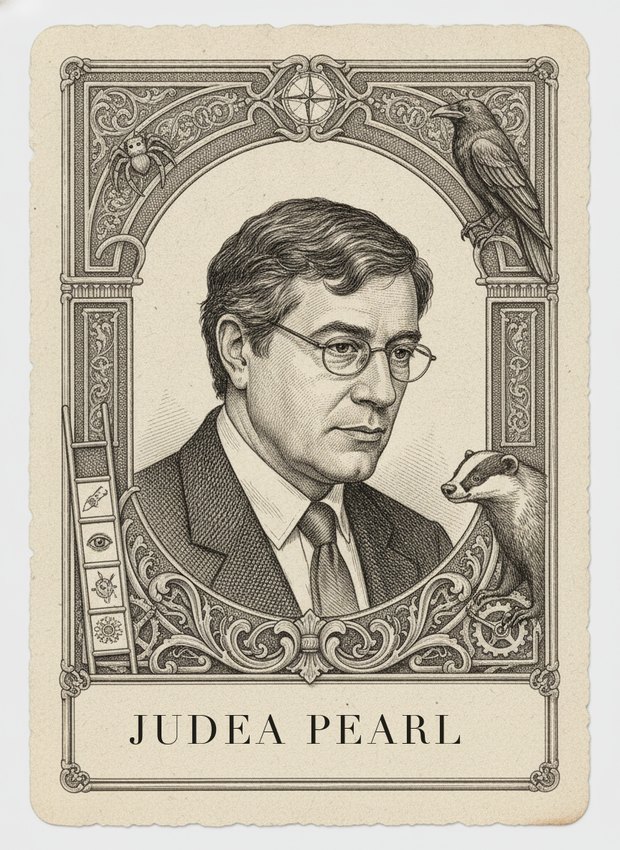
This problem is Pearl's biography rendered as an exam question. Probabilistic Reasoning in Intelligent Systems (1988) built the graphical substrate; the early 1990s papers with Verma on equivalence classes established exactly which structures observational data can and cannot distinguish; and the 1993-1995 arc — intervention as graph surgery, the do-operator, the back-door and front-door criteria, culminating in the do-calculus completeness program — is precisely the requested formalization: what mechanism knowledge licenses a causal claim, what intervening means as a mathematical operator distinct from conditioning, and when interventional quantities are computable from observational data. Even the smoking example is his: the front-door criterion's canonical illustration uses tar deposits to identify the smoking-cancer effect despite an unmeasured genotype confounder — Fisher's objection, answered by theorem. The 1993 date catches him mid-revolution, on his own turf, at full strength.
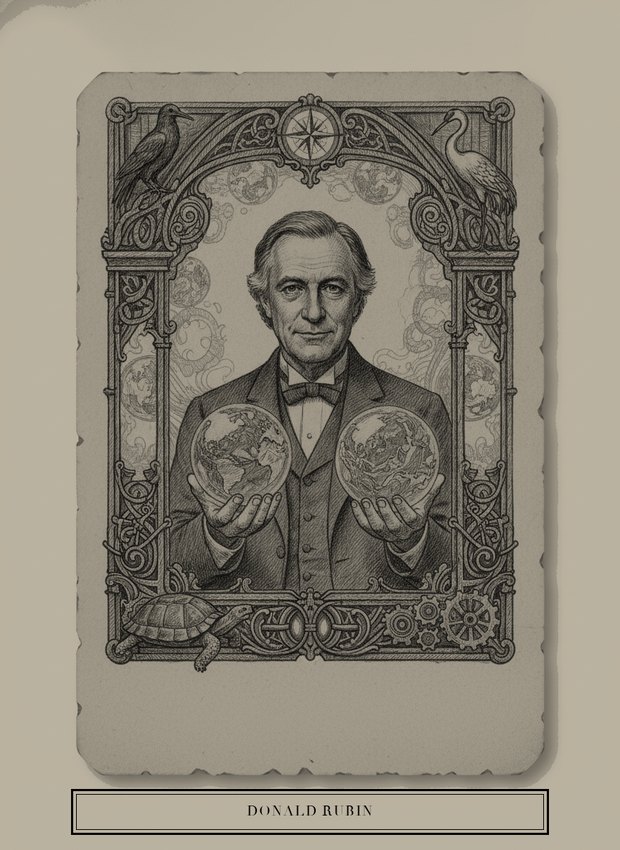
Rubin is a designated winner, and by 1993 the record fully supports it. His 1974 paper recast causal effects as comparisons of potential outcomes; his 1976-1978 work formalized the assignment mechanism and ignorability — the precise statement of what must hold for observational data to license causal claims; and propensity scores (1983, with Rosenbaum) plus sensitivity analysis gave working tools for estimation and for honesty about unmeasured confounding, the exact Fisher-versus-smoking scenario. Extending Neyman's randomization-based notation to observational studies is the problem statement almost verbatim. His framework does not draw the mechanism graph — intervention lives in the assignment mechanism rather than as graph surgery, and he remained famously cool toward diagram-based identification — so the graphical half of the problem belongs to Pearl. The licensing-conditions half is substantially his.
In the mind map
The same ideas, as concepts rather than history — in John's ML knowledge map.
61 figures are scored on this problem. Draw it in a battle to see where you land.