causality
The confounder you can't measure
It is 1990, and the question is whether military service depresses lifetime earnings — but the men who served differ from those who didn't in every way you cannot record: health, ambition, family, luck. Estimate a treatment effect when an unmeasured confounder lurks in exactly this fashion, using an instrument — the draft lottery's random numbers — that affects treatment but cannot plausibly touch the outcome except through it. The technique must be honest about its assumptions: a slightly invalid instrument does not degrade gracefully, it lies fluently. Veterans' compensation policy, and after it a generation of empirical economics, will be built on estimates of this kind. An instrument accepted uncritically turns randomization's prestige into a laundering service for bias.
Who this problem belongs to
The two figures whose methods fit it best, out of 59 in contention.
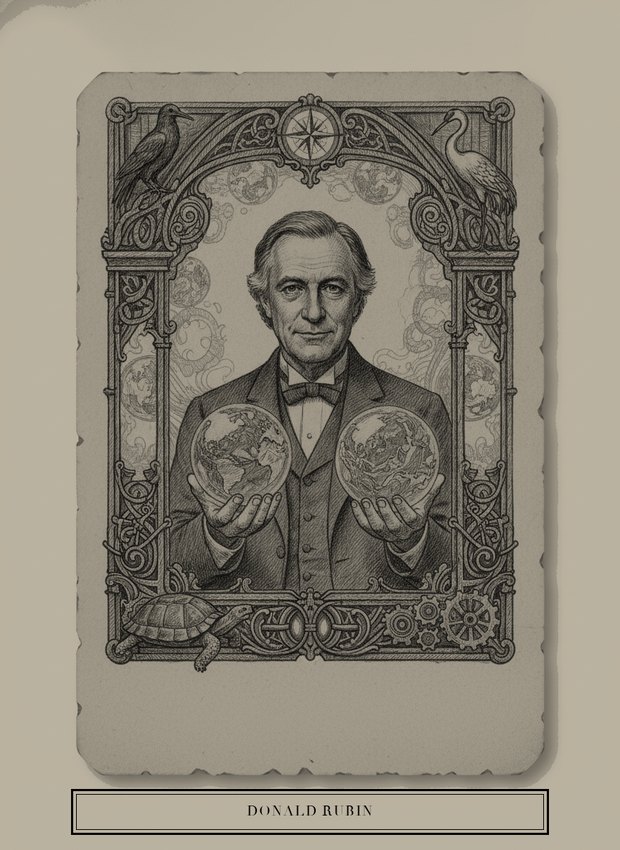
This problem is Rubin's home turf, stated in his own vocabulary. His 1974-1983 potential-outcomes framework — each veteran carries an earnings outcome under service and under no service, only one observed — is the language in which the estimand is even defined, and his propensity-score work with Rosenbaum formalized why unmeasured confounding defeats adjustment. Most decisively, the draft lottery as instrument is the canonical example of his 1996 paper with Angrist and Imbens, which reframed IV in potential outcomes: relevance, exclusion, and monotonicity assumptions delivering the complier average causal effect, with explicit accounting of how each assumption's failure propagates — the honesty requirement stated as theorems. The 1990 setting catches him mid-development, potential outcomes fully built, the IV synthesis crystallizing. No one else in this batch owns the problem so completely.
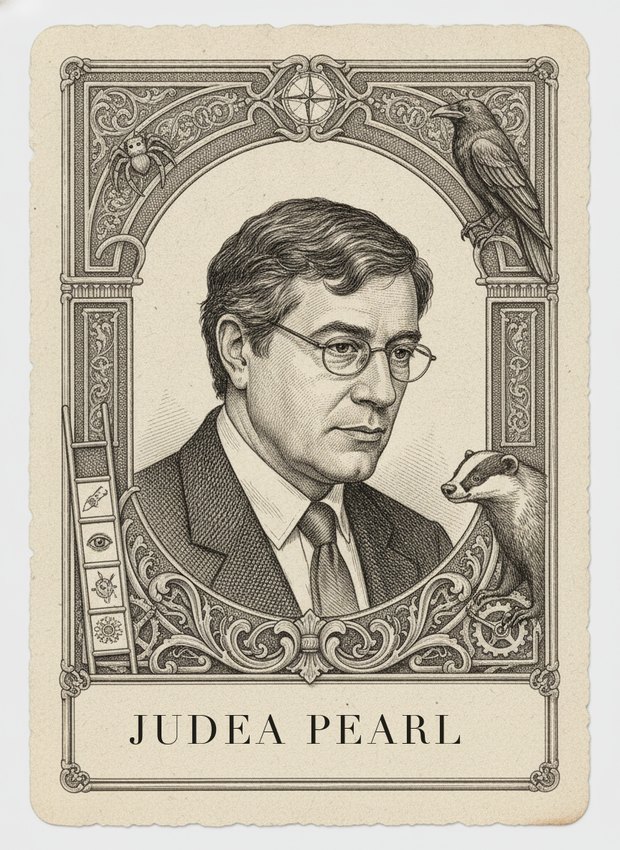
By 1990 Pearl had just published Probabilistic Reasoning in Intelligent Systems (1988) and was turning Bayesian networks causal — and the instrument problem sits squarely in his emerging calculus. His framework defines an instrument graphically: a variable with an arrow into treatment, no direct path to outcome, independent of the unmeasured confounder — making the exclusion restriction a visible, criticizable assumption rather than folklore. His school then produced exactly the honesty machinery the problem demands: the instrumental inequality (a testable necessary condition an invalid instrument can violate) and, with Balke, tight bounds on the treatment effect that hold without point identification. The do-operator formalizes intervening versus observing, this problem's philosophical core. He cedes a few points to Rubin only because the draft-lottery LATE analysis was executed in potential-outcomes dress; the underlying logic is as much his.
In the mind map
The same ideas, as concepts rather than history — in John's ML knowledge map.
59 figures are scored on this problem. Draw it in a battle to see where you land.