causality
Missing, not at random
It is 1976, and survey research has a dirty habit: rows with holes get quietly deleted, as if the people who didn't answer were a random sample of the people who did. They are not. A third of your survey's income responses are missing, and missingness correlates with the answer itself — the rich decline to say. Estimate honestly anyway: formalize the taxonomy of missingness, state exactly which mechanisms permit recovery and which leave the estimand unidentified, and produce estimates whose uncertainty admits what was never observed. Census figures, unemployment rates, and epidemiological surveys all inherit this problem; every downstream policy dollar is allocated by these numbers. Deleting the holes doesn't remove the bias — it launders it into official statistics.
Who this problem belongs to
The two figures whose methods fit it best, out of 65 in contention.
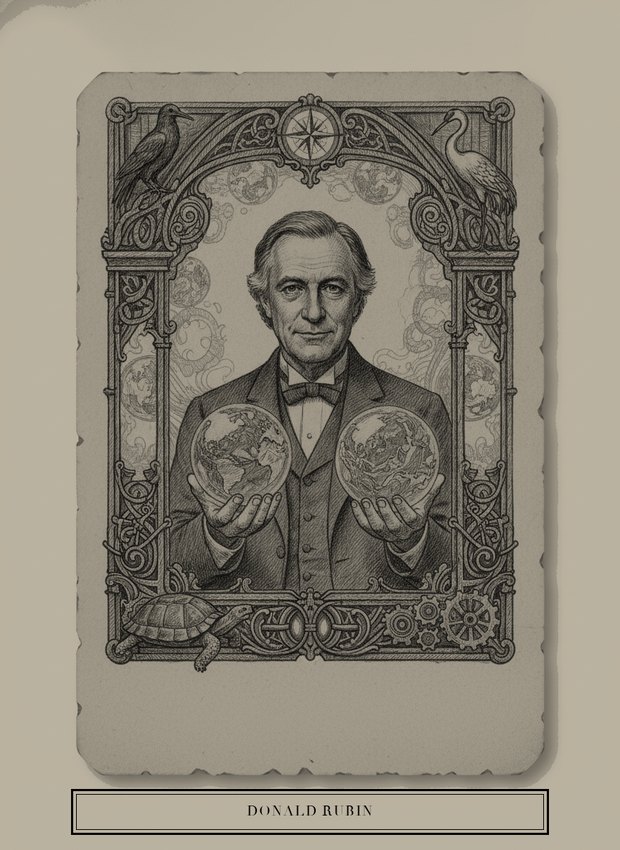
This problem is Rubin's biography. The year 1976 is the publication date of his Biometrika paper Inference and Missing Data, which did exactly what the problem demands: formalized missing completely at random, missing at random, and the nonignorable remainder, and stated the conditions under which likelihood and Bayesian inference may ignore the response mechanism. Next came his work on nonresponse in sample surveys; 1977 brought the EM paper with Dempster and Laird for maximum likelihood from incomplete data; and his multiple imputation program, culminating in the 1987 book, produced estimates whose between-imputation variance admits what was never observed — the problem's closing requirement, nearly verbatim. Census and epidemiological practice adopted all of it. No other carrier in this batch owns a problem so completely; the score reflects that.
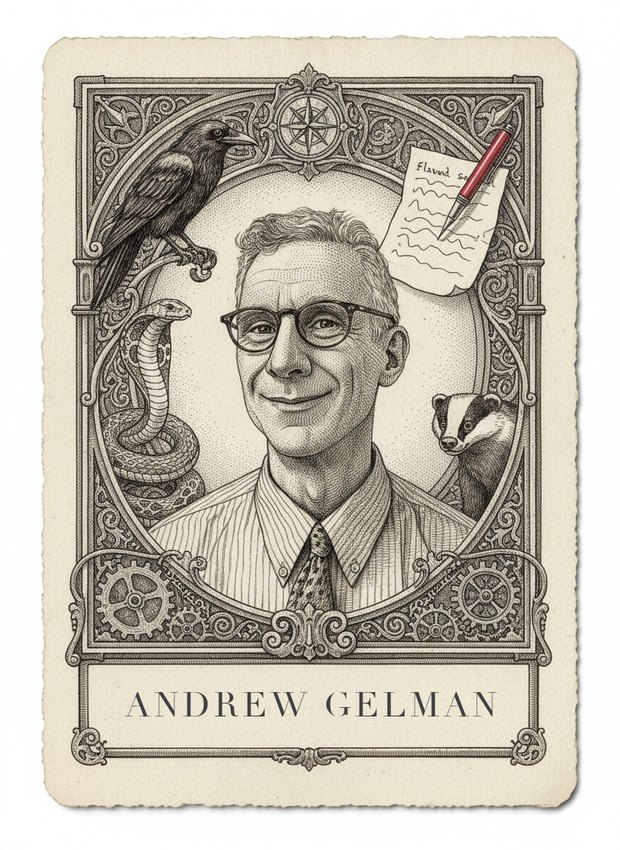
Gelman is one of the problem's named winners for good reason: he trained under Rubin, co-wrote Bayesian Data Analysis with him, and made imputation and nonresponse adjustment routine parts of applied Bayesian workflow. His multilevel regression and poststratification program is precisely the art of estimating population quantities from unrepresentative respondents — famously stretched to an Xbox-user election sample — and Stan makes joint models of outcome and missingness mechanism fittable in practice. He would state the missing-at-random assumption, fit under it, then attack it with sensitivity analysis and posterior predictive checks, exactly the uncertainty-that-admits-ignorance the problem demands. The era gap runs backward — in 1976 he was a child — but his toolkit is the direct operational descendant of that paper. Only the taxonomy's authorship keeps him below Rubin.
In the mind map
The same ideas, as concepts rather than history — in John's ML knowledge map.
65 figures are scored on this problem. Draw it in a battle to see where you land.