systems
The language for the job
It is 1959, and the world's data processing is written in machine-specific assembly by a tiny priesthood, while the people who actually understand the payroll, the inventory, and the actuarial tables — the domain experts — cannot touch the machines at all. Design a programming language in which non-specialists can express data analysis clearly, safely, and fast enough to run the business: readable by a manager, checkable by a compiler, portable across the incompatible hardware of half a dozen vendors. Every design choice trades expert power against newcomer clarity, and the compiler itself is a research problem. The stakes are who gets to compute: keep the priesthood, and software stays scarce and expensive; open the gate, and computing becomes something an economy runs on.
Who this problem belongs to
The two figures whose methods fit it best, out of 37 in contention.
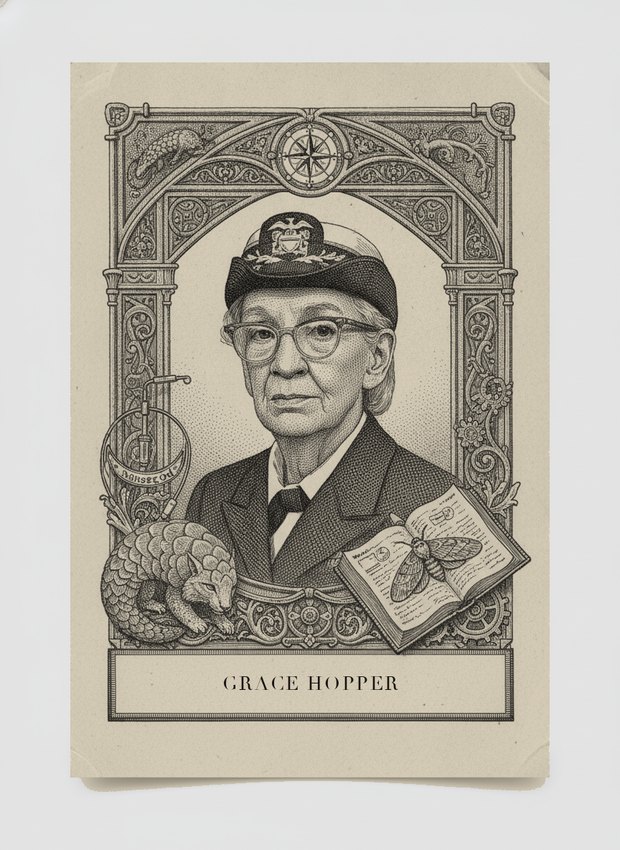
This is Hopper's exact desk in 1959. She had already built the A-0 and FLOW-MATIC compilers arguing, against near-universal skepticism, that a computer could translate English-like statements into machine code, and in 1959 she sat on the committee that used FLOW-MATIC as the direct model for COBOL: a language readable by a manager, checkable by a compiler, and portable across UNIVAC, IBM, and Honeywell hardware alike. Her insistence that programs should read like business prose rather than opcodes is precisely the design axis this problem turns on. She spent the following two decades pushing standardization across vendors so the same COBOL source would compile everywhere. The only reason this is not a full 100 is that in 1959 COBOL itself is still being drafted, not yet proven at scale.

Van Rossum did not solve the 1959 problem, he re-solved it thirty years later for the same reason: he built Python (1989-91) explicitly so that readability and clarity would beat expert cleverness, borrowing directly from the ABC language's project of making programming accessible to non-specialists. His design instincts (one obvious way to do it, indentation as syntax, batteries-included portability across platforms) answer this problem's brief almost exactly, and Python became the language domain experts without CS training actually use. The deduction is pure anachronism: he is answering Hopper's question a full computing generation later, with tools (garbage-collected interpreters, cross-platform runtimes) that plainly did not exist in 1959, so he could not have executed this in the actual year.
37 figures are scored on this problem. Draw it in a battle to see where you land.