high-dim
Tensors don't factor like matrices
It is 2013, and the recommender-systems gold rush has taught everyone matrix factorization — so everyone now flattens their genuinely multi-way data (users x items x time) into matrices and factors away, destroying exactly the structure that made the data valuable. Work in the tensor's native geometry instead: define the right notion of rank, and show where matrix intuition catastrophically fails — rank exceeding every dimension, best low-rank approximations that simply do not exist, decompositions that are NP-hard to compute. Then the payoff for the pain: establish when the latent factors are identifiable — unique, not rotatable into nonsense — which matrices can never offer. Downstream, latent factors get read as real things: user tastes, disease subtypes, topics. Estimate them non-identifiably and you are interpreting an artifact of the algorithm.
Who this problem belongs to
The two figures whose methods fit it best, out of 56 in contention.
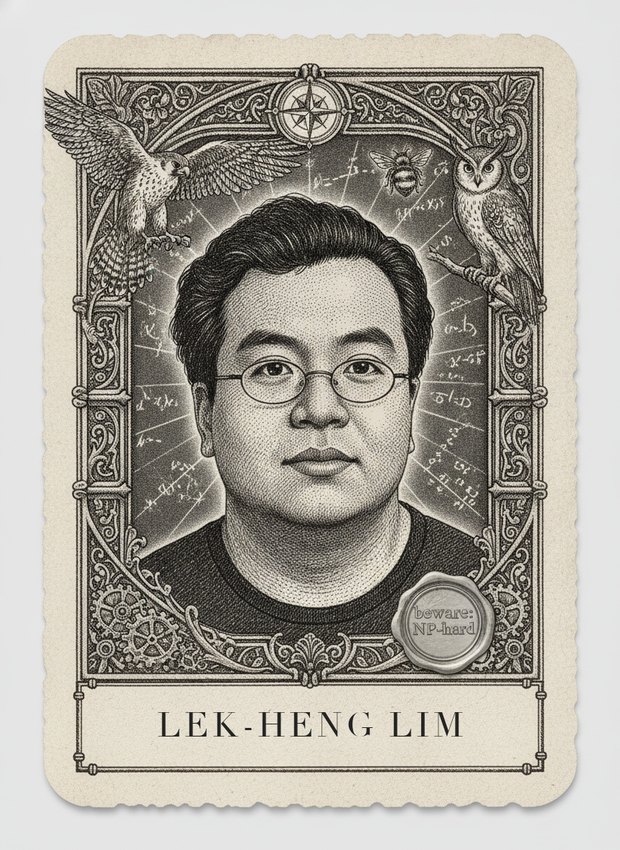
Lim's entire research program is tensors and multilinear algebra for data science — defining the right notion of tensor rank, proving where matrix intuition catastrophically fails (rank exceeding every dimension, NP-hard decompositions, best low-rank approximations that do not exist), and characterizing when latent factors are identifiable — which is this problem restated almost verbatim as his own published research agenda. His work directly addresses the recommender-systems context named in the problem, showing precisely why flattening genuinely multi-way data (users, items, time) into matrices destroys the structure that makes the data valuable. There is no better-matched carrier in this or nearly any pool: this is not analogous to his career, it is his career.

Anandkumar's research career is built directly on this problem: tensor methods for machine learning, including establishing when tensor decompositions yield unique, identifiable latent factors — the exact 'unique, not rotatable into nonsense' guarantee matrix factorization cannot offer that this problem demands. Her work on moment-tensor methods for latent variable models (topic models, mixture models) shows tensors' native geometry solving problems matrix flattening destroys, and her tensor-based neural operators extend this facility further. She is one of the strongest possible carriers in this pool; the problem restates her own research program's central thesis.
In the mind map
The same ideas, as concepts rather than history — in John's ML knowledge map.
56 figures are scored on this problem. Draw it in a battle to see where you land.