fairness
The statistic that can't betray you
It is 2006 at Microsoft Research, and the comfortable fictions of "anonymization" are collapsing one re-identification at a time: stripped names undone by zip code and birthdate, anonymous search logs unmasked by the queries themselves. The lesson is that ad hoc scrubbing cannot be patched — privacy needs a definition with a proof attached. Publish aggregate statistics from a medical database with a mathematical guarantee that no individual's presence or absence can be inferred from the outputs, no matter what auxiliary information an adversary holds — and price the accuracy cost explicitly, because the guarantee is purchased with calibrated noise and the budget is finite. National statistics agencies and every hospital data-sharing agreement are waiting on this calculus. Anything weaker is a promise, and promises have been breaking.
Who this problem belongs to
The two figures whose methods fit it best, out of 30 in contention.
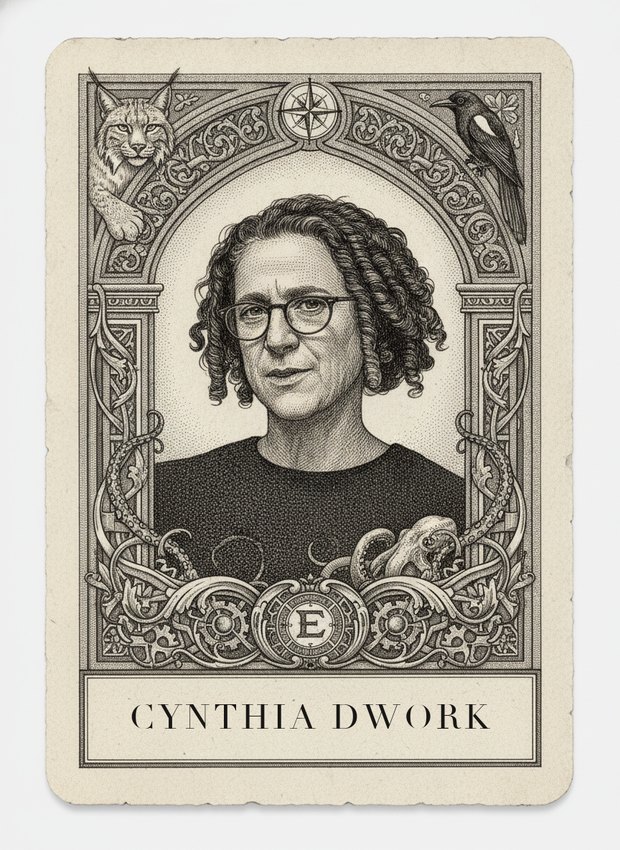
This is Dwork's field, essentially by definition. Working at Microsoft Research in the mid-2000s, she co-invented differential privacy specifically to replace ad hoc anonymization with a mathematical definition carrying a provable guarantee: no individual's presence or absence in a dataset can be inferred beyond a quantified bound, regardless of an adversary's auxiliary knowledge, purchased with calibrated noise against an explicit privacy budget. That is a description of this problem's ask, not an analogy to it. She built the composition theorems, the noise mechanisms, and the formal privacy-accuracy tradeoff the problem demands be priced explicitly. No carrier's toolkit is closer to zero translation distance from this scenario.
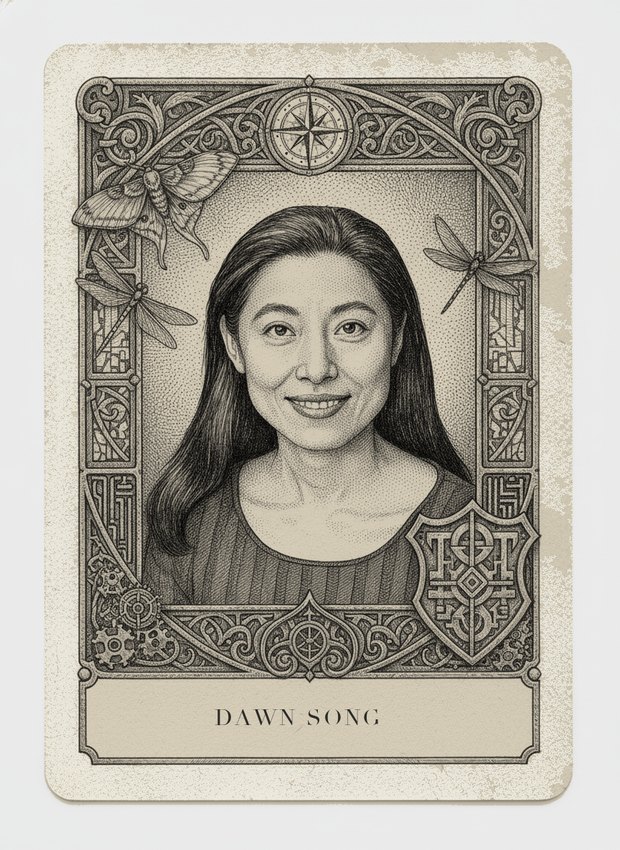
Song's work on AI security and adversarial privacy attacks (2000s-2010s, Berkeley) is squarely built around exactly the failure mode this problem opens with: re-identification attacks that undo naive anonymization by exploiting auxiliary information. She has studied both sides — how attackers unmask stripped datasets and how to build systems resistant to such attacks — giving her direct expertise in the threat model differential privacy formalizes against. Her focus skews toward adversarial and systems security more than the specific mathematical mechanism-design (noise calibration, composition) that produces the provable guarantee itself, keeping her just behind Dwork in this specific mechanism-design task.
In the mind map
The same ideas, as concepts rather than history — in John's ML knowledge map.
30 figures are scored on this problem. Draw it in a battle to see where you land.