classification
Just look at the neighbors
It is 1967, and a deceptively simple idea is about to get a theorem: to classify a new point, find the labeled examples nearest it and let them vote. No model is fitted, no parameters trained — the data is the classifier. Two questions decide whether this is wisdom or laziness: what distance metric makes "near" mean "similar," and how badly the scheme rots as dimensions pile up and everything becomes equidistant. Prove what this rule can guarantee — that with infinite data its error is at most twice the best achievable — and state where the curse of dimensionality voids the promise. Get it wrong and a method that looks foolproof degrades into noise exactly when the features multiply.
Who this problem belongs to
The two figures whose methods fit it best, out of 71 in contention.
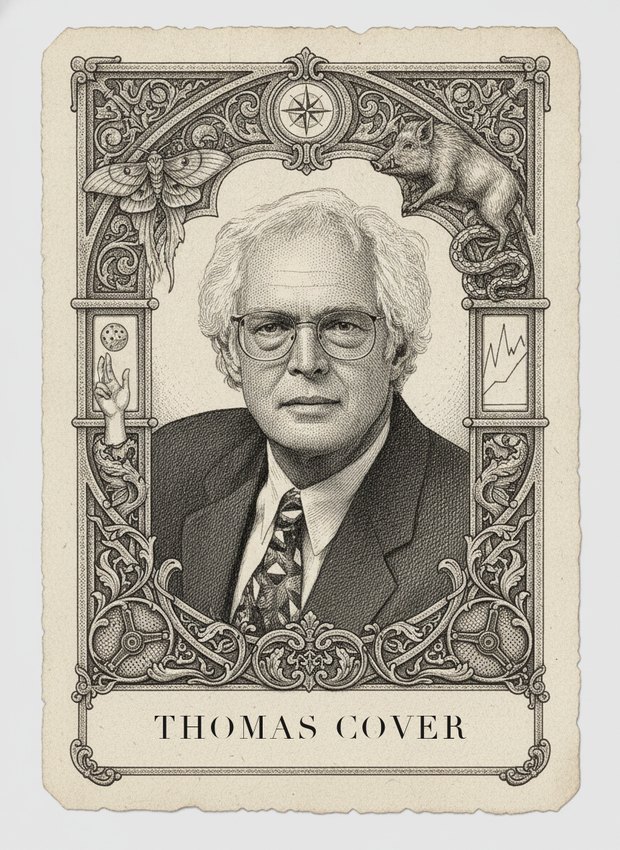
Cover's 1967 paper with Peter Hart, 'Nearest Neighbor Pattern Classification,' is this problem verbatim: it proves that as the sample size grows to infinity, the nearest-neighbor rule's error rate is bounded above by at most twice the Bayes-optimal error, the exact 'foolproof' guarantee this problem asks someone to prove. Cover's broader career in information theory gave him the precise tools to state and prove this bound rigorously, distinguishing genuine asymptotic guarantee from statistical folklore. His later work on universal portfolios shows the same taste for showing what a simple, model-free rule can and cannot promise. No one else on this roster is the actual author of the theorem this problem is explicitly asking someone to state and prove.
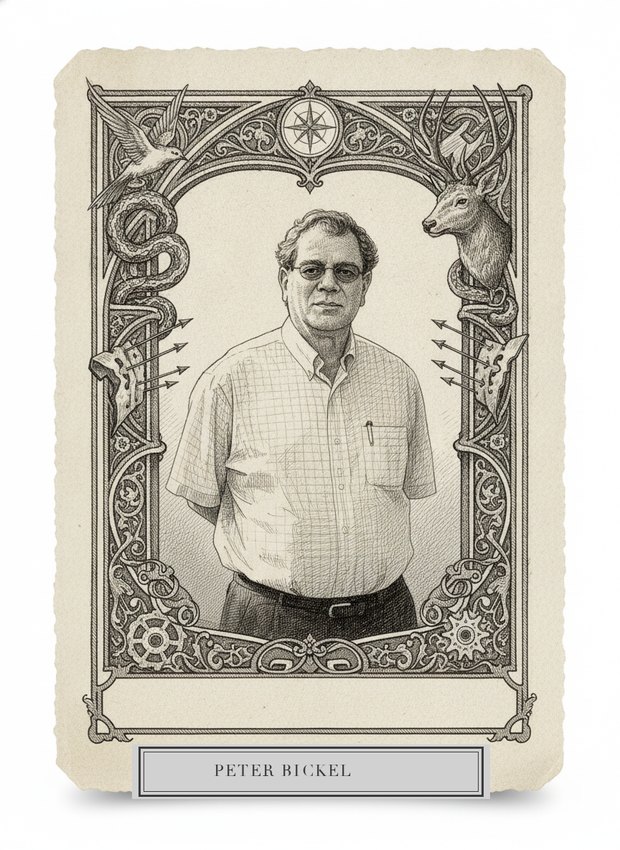
Bickel's rigorous analysis of nearest-neighbor and other nonparametric methods in high dimensions, developed at Berkeley from the 1970s onward and including his influential later work with Levina on when high-dimensional data breaks distance-based classifiers, directly addresses this problem's second demand: precisely characterizing where the curse of dimensionality voids the nearest-neighbor guarantee as features multiply and points become equidistant. His semiparametric efficiency theory gives the formal machinery to state exactly how fast performance degrades. He did not prove Cover and Hart's original asymptotic bound, arriving at the dimensionality analysis a generation later, but his work supplies precisely the honest fine print this problem's second half is asking for. That combination of applicable insight and honest limitation is what makes Peter Bickel a genuinely strong, if not the single strongest, carrier for this exact classical problem.
Fought here
In the mind map
The same ideas, as concepts rather than history — in John's ML knowledge map.
71 figures are scored on this problem. Draw it in a battle to see where you land.