classification
The tree you can read
It is 1984, and a loan officer and a physician ask the same thing of their models: not just the answer, but a reason they can say aloud. Build a classifier that splits the data one question at a time — recursively partitioning on the feature that most purifies each branch — until the path from root to leaf reads as a rule a human can follow and defend. The hard part is knowing when to stop: grow the tree fully and it memorizes every quirk; prune too hard and it forgets real structure. Choose the split criterion and the pruning honestly. Get it wrong and you ship either an overfit tree that fails in the field or a stump that explains nothing.
Who this problem belongs to
The two figures whose methods fit it best, out of 71 in contention.
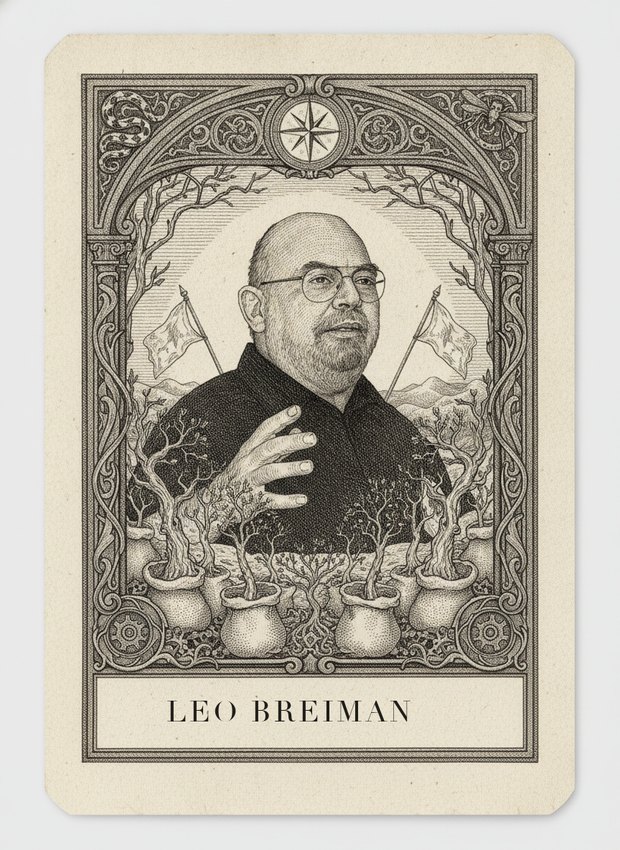
This problem is not an analogy for Breiman; it is his desk in 1984. With Friedman, Olshen, and Stone he published Classification and Regression Trees that same year, formalizing exactly this: recursive binary partitioning on the feature that most reduces impurity (Gini index or twoing), and, critically, cost-complexity pruning so a fully grown tree that memorizes noise gets cut back using cross-validated error rather than a fixed depth. Breiman came to trees from consulting work where clients demanded readable rules, not equations, which is precisely the loan-officer and physician framing here. He later built bagging and random forests on top of this exact machinery. The only reason this is not a perfect 100 is that his own later work argued single trees are unstable predictors even as they remain the most interpretable ones.
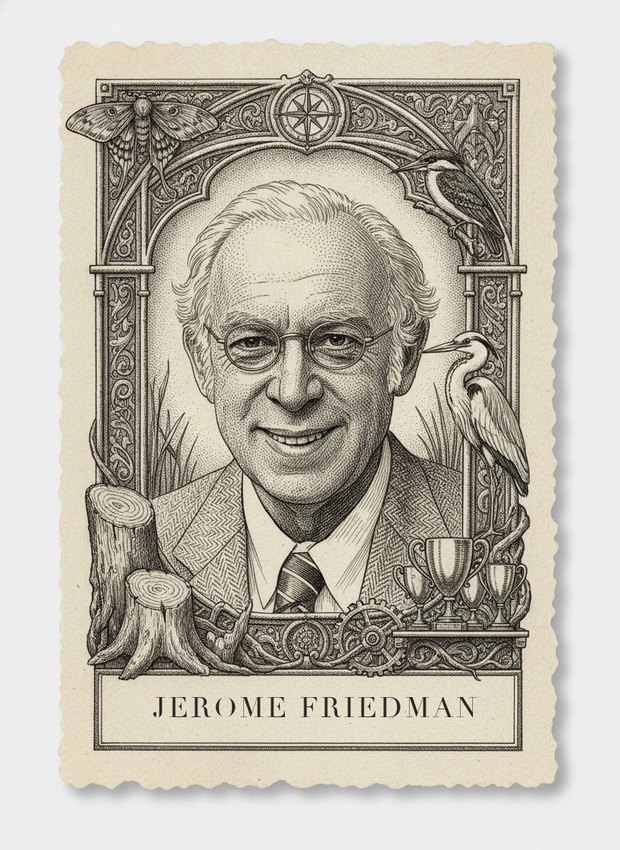
Friedman co-authored CART itself in 1984, jointly with Breiman deriving the impurity-reduction split criteria and the pruning algorithm this problem asks for, so the historical fit is nearly total. His Stanford statistics background gave the tree-growing procedure its computational rigor: efficient search over split points, surrogate splits for missing data, and the cost-complexity pruning path indexed by a tunable penalty. He later built on this exact insight with gradient boosting, stacking many shallow, readable trees into an ensemble that traded some interpretability for accuracy — a tension this very problem raises. His fingerprints are on both the split criterion and the honest-stopping-rule half of the ask, making him essentially a co-author of the historical answer this problem wants.
In the mind map
The same ideas, as concepts rather than history — in John's ML knowledge map.
71 figures are scored on this problem. Draw it in a battle to see where you land.