information
The scratch on the disc
It is the era when data must survive physical insult: a scratch across a compact disc, a burst of cosmic radiation flipping a run of bits on a probe billions of miles from home, where no retransmission is possible because the round trip is hours. Random single-bit codes are the wrong tool — the errors here come in contiguous bursts. Construct algebraic codes over finite fields that correct many consecutive corrupted symbols in a block, with decoding cheap enough for a spacecraft or a music player. Get it wrong and a scratched disc skips, or a transmission from deep space arrives as noise after years — these codes are why a fingerprinted CD still plays and images from the outer planets came home intact.
Who this problem belongs to
The two figures whose methods fit it best, out of 36 in contention.

Hamming's foundational 1950 error-correcting codes, developed at Bell Labs, established the core principle this entire problem descends from: that structured redundancy allows a receiver to detect and correct corrupted symbols, and his broader career-long expertise in coding theory over the following decades placed him squarely within the tradition that produced Reed and Solomon's 1960 algebraic, burst-error-correcting construction over finite fields. His deep, practical fluency with the mathematics of reliable representation under real engineering constraints, redundancy budgets, and decoding complexity gives him genuine, professional-grade proximity to this problem's exact engineering challenge. He is not the specific inventor of Reed-Solomon codes, but the discipline they belong to is substantially the one Hamming helped found and define.
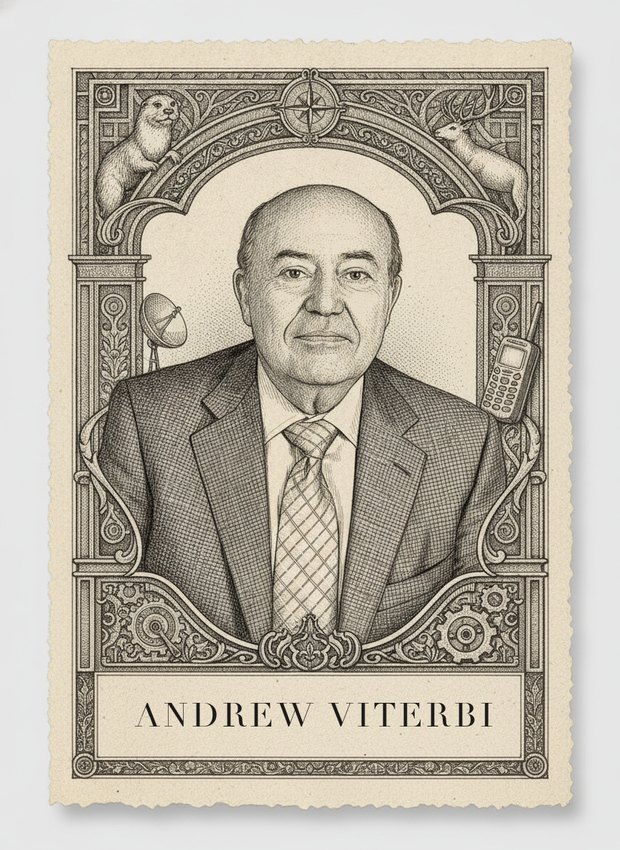
Viterbi's decoding algorithm, and the broader coding-theory career it anchored, sits at the historical center of exactly this problem: the concatenated coding schemes used on NASA's Voyager missions and countless deep-space and satellite links paired algebraic Reed-Solomon outer codes for burst-error correction with convolutional inner codes decoded by his own algorithm, precisely the real-world engineering this problem describes. His deep, career-long fluency with practical, hardware-cheap decoding under severe power and complexity constraints is directly the discipline this problem occupies. He did not personally invent the algebraic Reed-Solomon construction, that belonging to Irving Reed and Gustave Solomon's 1960 work, but his decoding expertise is inseparable from how these systems actually flew and worked.
In the mind map
The same ideas, as concepts rather than history — in John's ML knowledge map.
36 figures are scored on this problem. Draw it in a battle to see where you land.