optimization
Cut through the interior
It is 1984, and linear programming has a paradox: the simplex method that has run the world's logistics for decades walks the edges of the feasible polytope and works beautifully in practice, yet can be forced, on cunning inputs, to visit exponentially many vertices — it has no polynomial guarantee. A rival approach ignores the edges and drives straight through the interior toward the optimum. Develop such a method, prove it converges in polynomially many steps regardless of input, and show it competes on real problems, not just in theory. Get it wrong and optimization stays hostage to a method with no guarantee, or you ship a solver too slow to matter — interior-point had to be both.
Who this problem belongs to
The two figures whose methods fit it best, out of 70 in contention.
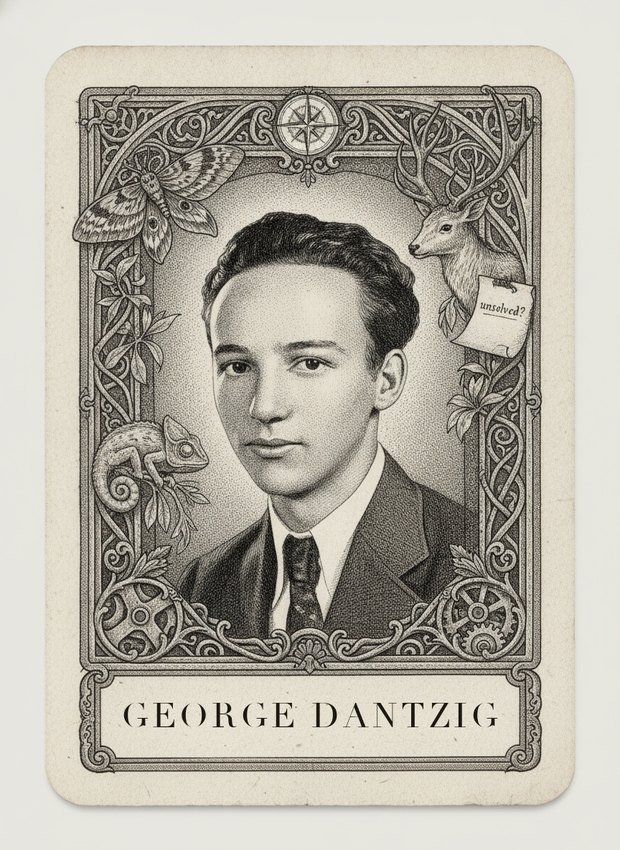
Dantzig is the simplex method's own creator, developing it in 1947 while working on Air Force logistics planning, and by 1984 the paradox this problem describes, that his edge-walking algorithm runs beautifully in practice yet has no polynomial worst-case guarantee, was already famous, sharpened by Klee and Minty's adversarial examples showing simplex could visit exponentially many vertices. His decades of hands-on experience with the geometry of the feasible polytope, its vertices, edges, and degenerate cases, give him unmatched intuition for exactly what an interior-point rival would need to avoid. He did not himself develop the interior-point method, since Karmarkar's 1984 breakthrough came near the end of his career and from outside his own research direction, keeping him just short of full marks despite being the field's foundational figure.

Boyd's Convex Optimization, written with Vandenberghe and now the standard reference across engineering and machine learning, treats interior-point methods as a central topic, deriving the barrier-function machinery and polynomial convergence proofs this problem asks for with exactly the rigor-plus-practice standard it demands. His own solver development work, building software that actually runs interior-point methods efficiently on real convex problems at scale, directly answers the problem's insistence that the method 'compete on real problems, not just in theory.' He arrives decades after Karmarkar's original 1984 breakthrough, working as the field's most influential systematizer, popularizer, and extender of interior-point theory into the broader convex optimization landscape rather than as the method's original inventor.
Fought here
In the mind map
The same ideas, as concepts rather than history — in John's ML knowledge map.
70 figures are scored on this problem. Draw it in a battle to see where you land.