optimization
A good-enough tour of a thousand cities
It is the era when the traveling salesman stops being a complexity abstraction and becomes a circuit board to drill, a truck route to run, a telescope's night to schedule — a thousand real stops, and no one will wait geologic time for the provably shortest tour. Abandon exactness on purpose: build a tour demonstrably close to optimal, fast. Use a construction with a proven approximation ratio, then improve it with local moves that swap edges to untangle crossings, escaping the traps greedy routing falls into. State the guarantee your method carries. Get it wrong and you chase an exact optimum that misses the deadline, or accept a naive route that wastes fuel and hours daily — the art is provably good, not perfect, on time.
Who this problem belongs to
The two figures whose methods fit it best, out of 71 in contention.
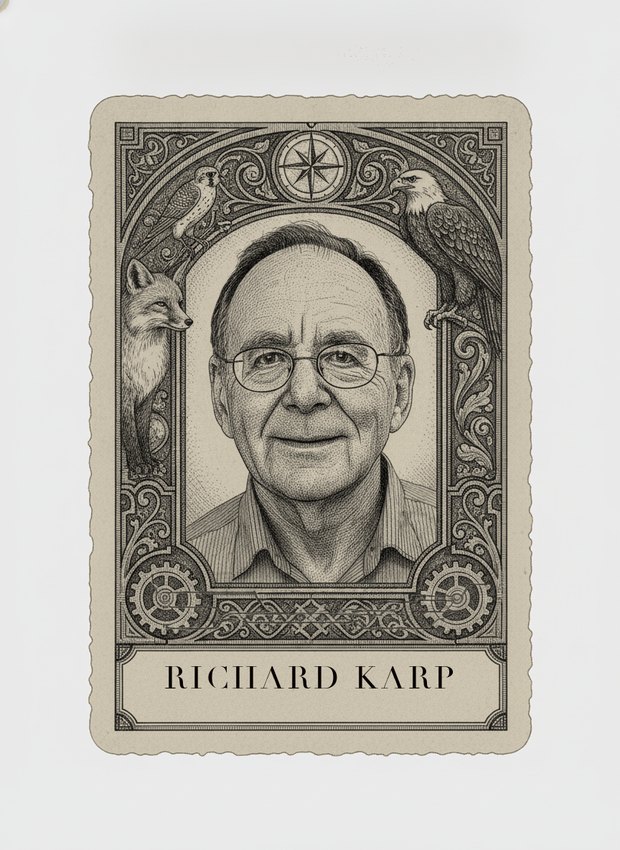
Karp's 1976 approximation-algorithm analysis of the Euclidean traveling salesman problem, together with his broader program classifying combinatorial optimization by hardness, gives him direct, foundational authority over exactly this problem's premise: proving how close a fast algorithm can get to optimal on an NP-hard tour. His probabilistic analysis of TSP heuristics on random instances, showing near-optimal tours are achievable with high probability, anticipates the 'demonstrably close, fast' framing this problem demands. He did not personally engineer the 2-opt local search moves, but the theoretical apparatus for stating and proving an approximation ratio is substantially his. His score reflects direct authorship of the analytical framework this problem's 'state the guarantee' clause requires.
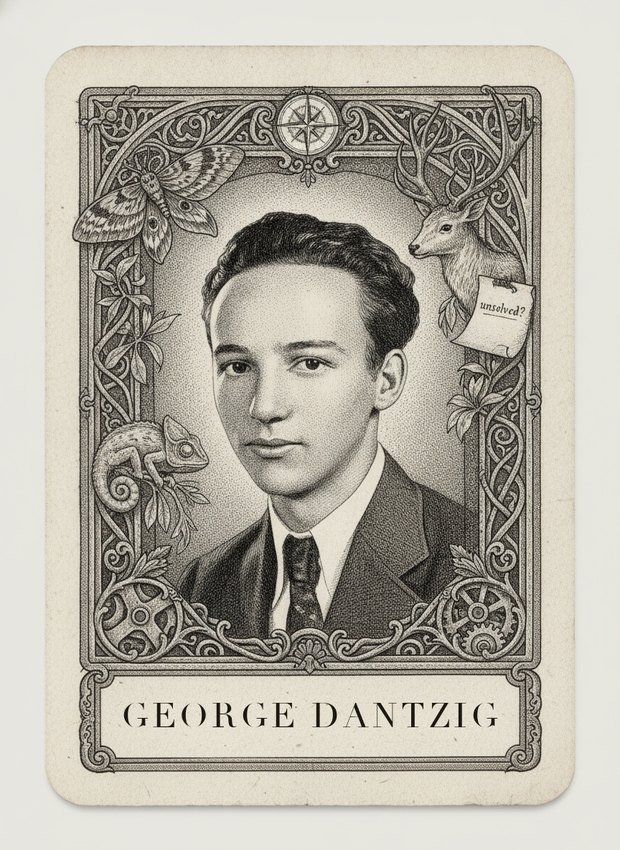
Dantzig's own operations-research career included direct work on the traveling salesman problem: with Fulkerson and Johnson in 1954, he solved a 49-city instance using linear programming relaxation and cutting planes, a landmark demonstrating exact methods could handle real instances far larger than brute force allowed. That is close kinship but not identical to this problem's ask, which wants a fast approximation with a stated guarantee rather than an exact solve. His simplex-based cutting-plane approach nonetheless established the computational culture, LP relaxation plus combinatorial refinement, from which later approximation algorithms and local-search heuristics for large-scale routing directly descended. His score reflects direct historical ownership of the TSP tradition. That direct authorship of the exact-solution tradition is why this problem, even framed as approximate, sits squarely inside his lifelong professional domain.
In the mind map
The same ideas, as concepts rather than history — in John's ML knowledge map.
71 figures are scored on this problem. Draw it in a battle to see where you land.