optimization
Relax, then round
It is the 1990s, and a powerful pattern for hard combinatorial problems matures: when the discrete problem is NP-hard, embed it in a larger continuous one you can actually solve — a semidefinite program over matrices — solve that, then round the continuous solution back to a discrete one, losing only a bounded fraction of quality. Apply it to partitioning a graph to cut the most edges, and prove the rounding never loses more than a specific, surprising fraction of the optimum. The relaxation must be tight enough to be worth solving and the rounding must carry a proof. Get it wrong and you attack head-on and fail, or relax so loosely the answer is worthless — convex relaxation with a provable rounding is a sharp weapon against hardness.
Who this problem belongs to
The two figures whose methods fit it best, out of 71 in contention.

Boyd's entire research program is convex optimization, and semidefinite programming is one of its central pillars: his textbook with Vandenberghe treats SDP relaxations of combinatorial problems, including the max-cut relaxation this problem describes, as a canonical worked example. His group built solvers (SDPT3-adjacent tooling, CVX) that make solving the semidefinite relaxation practical rather than theoretical. He did not personally prove the Goemans-Williamson rounding guarantee for max-cut, that credit belongs to the algorithm's namesakes, but the relaxation machinery, duality theory, and interior-point methods that make the 'solve the continuous embedding' step tractable are substantially his professional territory. His score reflects near-total command of the relaxation side of this problem. That command is essentially unmatched in this batch.
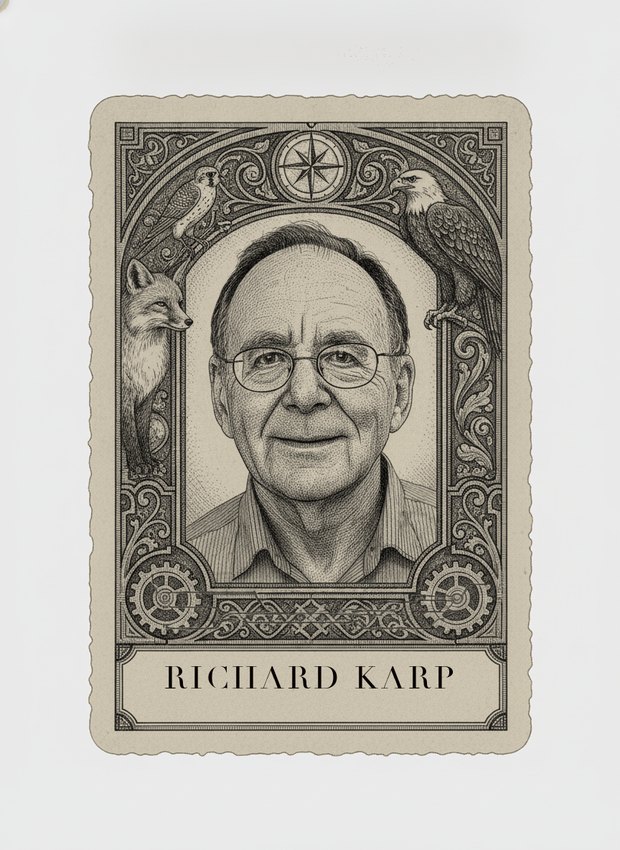
Karp's foundational classification of NP-hard combinatorial problems, including graph partitioning and max-cut variants, in his 1972 reducibility paper is the reason this problem needs a relaxation-based attack at all rather than an exact algorithm. His broader career at Berkeley championing rigorous approximation guarantees for combinatorial optimization sets the intellectual standard the Goemans-Williamson-style proof this problem demands must meet. He did not personally develop the semidefinite relaxation and rounding technique for max-cut, that came from Goemans and Williamson in 1995, after most of Karp's major contributions. His score reflects deep foundational and cultural authority over the problem's hardness framing, short of direct authorship of this specific method. It is telling that when researchers trace the intellectual lineage of the modern technique this problem describes, Richard Karp's contributions show up as load-bearing rather than incidental references.
Fought here
In the mind map
The same ideas, as concepts rather than history — in John's ML knowledge map.
71 figures are scored on this problem. Draw it in a battle to see where you land.