search
Solve the impossible formula
It is the era when hardware verification lives or dies on a logical question of staggering size: does there exist an assignment of true and false to hundreds of thousands of variables satisfying a formula with millions of clauses encoding a circuit's correctness? In theory this is the canonical intractable problem; in practice, engineers need answers on real chips before tape-out. Build a solver that searches the assignment space intelligently — propagating forced choices, backtracking from dead ends, and learning a new clause from every conflict so the same failure never repeats. Get it wrong and verification is abandoned and buggy silicon ships unpatched, or the solver grinds forever on instances a smarter search cracks fast — SAT solving is how the intractable is routinely tamed.
Who this problem belongs to
The two figures whose methods fit it best, out of 65 in contention.
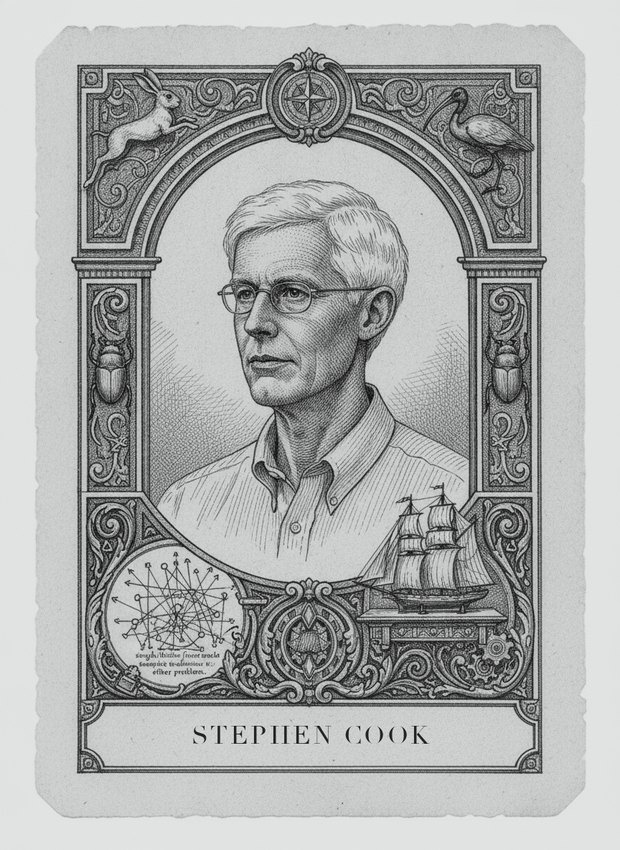
This problem is Cook's own theorem made concrete. His 1971 paper 'The Complexity of Theorem-Proving Procedures' proved SAT is NP-complete via the Cook-Levin theorem, establishing that boolean satisfiability is the canonical hard problem to which every other NP problem, including hardware-verification questions about circuits with millions of clauses, can be reduced. He gave the field the exact vocabulary this scenario uses: variables, clauses, satisfying assignments, and the gulf between worst-case intractability and the practical solvers engineers actually need before tape-out. He did not himself build a conflict-driven solver, since DPLL and clause learning came later from others, but he is the reason anyone recognizes this as the fundamental problem it is, which is why almost nothing here caps his score below the ceiling.
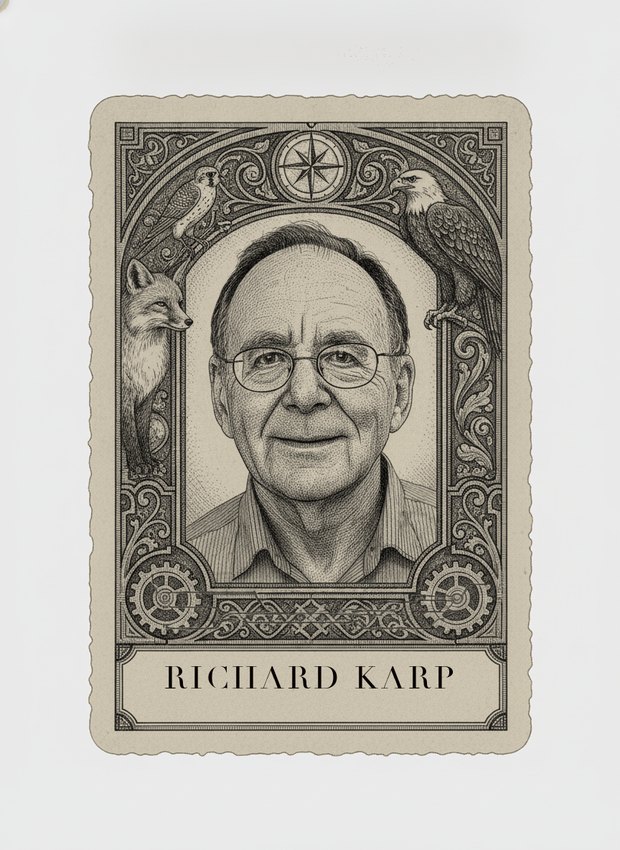
Karp's 1972 paper '21 NP-complete problems' built directly on Cook's theorem and showed that SAT's hardness propagates through circuit design, scheduling, and countless other domains via polynomial reductions, which is exactly the theoretical backbone explaining why hardware-verification SAT instances with millions of clauses cannot simply be brute-forced. His subsequent Berkeley career on randomized and approximation algorithms shows continued fluency with worst-case-versus-practical-performance arguments, the same gap this problem's engineers must navigate. He did not build the conflict-driven-clause-learning solvers that actually crack real instances, a later, more applied lineage (Marques-Silva, Malik, Moskewicz), so his score reflects deep theoretical authorship of the hardness landscape rather than the specific engineering solution. His Berkeley theory group trained several researchers who later worked directly on practical SAT algorithms, a real if indirect lineage connecting his hardness results to the applied solvers this problem needs.
In the mind map
The same ideas, as concepts rather than history — in John's ML knowledge map.
65 figures are scored on this problem. Draw it in a battle to see where you land.