perception
Two voices, two microphones
It is 1994, and the cocktail-party problem has been formalized to its skeleton: two people speak at once, two microphones each record an unknown mixture, and the task is to recover both voices with no model of either speaker and no knowledge of the mixing — blind separation. The key is an assumption of almost impudent weakness: the sources are statistically independent, and independence is all you use. Gaussian statistics provably cannot do it — second-order correlations leave a rotation undetermined — so the algorithm must consume higher-order structure, the non-Gaussianity of real speech. Derive the learning rule, characterize what remains unidentifiable (order and scale), and separate real recordings. Get it wrong and hearing aids, EEG analysis, and every crowded-room interface stay deaf to the voice that matters.
Who this problem belongs to
The two figures whose methods fit it best, out of 59 in contention.
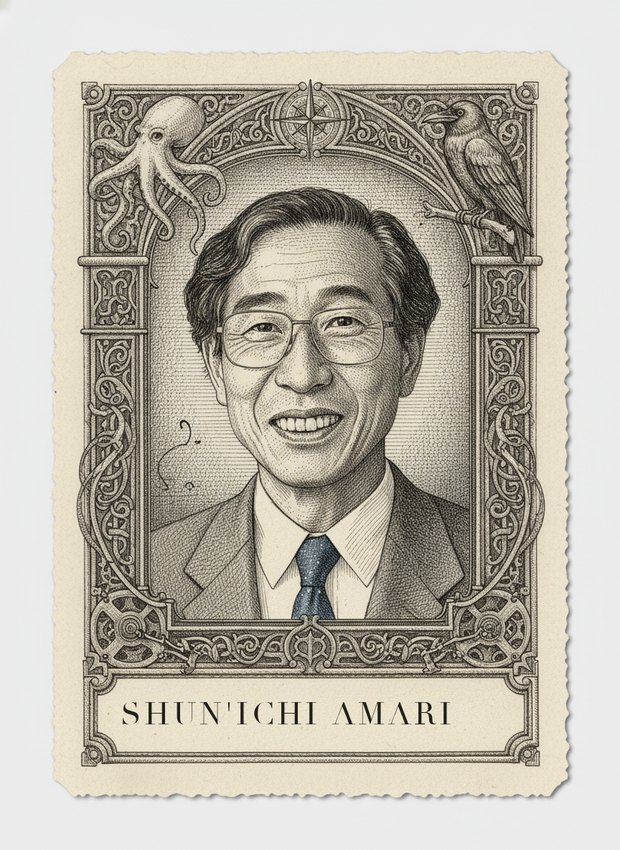
This problem is substantially Amari's own contribution. Through the 1990s he developed the natural gradient learning rule for independent component analysis, published with Cichocki and Yang in the mid-1990s, deriving exactly the update rule this problem asks for: a learning rule that separates statistically independent, non-Gaussian sources from linear mixtures using only higher-order statistics, since second-order Gaussian correlations leave a rotational ambiguity unresolved. His information-geometric framework explains precisely why the natural gradient converges faster and more stably than naive gradient descent on this exact problem, and his analysis of the identifiability limits — permutation and scaling remaining unresolved, exactly as this problem specifies — is a core contribution of his research program. He worked on real separation of real recorded mixtures using this framework, essentially living this problem's entire technical content rather than approximating it from an adjacent field.
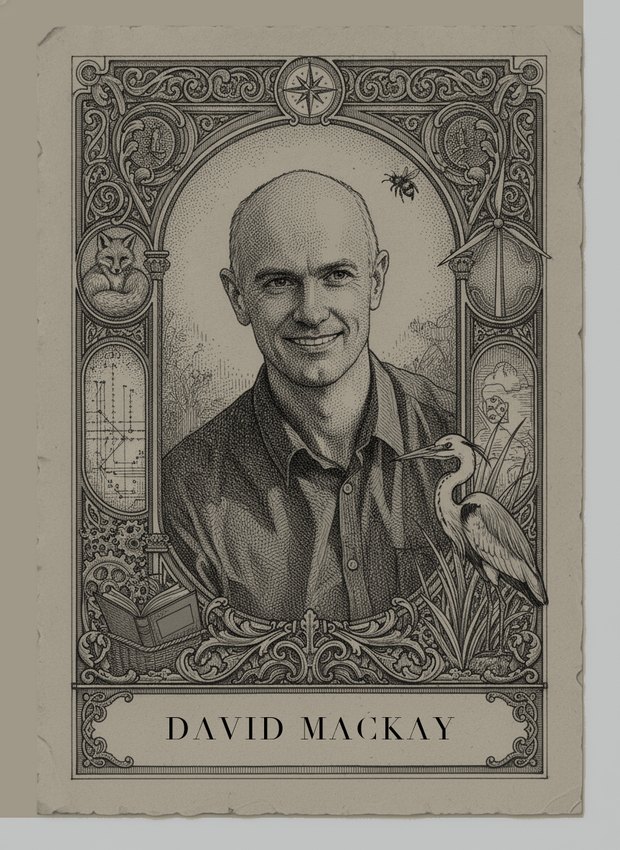
MacKay's 2003 textbook on information theory, inference, and learning includes an extended, influential treatment of independent component analysis presented in exactly this problem's terms: derive a learning rule from the assumption of source independence alone, show why Gaussian sources are unidentifiable up to rotation, and characterize what remains unresolved even for a correct algorithm — permutation and scaling. His Bayesian and information-theoretic framing of ICA as maximizing non-Gaussianity or minimizing mutual information between recovered components is a rigorous, widely taught derivation of this problem's central algorithm. He did not originate ICA himself — that credit belongs more to Amari, Bell, Sejnowski, and others working concurrently in the 1990s — and his own primary research applications lean toward coding theory and Bayesian neural networks rather than a career built on separation itself, keeping this narrowly below the field's actual originators.
Fought here
In the mind map
The same ideas, as concepts rather than history — in John's ML knowledge map.
59 figures are scored on this problem. Draw it in a battle to see where you land.