nlp
The meaning of a word is its company
It is 2013, and the machinery of NLP still treats words as atoms: "hotel" and "motel" are as unrelated, to the models, as "hotel" and "asparagus," and every system relearns from scratch what any speaker knows. The old distributional hypothesis — you shall know a word by the company it keeps — is finally computationally affordable at web scale. Learn a vector for every word from billions of tokens of raw text, such that similarity in the space tracks similarity in meaning, and analogy becomes arithmetic. Then be honest about what else the vectors absorb: the corpus's biases, its stereotypes, frozen into geometry. Get it wrong and downstream systems inherit either the atomized ignorance of one-hot words or the prejudices of the training text, invisibly.
Who this problem belongs to
The two figures whose methods fit it best, out of 49 in contention.
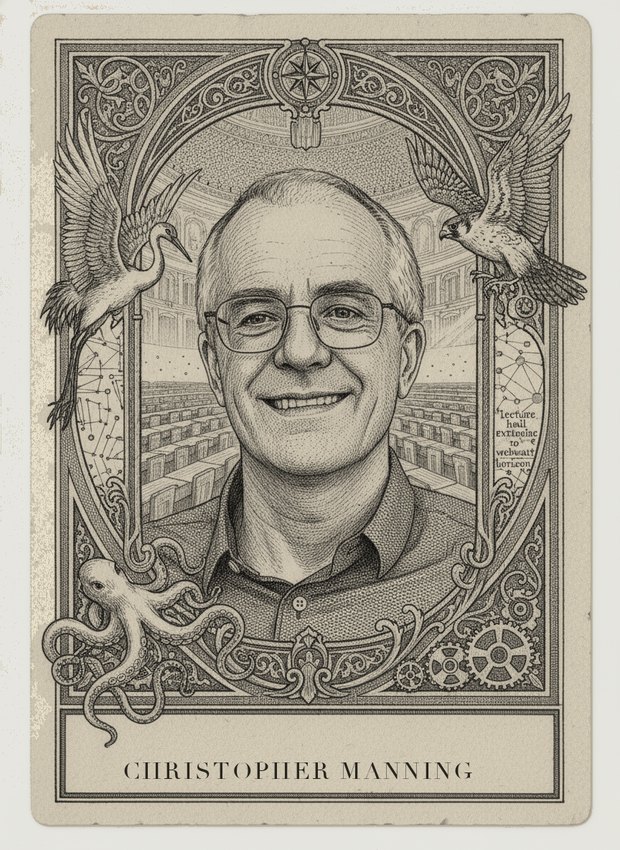
Manning's Stanford lab produced GloVe in 2014, developed as a direct response to word2vec and explicitly designed around this problem's core insight: word co-occurrence statistics across a massive corpus encode semantic similarity, and factoring that co-occurrence structure yields vectors where analogy becomes arithmetic. His statistical NLP research and widely used textbook trace the distributional hypothesis this problem invokes — 'you shall know a word by the company it keeps,' originally Firth's 1957 formulation — directly into the computational method this problem asks someone to build. His scholarship is also explicit and careful about what embeddings absorb from their training corpus, including bias, matching this problem's honesty requirement. Few figures on this roster are more directly the answer to this exact 2013 technical moment. Score: near-maximal.

Bengio's 2003 paper 'A Neural Probabilistic Language Model,' a decade before this problem's 2013 setting, is the direct technical ancestor of learning dense word vectors from raw text via self-supervision: he trained a neural network to predict a word from its context and showed the learned hidden representations captured genuine semantic and syntactic structure, exactly the mechanism this problem asks someone to scale to web-sized corpora. His sustained argument that distributed representations are more powerful than one-hot symbolic encodings is close to a direct restatement of this problem's central claim. He scores just below Manning because his foundational contribution, while a decade earlier and technically the deepest, arrived before the problem's specific 2013 word2vec-era engineering rather than during it.
In the mind map
The same ideas, as concepts rather than history — in John's ML knowledge map.
49 figures are scored on this problem. Draw it in a battle to see where you land.