nlp
The inbox under siege
It is 1998, and email is being buried alive: unsolicited mail is doubling every few months, hand-written filter rules lag weeks behind the spammers' mutations, and users are abandoning addresses like burned safehouses. Build the statistical filter: classify each message from its words, learned from each user's own mail, updating as the adversary adapts — because this classifier, unlike the textbook kind, is being actively gamed by an opponent who reads the same papers you do. Set the operating point with eyes open: a lost legitimate offer letter costs far more than a hundred surviving advertisements. Get it wrong in one direction and email drowns; get it wrong in the other and the filter silently eats the message that mattered — and trust in the channel dies either way.
Who this problem belongs to
The two figures whose methods fit it best, out of 57 in contention.
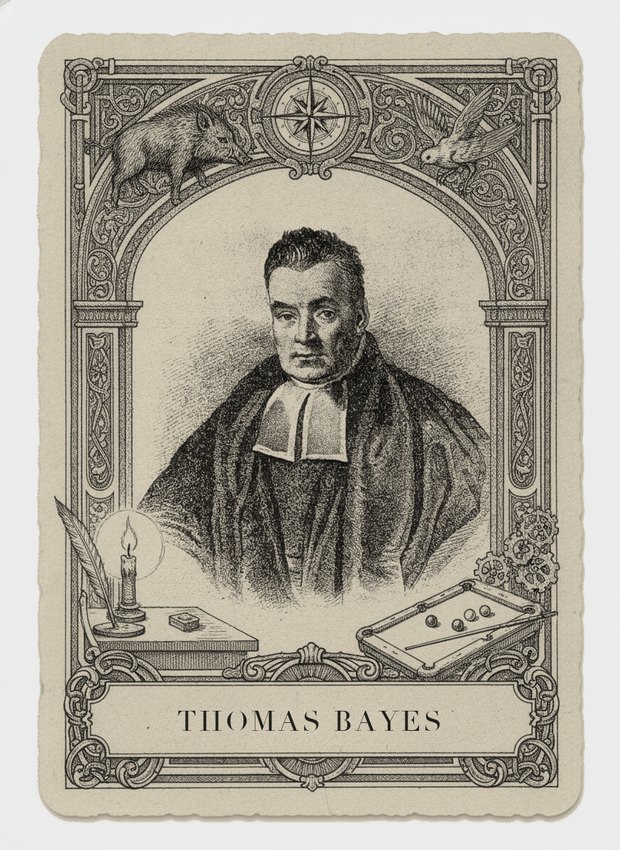
The classifier this problem needs bears his name for a reason. A paper found among his papers and published posthumously in 1763 by Richard Price laid out the inversion at the heart of naive Bayes spam filters: turn 'given this word, how likely is spam' into 'given spam, how likely this word' times a prior, then combine. Bayes was a Presbyterian minister reasoning about billiard-table thought experiments, with no notion of text, tokens, or an adversary reading his methods back at him, so the per-user adaptation and asymmetric cost-setting are later engineering layered on top. But the inferential core that makes 1998's filter work at all — updating belief from evidence under uncertainty, one word at a time — is entirely his invention, two centuries early.
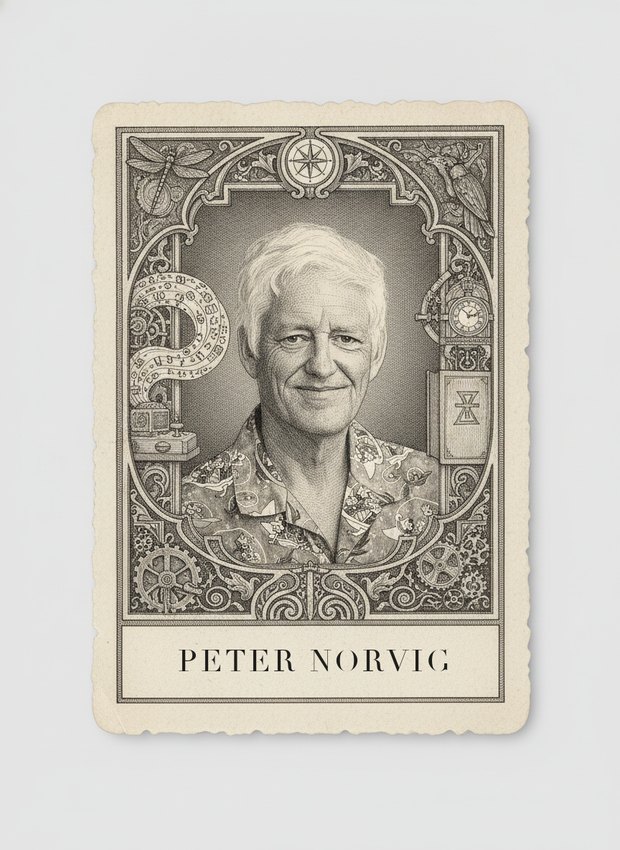
Norvig is close to a direct historical carrier here: he wrote one of the most-cited expositions of statistical spam filtering, walking through exactly the naive Bayes word-probability approach this problem calls for, and later at Google championed 'the unreasonable effectiveness of data' — the view that simple statistical classifiers, retrained continuously on huge real-world streams, beat hand-built rules precisely because rules can't keep pace with an adaptive adversary. His and Russell's AI: A Modern Approach codified Bayesian classification for a generation of students who then built real filters. He did not personally build Gmail's spam system, and the asymmetric-cost tuning is an engineering judgment call rather than a theorem, but the statistical philosophy — learn from labeled data, update as the world drifts, don't hand-write brittle rules — is exactly his stated position.
In the mind map
The same ideas, as concepts rather than history — in John's ML knowledge map.
57 figures are scored on this problem. Draw it in a battle to see where you land.