networks
Learning on the molecule graph
It is 2017, and drug discovery wants what image classification has, but its data refuses the template: a molecule is a graph — atoms and bonds, no canonical ordering, no grid — and flattening it into a fingerprint vector discards the very structure that determines chemistry. Design learning that respects the object: representations computed by passing messages along bonds, invariant to how the atoms happen to be numbered, equivariant where geometry demands it, and expressive enough to distinguish molecules that simple message passing provably confuses. Validate against the graph-isomorphism limits, not just benchmarks. Get it wrong and the models memorize dataset artifacts while candidate drugs that merely renumbered their atoms score differently — and a field bets screening budgets on symmetry violations no chemist would accept.
Who this problem belongs to
The two figures whose methods fit it best, out of 50 in contention.

Kondor's research program is built precisely on this problem's mathematical core: group-theoretic and equivariant machine learning, formalizing exactly what it means for a representation to be invariant to how a graph's nodes happen to be numbered and equivariant where geometry demands it, the specific requirement this problem's molecule-graph scenario names explicitly. His graph kernels work, developed years before message passing became standard, directly tackled representing molecular and relational structure without flattening it into an arbitrary-ordering fingerprint vector, exactly this problem's central complaint about naive approaches. His theoretical grounding in group representation theory also gives rigorous machinery for validating against graph-isomorphism expressiveness limits, the problem's explicit closing demand. No other career on this card maps this precisely onto the problem's exact mathematical requirements, which is why his score sits at the maximum.
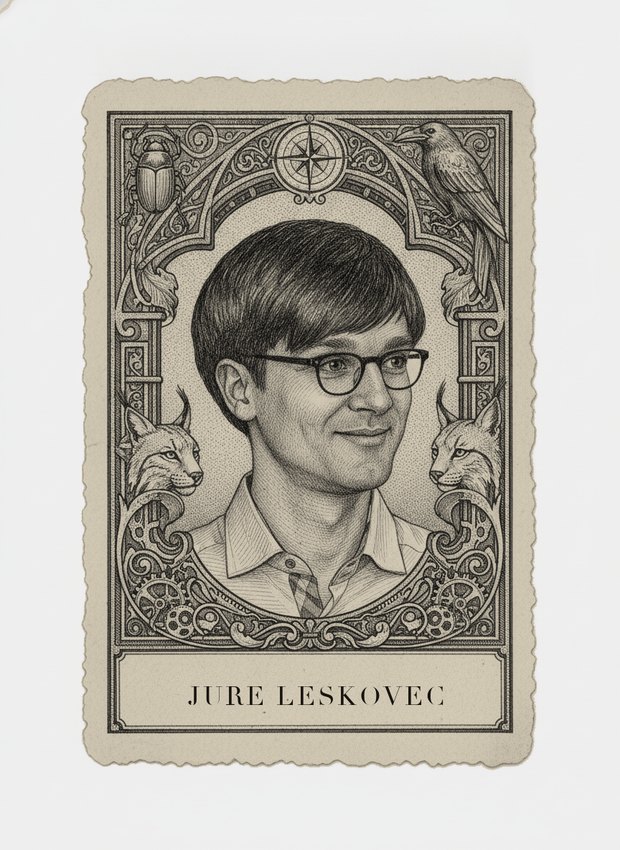
This is Leskovec's own moment, and the expressiveness clause nearly describes his paper: with Xu, Hu and Jegelka he asked how powerful graph neural networks are, tied message passing's discriminative ceiling to the Weisfeiler-Lehman isomorphism test, and showed which architectures reach that ceiling and which provably confuse distinguishable graphs. GraphSAGE, in 2017, is the inductive message-passing framework this setting needs, since it embeds nodes in graphs never seen during training. The biological half is his too: Zitnik, Agrawal and Leskovec modeled polypharmacy side effects on molecular and interaction graphs in 2018. Permutation invariance he treats as a design constraint rather than a theorem, and the deeper equivariance and geometric-symmetry story belongs to Kondor. On message passing, inductive representation and the isomorphism limit, he is the source rather than a consumer.
In the mind map
The same ideas, as concepts rather than history — in John's ML knowledge map.
50 figures are scored on this problem. Draw it in a battle to see where you land.