fairness
The census under a privacy budget
It is 2019 at the Census Bureau, and an internal reconstruction attack has ended an era: staff rebuilt individual-level records for much of the country from published tables alone and matched many to commercial databases. The response — formal privacy with calibrated noise for 2020 — ignites civil war among the bureau's users: redistricting lawyers, rural demographers, and epidemiologists discover that small-area counts now carry deliberate error. Allocate the privacy budget: which statistics get accuracy, which absorb noise, how to publish the noisy counts' uncertainty honestly, and how to adjudicate between a constitutional mandate to count and a legal mandate not to reveal. Get it wrong in either direction and you betray respondents' confidentiality — or misdraw the districts and misallocate the funds a decade depends on.
Who this problem belongs to
The two figures whose methods fit it best, out of 30 in contention.
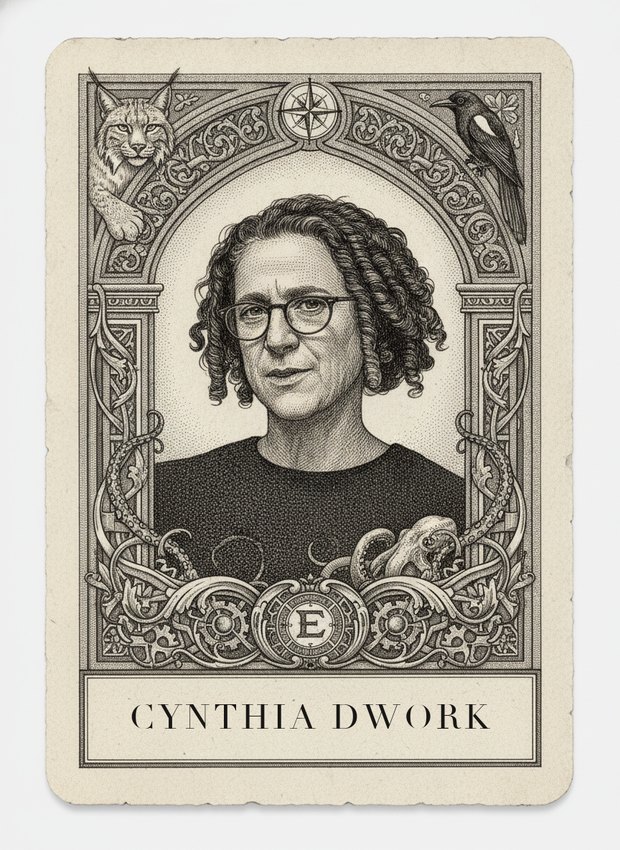
The 2020 Census's move to formal privacy is, almost literally, Dwork's framework deployed at national scale: differential privacy, which she co-invented in 2006 with McSherry, Nissim, and Smith, is precisely the machinery the Census Bureau adopted after its own internal reconstruction attack proved that published tabulations could rebuild individual records. She would recognize the reconstruction result immediately as confirmation of the theorems she spent two decades proving — that any sufficiently rich set of accurate statistics permits reconstruction — and she has the exact vocabulary, the privacy-loss budget, the composition theorems, needed to allocate accuracy across statistics rigorously rather than by political horse-trading. No other carrier on this list originated the formal apparatus the Bureau actually adopted; this is her problem by direct authorship.
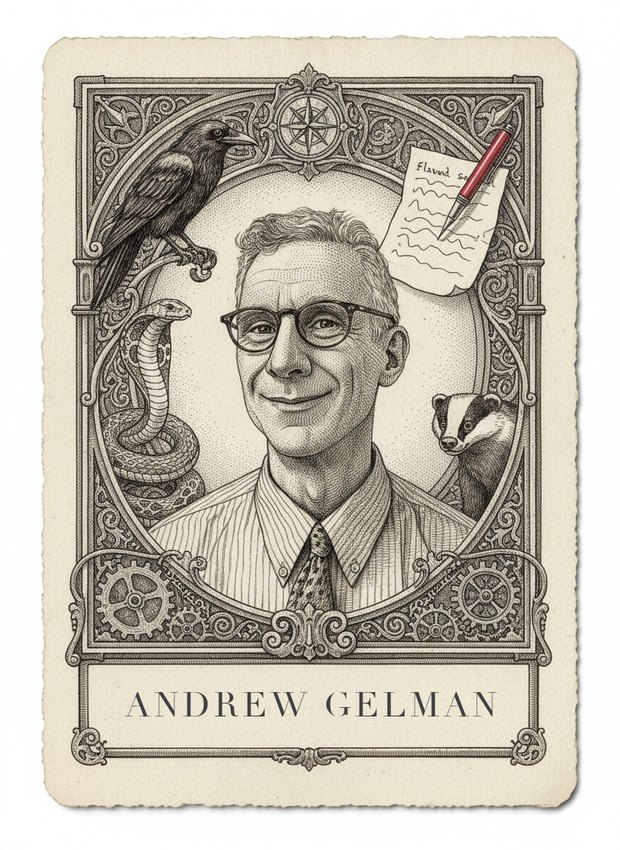
Gelman's applied Bayesian statistics, developed through decades of work on hierarchical models, election forecasting, and Stan, is exactly what is needed to communicate noisy small-area census counts honestly rather than as false-precision point estimates, and he publicly engaged with the 2020 census disclosure-avoidance controversy as it unfolded, weighing in on the tension between redistricting lawyers' demand for exact counts and the Bureau's privacy obligations. His hierarchical-modeling instinct — borrow strength across related small areas rather than trusting each noisy cell in isolation — is a genuinely constructive technical response to the accuracy-versus-confidentiality tradeoff, and his applied-workflow rigor about honestly reporting uncertainty is precisely the discipline the noisy-count rollout needed and often lacked.
In the mind map
The same ideas, as concepts rather than history — in John's ML knowledge map.
30 figures are scored on this problem. Draw it in a battle to see where you land.