It is 2008, and the sampling revolution has hit a wall of its own: MCMC is exact in the limit but the limit never arrives when the model has millions of latent variables and the corpus has billions of words — the chain would need geological time. Trade exactness for reach: recast posterior inference as optimization, fitting the closest tractable distribution to the true posterior and bounding what the approximation gives up. Make it stream, so the fit updates from minibatches without revisiting the archive. Then be honest about the known sin — variational approximations understate uncertainty. Get it wrong and every large-scale probabilistic model reports intervals systematically too narrow, a whole literature of overconfidence dressed in Bayesian clothing.

Allen's foundational work on optimizing compilers, developed at IBM from the 1950s through the 1970s and recognized as the first woman to receive the Turing Award, gave computer science rigorous techniques for automatically transforming programs into more efficient executable code, important infrastructural work with essentially no direct bearing on the statistical mathematics of variational Bayesian inference. Her optimization techniques targeted program transformation and execution efficiency, a different sense of optimization than fitting a tractable probability distribution to an intractable posterior. Allen's career, centered on compiler theory and high-performance computing, never engaged Bayesian statistics or the specific streaming web-scale text-corpus problem the 2008 revolution addressed. The connection here is best described as thematic proximity rather than any substantive technical or historical bridge to the actual 2008 web-scale posterior problem.
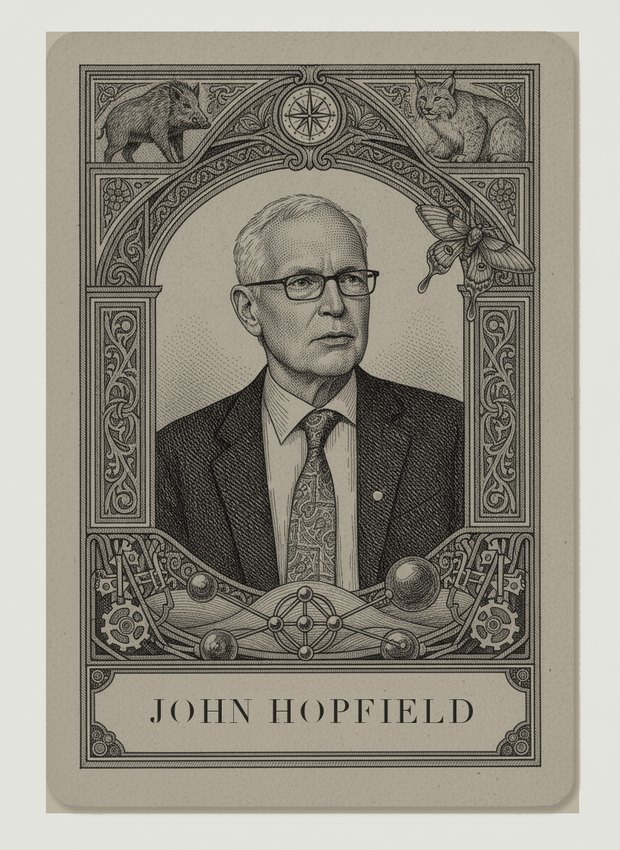
Hopfield's 1982 energy-based neural networks, drawing directly on statistical mechanics and the physics of spin glasses, share the same free-energy formalism that gives variational inference its name and its mathematical structure: minimizing a variational free energy is, at bottom, the same optimization framework Hopfield used to characterize how energy-based systems settle into stable states. That shared statistical-mechanics vocabulary gives Hopfield real, if indirect, technical proximity to the core mathematics the problem describes. But Hopfield's own research targeted associative memory and pattern completion rather than Bayesian posterior approximation, and he never engaged the specific streaming, web-scale text-corpus engineering problem that motivated the 2008 variational inference breakthrough directly. That is a real if partial methodological echo rather than direct participation in the actual 2008 breakthrough, which was built by others working the specific problem directly.
Battle #104 · 8/10/2026, 11:38:02 AM · this result is deterministic: the same two personas on this problem always resolve the same way.