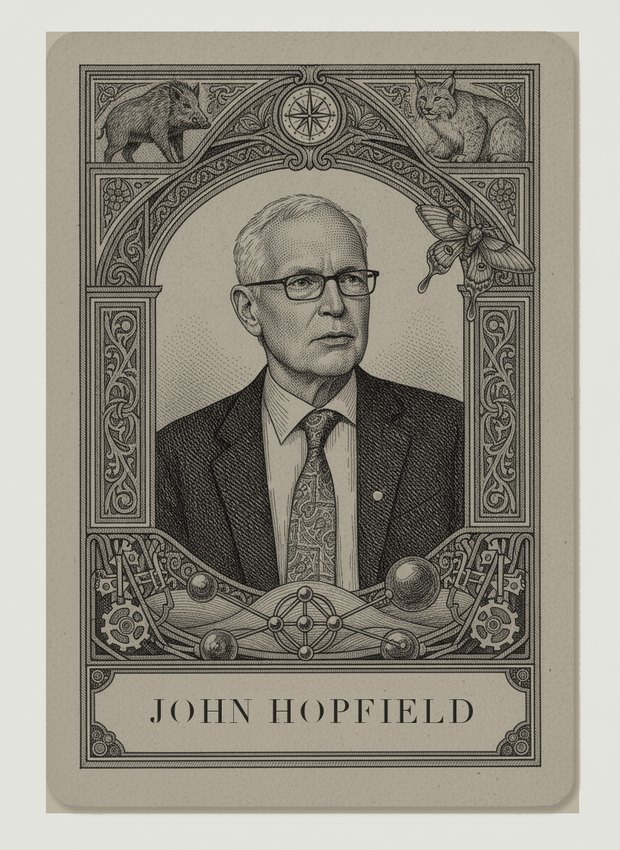
John Hopfield
Energy-based neural networks; attractor memory; Nobel 2024
Played by Ryan
Strongest on
Battles
Thirty percent chance of rain W Frances Allen
The posterior at web scale W Noam Chomsky
The pixel you cannot see W Frances Allen
Sequence the robot's actions
Life and career
John Hopfield was born in Chicago in 1933 into a household where physics was the family trade — both of his parents were physicists — and he spent the first half of his career as an entirely conventional and very successful condensed-matter theorist. He took his PhD at Cornell in 1958, joined Bell Laboratories, and made his name on the interaction of light with matter in solids: his early work on how a photon couples to an excitation in a crystal to form a mixed light-matter quasiparticle is standard material, and the polariton picture he developed still carries his name in the literature. He held appointments at Berkeley and then at Princeton's physics department. By the late 1960s he was, by any external measure, a settled and eminent solid-state physicist.
What makes his arc interesting is that he kept walking away from settled ground. In the early 1970s he turned to molecular biology and asked a question no one had posed sharply: how does a cell copy DNA or translate a protein with an error rate far lower than the underlying thermodynamics of binding seems to allow? His 1974 answer, kinetic proofreading, showed that a biochemical pathway can buy accuracy by burning free energy in an irreversible discard step — spending ATP to get a second, independent look at the substrate. It is a beautiful piece of physical reasoning about biology, and it would be a career for most people. It was, for Hopfield, an intermediate stop.
In 1980 he moved to Caltech as a professor of chemistry and biology, and it was there that he wrote the 1982 paper that eventually took him to Stockholm: "Neural networks and physical systems with emergent collective computational abilities," published in PNAS. The paper's audience was, deliberately, physicists. Hopfield's argument was that a network of simple two-state units with symmetric connections is formally a spin system, that it therefore has an energy function, and that its dynamics must run downhill in that energy. Memories are the minima. Recall is relaxation. That reframing gave the statistical mechanics community a rigorous, familiar-looking handle on neural computation, and within a few years the tools of spin-glass theory — replica methods, phase diagrams, capacity calculations — were being turned loose on learning machines. Hopfield helped found Caltech's Computation and Neural Systems doctoral program in the mid-1980s, one of the first institutional homes for what we would now call computational neuroscience. He returned to Princeton in 1997, in molecular biology, and later served as president of the American Physical Society. In 2024 he shared the Nobel Prize in Physics with Geoffrey Hinton for foundational work on machine learning with artificial neural networks.
Key contributions
The Hopfield network is worth stating precisely because its economy is the point. Take *N* binary units *s_i* ∈ {−1, +1} and a symmetric weight matrix *W* with zero diagonal. Define the energy *E* = −½ Σ_ij *W_ij s_i s_j*. Update units asynchronously by the sign of their local field. Because *W* is symmetric, every single-unit flip either lowers *E* or leaves it unchanged, so *E* is a Lyapunov function and the dynamics provably converge to a fixed point. That is the whole theorem, and its consequences are large: the network has no external clock, no supervisor, no readout stage. Computation *is* the relaxation.
To store patterns, Hopfield used a Hebbian outer-product rule, *W* ∝ Σ_μ ξ^μ (ξ^μ)^T over the stored patterns ξ^μ. Each stored pattern becomes (approximately) a local minimum with a basin of attraction around it, so a corrupted or partial input flows to the nearest stored memory. This is content-addressable memory: you retrieve by resembling, not by pointing at an address. Hopfield's own simulations put the usable capacity at roughly 0.15N patterns before recall degrades; the subsequent statistical-mechanics analysis by Amit, Gutfreund and Sompolinsky pinned the critical load near 0.138N and mapped the full phase diagram, including the spurious mixture states — spontaneously created attractors that are superpositions of stored memories and correspond to nothing you put in.
The second major contribution is the optimization program he developed with David Tank in the mid-1980s. If a network's dynamics minimize an energy function, then you can run the construction backwards: write your objective and constraints *as* an energy function, wire up the corresponding network, and let it settle. They demonstrated this on combinatorial problems including the traveling salesman, using continuous-valued analog units with a gain parameter, so the network descends a smoothed landscape that sharpens toward the discrete problem. This is the ancestral form of an idea that keeps returning — continuous relaxation of a discrete problem, annealing a temperature or gain to avoid poor local minima, and treating the constraint structure as part of the physics rather than as a separate feasibility check.
The through-line across all three phases of his career — polaritons, proofreading, attractor memory — is a habit of asking what *collective* behavior emerges from many simple interacting parts, and refusing to accept that the answer requires a homunculus doing the coordinating.
In battle
Hopfield is one of the most extreme specialists on the roster, and the numbers say so bluntly: across a hundred problems he averages 20.6 with a median of 18, only three problems above 80, and sixty-six at or below 20. He is not a broad player. He is a single, devastating instrument.
His peak is "The memory that completes the pattern" at 99 — as close to a self-portrait as the game contains. That problem asks for exactly the 1982 construction, and the game's explanation notes both halves of the achievement: the Lyapunov convergence argument and the capacity limit at roughly 0.14N before recall collapses into spurious mixtures. Immediately behind it are two optimization problems that are really the Hopfield–Tank program in disguise: "Climb out of the local trap" at 88 and "Cool it slowly" at 85. Both reward the instinct that a hard search problem should be posed as an energy landscape and escaped by controlling an effective temperature. It is worth noticing that his single highest *category* average is optimization at 55.0 — but on only two problems, both of them landscape problems. That is what a spike looks like in the aggregate statistics.
He carries a secondary tier that is respectable rather than dominant: "The gradient that vanishes" (68) and "XOR" (66), where he counts as a founding member of the tradition without owning the fix; "Cut the image into things" (45), where spectral and energy-minimization formulations of segmentation share his DNA; and "Sixty thousand digits" (45), where he is present at the birth of the field that solved it but did not build the solution. His perception average of 46.2 across fifteen problems is his most reliable broad strength, and it comes from this family — vision problems with an energy or relaxation formulation.
The losses are clean and instructive. Classical statistics annihilates him: "Three species of iris" at 3 is his floor, and the game's explanation is unusually blunt that attractor dynamics have no analog to a discriminating axis. The same reasoning sinks "The paradox in the admissions data" (4) and "The therapy the trial reversed" (4) — causal inference asks about counterfactuals and confounding, questions an energy function cannot even express — and "How high must the dike be?" (4), which is extreme-value extrapolation, a tail-probability problem with no landscape in it. "The odds of default" (5) wants calibrated probabilistic prediction from tabular covariates; "Beat the world champion" (5) wants brute-force game-tree search with a hand-tuned evaluation function, which is the opposite of emergent collective relaxation. His category floors — experimental design 8.0, computability 8.0, testing 11.5, systems 11.0 — trace the same boundary.
Play Hopfield when the problem can be written as "find the minimum of a landscape" or "complete this from a fragment." Bench him the moment the problem involves inference from data about the world rather than dynamics on a network.