classification
XOR
It is 1969, and four points in the plane — two labeled one class, two the other, arranged as exclusive-or — are about to reshape the funding of an entire field. No straight line separates them; the single-layer perceptron, the great hope of machine intelligence, provably cannot solve this toy. Solve it — by transforming the representation until the classes come apart — and explain what the public demonstration of this failure did: it helped freeze neural-network research for the better part of two decades. The stakes here are historical, not just technical. Get the lesson wrong and you either overclaim for a method that has a hard wall, or abandon a whole paradigm over a limitation that richer representations dissolve. Four points decided who got money for twenty years.
Who this problem belongs to
The two figures whose methods fit it best, out of 71 in contention.
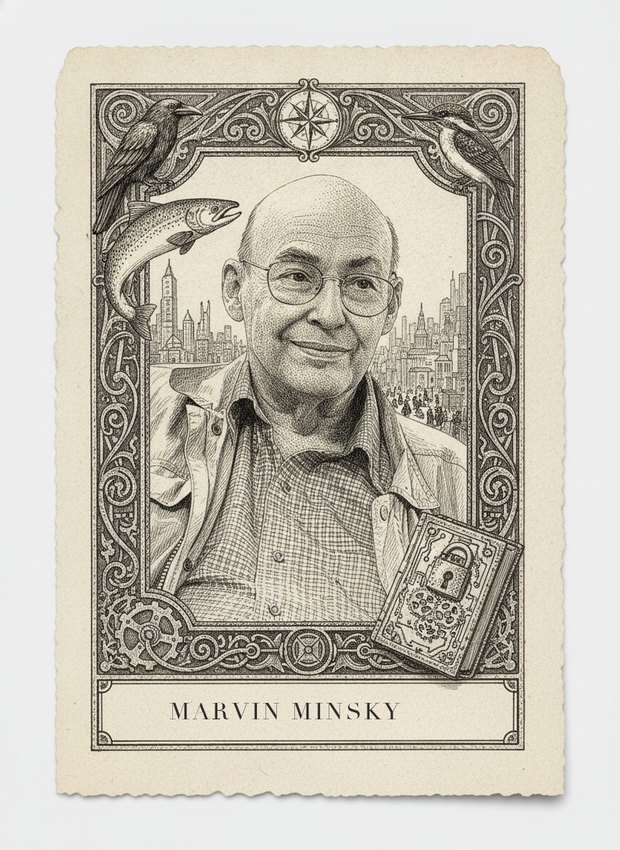
This problem is Minsky's problem. Perceptrons (1969, with Papert) proved with mathematical finality that no single-layer threshold unit computes parity — the XOR result is theirs, established by careful group-invariance arguments, not experiment — and the book's reception did exactly what the problem describes: it helped redirect funding from neural networks for nearly two decades, an outcome Minsky variously defended and lamented. He is the only carrier who both owns the theorem and shaped its historical consequence. He also knew multilayer networks escape the limitation; the book's pessimism was about whether the extension could be trained, a judgment history overturned but which was a genuine open question in 1969. He had himself built a learning machine (SNARC, 1951), so his critique came from inside. On methods, results, and history simultaneously, no one else comes close.
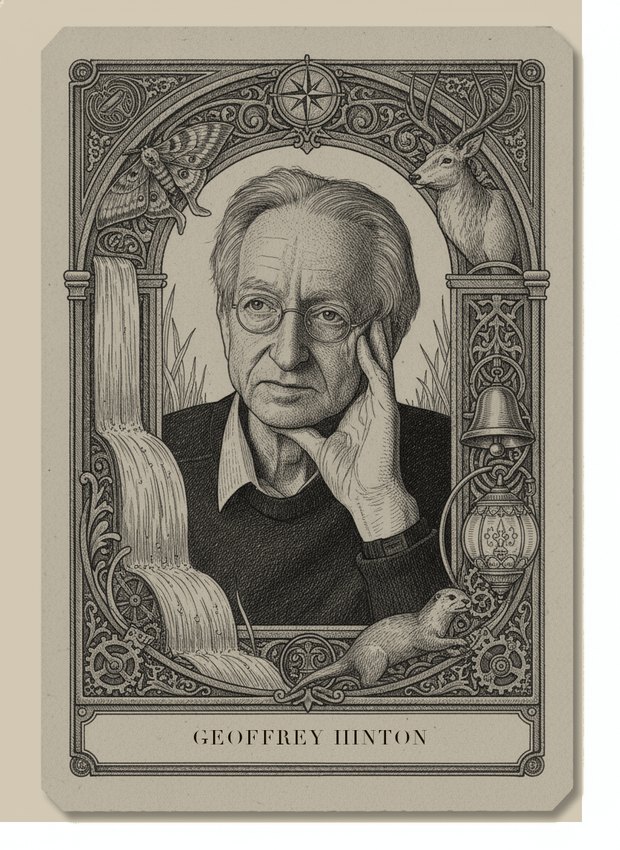
Hinton is the person who answered this problem historically. Through the frozen years he kept faith with distributed representations, and the 1986 Rumelhart-Hinton-Williams backpropagation paper used XOR as its opening demonstration: a two-layer network learns the hidden features — effectively AND and OR units — whose combination separates the parity classes. That is the exact 'transform the representation until the classes come apart' this problem demands, achieved by learning rather than hand-design, which was the whole contested point. He also embodies the historical half: his career spans the freeze, the 1980s connectionist revival, the second winter, and the 2012 vindication, giving him unmatched standing to explain what the Minsky-Papert episode did to funding and to intellectual fashion — he lived on the losing side and then won. Methods and history both converge here; near-maximal fit.
Fought here
In the mind map
The same ideas, as concepts rather than history — in John's ML knowledge map.
71 figures are scored on this problem. Draw it in a battle to see where you land.