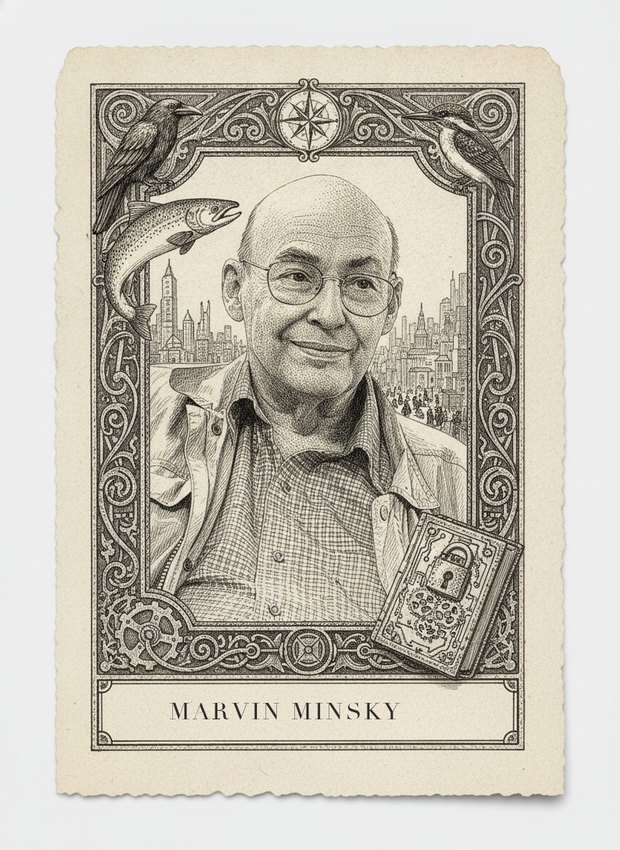
Marvin Minsky
Frames, society of mind; the perceptron critique
Strongest on
In the mind map
The same ideas, as concepts rather than history — in John's ML knowledge map.
Life and career
Marvin Minsky built a neural network learning machine in 1951, out of vacuum tubes and surplus parts from a B-24 bomber, with a clutch mechanism that adjusted forty analog weights as a simulated rat learned its way through a maze. He was a Princeton graduate student at the time and the machine, SNARC, is generally counted as one of the first hardware neural network learners ever constructed. Eighteen years later he co-authored the book that is widely blamed for stopping neural network research for a generation. Any account of Minsky that misses that arc misses the man.
Born in New York in 1927 to a physician father and an activist mother, Minsky attended the Fieldston School and the Bronx High School of Science, served briefly in the Navy at the end of the war, and took his BA in mathematics at Harvard in 1950 and his PhD at Princeton in 1954, on neural nets and the problem of learning. At Princeton he overlapped with John Nash and with John McCarthy; he attended the 1956 Dartmouth workshop as one of its four organizers. In 1958 he joined MIT, and with McCarthy founded the group that became the MIT Artificial Intelligence Laboratory — an institution whose influence on computing culture is hard to overstate, encompassing robotics, the hacker ethos, LISP machines, and a long line of students including Ray Kurzweil, Gerald Sussman, Patrick Winston, and Danny Hillis.
Minsky's MIT was a place of physical machines as well as theories. He and Seymour Papert built robot arms and vision systems; Minsky invented and built the confocal scanning microscope in 1957, a genuinely important optical instrument now standard in biology labs, and patented a head-mounted graphical display. He collaborated with Papert on Logo and on educational constructionism, and he consulted on *2001: A Space Odyssey*. He won the Turing Award in 1969 and the Japan Prize in 1990.
He was a provocateur by temperament — quick, funny, deliberately unsettling, fond of pushing an argument past where his interlocutor was comfortable. Some of his provocations aged badly, and his later life included the discomfort of having been named among the many academics who accepted travel funding from Jeffrey Epstein, an association that has been publicly examined since his death in 2016. On the science, the controversy that defines him professionally is *Perceptrons*. Minsky's own position on it was more complicated than the caricature: he had built a learning machine himself, he knew perfectly well that multilayer networks escaped the limitation the book proved, and in later years he both defended the book's mathematics and expressed regret about the funding consequences. But the consequences were real, and he was the most visible person attached to them.
Key contributions
**Perceptrons (1969, with Seymour Papert).** The book is a serious piece of mathematics and deserves to be read as one. Its subject is what a *single-layer* threshold predicate can compute when each unit sees only a restricted portion of the retina. Using group-invariance arguments — averaging predicates over the symmetry group of the input space — Minsky and Papert proved that certain functions cannot be computed by a perceptron with bounded-diameter or bounded-order predicates. Parity (XOR is its two-input case) requires order equal to the whole input; connectedness likewise cannot be computed by any diameter-limited perceptron. These are theorems, not experiments, and they stand. What did not stand was the book's more speculative pessimism about extending the results to multilayer networks — the authors suspected the extension would prove "sterile," and the field read this as a verdict. Backpropagation, popularized in the mid-1980s, showed otherwise.
**Frames (1974).** "A Framework for Representing Knowledge" proposed that memory is organized not as isolated logical assertions but as *frames*: structured stereotypes for situations, with named slots, default fillers, and attached procedures that fire when a slot is filled or violated. Walk into a room and you instantiate a room-frame, already expecting walls, a ceiling, and a door; the defaults do enormous inferential work and get overridden only when the world objects. Frames are the direct ancestor of object-oriented knowledge representation, of schemas and scripts in cognitive psychology (Schank and Abelson's scripts are close cousins), of semantic networks and description logics, and — arguably — of the class-with-defaults idea in programming languages. Frames also anticipate the nonmonotonic reasoning problem: default fillers are conclusions you retract when contradicted.
**The Society of Mind (1986).** Minsky's most ambitious and least formal work argues that intelligence is not produced by one clever mechanism but by a large federation of small, individually unintelligent agents, each doing something narrow, organized into competing and cooperating hierarchies. Mind, on this account, is an administrative achievement rather than an algorithmic one. The book has no equations and is often dismissed for that, but it stated clearly a thesis that modular and mixture-of-experts architectures, and multi-agent systems generally, keep rediscovering: that specialization plus arbitration can produce behavior no component understands. *The Emotion Machine* (2006) extended the argument, treating emotions as alternative "ways to think" — resource-allocation regimes rather than decoration on cognition.
Alongside these, Minsky did early work on computational geometry with Papert, on Turing machines and computability, on robotics and machine vision, and on what he called "the problem of common sense" — the observation, still largely unaddressed, that ordinary human reasoning depends on a vast, unformalized stock of everyday knowledge.
In battle
Minsky carries a hundred problems at a mean of 24 and a median of 20, with one towering result and a broad middle band. That single dominant score is **XOR** (P024) at 96 — the highest single-problem score he has and one of the most decisive in the game. The reason is that this problem is not merely adjacent to his work; it *is* his work, three times over. He owns the theorem (the parity impossibility is his and Papert's, proved by group-invariance argument rather than experiment). He shaped its historical consequence (the funding redirection the problem describes). And he had built a learning machine himself in 1951, so the critique came from inside the connectionist tradition rather than from a hostile outsider. No other figure in the roster holds methods, results, and historical consequence on the same problem simultaneously.
After that peak, his strength is broad rather than sharp. **The imitation game, scored** (P259) at 76 puts him among the field's founding definers of machine intelligence. Then a cluster in the 55–62 range that maps cleanly to symbolic AI: **Color the map, meet the constraints** (P188) and **Let the machine find the proof** (P195) at 62, **The memory that completes the pattern** (P242) and **A computer shared by fifty** (P245) at 56, **Climb out of the local trap** (P189) and **Sequence the robot's actions** (P190) at 55. His best categories are `search` (41.6 across sixteen problems) and `nlp` (41.0) — the former because heuristic search over symbolic state was the MIT AI Lab's core method, the latter because frames and scripts were the dominant pre-statistical account of how a machine could understand a sentence in context.
Notice something specific about his classification mean: 19.8 across seventeen problems, which is low in absolute terms but roughly double McCarthy's on the same category. Minsky is not blind to pattern recognition the way a pure logician is — he built vision systems and a learning machine — he simply lacks the statistical apparatus to do it well. Similarly `perception` at 32.2 is respectable, reflecting real work on machine vision.
His floor is the same floor most symbolic AI figures hit. He scores 4 on **Sample from the impossible posterior** (P212), **The posterior at web scale** (P213), **The paradox in the admissions data** (P214), and **The therapy the trial reversed** (P215), and 3 on **Calculus for a jagged path** (P216) and **How high must the dike be?** (P217). MCMC, scalable Bayesian inference, Simpson's paradox, confounding, stochastic calculus, extreme value theory: none of these have any purchase on frames, agents, or heuristic search. His `testing` mean of 6.5 and `regression` mean of 8.5 are the numerical signature of a career that never needed a standard error.
There is a delicious irony in how he plays. Send Minsky against a modern deep learning figure on **XOR** and he wins overwhelmingly, because the impossibility theorem is his — the very result whose overreading he is blamed for. Send him against almost any statistician on anything involving data and uncertainty and he is dismantled. Both outcomes are historically accurate, and a student who understands why gets the whole shape of the first AI winter for free.