perception
The memory that completes the pattern
It is 1982 at Caltech, and a physicist is proposing that memory recall is a phenomenon of collective physics: store patterns in a network of simple binary units with symmetric connections, and retrieval becomes relaxation — present a corrupted fragment of a stored face or word, let the dynamics run downhill on an energy function, and the network settles into the nearest stored pattern, whole. Make it rigorous: prove the dynamics converge, compute the storage capacity — how many patterns before memories merge into spurious blends — and characterize the failure at the limit. The prize is a bridge: spin-glass physics, neuroscience, and computation speaking one language, and the credibility that draws physicists into neural networks — years before the field's revival needs them.
Who this problem belongs to
The two figures whose methods fit it best, out of 56 in contention.
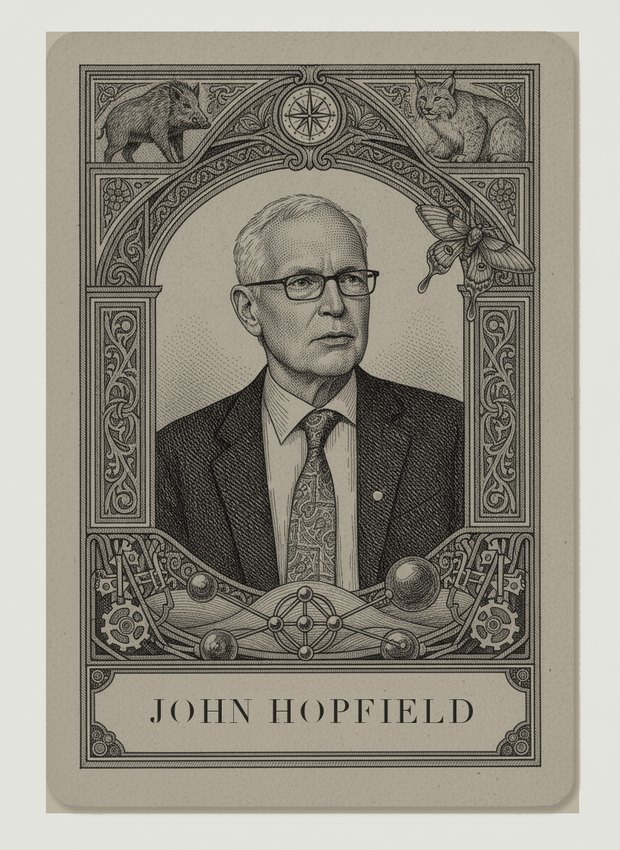
This is not a hypothetical for Hopfield; it is his own 1982 paper, 'Neural networks and physical systems with emergent collective computational abilities,' written while he was a Caltech biophysicist moving between chemistry and neuroscience. He proposed exactly this: symmetric binary-unit networks whose dynamics minimize an energy function borrowed from spin-glass physics, so that a corrupted input relaxes downhill into the nearest stored memory. He proved convergence using a Lyapunov argument and, with Hopfield-Tank follow-up work, analyzed storage capacity, finding roughly 0.14N patterns before recall degrades into spurious mixtures. The paper's real achievement was sociological as much as mathematical: it gave statistical physicists a rigorous reason to take neural computation seriously, seeding the 1980s connectionist revival that Hinton and others built on directly.

Amari is the closest rival claim to priority here: his 1972 paper 'Learning patterns and pattern sequences by self-organizing nets of threshold elements' already analyzed randomly connected networks storing associative memories via correlation-based weights, including an early capacity estimate, a full decade before Hopfield's paper. His subsequent information-geometric framework gives a natural differential-geometric language for characterizing the space of achievable network states and their statistical efficiency, directly relevant to rigorously computing storage capacity. Where Hopfield supplied the crisp physics metaphor (energy landscapes, spin glasses) that made the result legible to physicists and triggered the field's revival, Amari had the mathematical content earlier but without that framing's persuasive power, which is why history credits Hopfield with the breakthrough Amari substantially anticipated.
Fought here
In the mind map
The same ideas, as concepts rather than history — in John's ML knowledge map.
56 figures are scored on this problem. Draw it in a battle to see where you land.