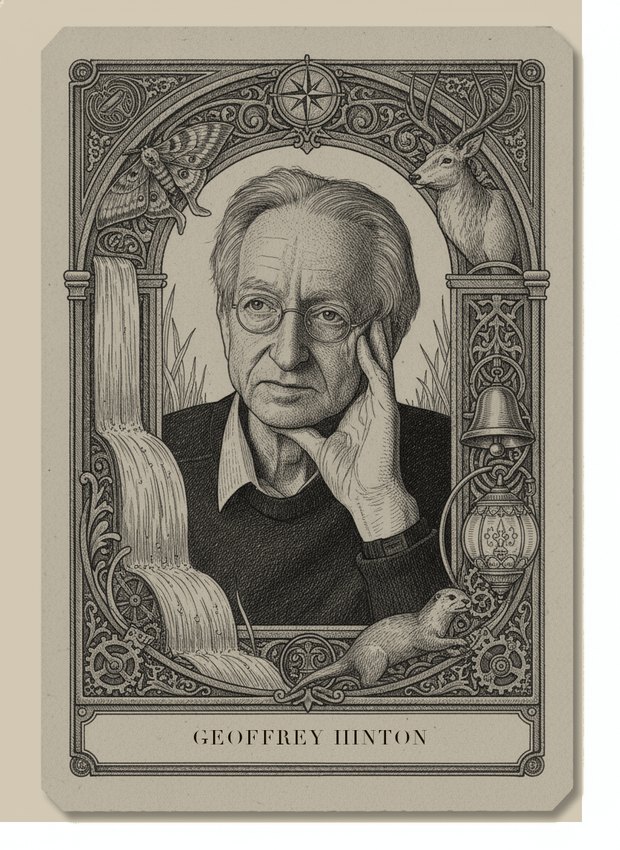
Geoffrey Hinton
Backprop popularizer; Boltzmann machines; deep learning revival; Nobel 2024
Strongest on
In the mind map
The same ideas, as concepts rather than history — in John's ML knowledge map.
Life and career
Geoffrey Hinton's career is the clearest case in modern science of someone being wrong about the timeline and right about everything else.
He was born in London in 1947 into a family with an intimidating intellectual pedigree — his father was a Fellow of the Royal Society, and the logician George Boole is among his ancestors — and he arrived at his subject by a wandering route. At Cambridge he moved between physiology, philosophy, and physics before finishing in experimental psychology in 1970. That degree matters: Hinton's lifelong question is not "how do we build a classifier" but "how does a brain represent anything," and he has always treated machine learning as a theory of mind that happens to run on silicon. He took his PhD in artificial intelligence at Edinburgh in 1978, working on neural networks at a moment when the symbolic camp had won the argument decisively and neural approaches were regarded, in his own later telling, as a discredited enthusiasm.
A postdoc at UC San Diego put him alongside David Rumelhart and James McClelland in the group that produced the *Parallel Distributed Processing* volumes — the manifesto of 1980s connectionism. He then spent five years at Carnegie Mellon before moving to the University of Toronto in 1987, a decision shaped in part by his unwillingness to have his work funded by the U.S. military. Toronto became the base for the next three and a half decades, with an interlude in London founding the Gatsby Computational Neuroscience Unit at UCL. It also became, improbably, the place where deep learning was kept alive. Through the 1990s and early 2000s the field's mainstream had moved to kernel methods and graphical models with strong theoretical guarantees; Hinton's students and a small international network — LeCun in New York, Bengio in Montreal — kept training neural networks anyway, mostly on the argument that the models were right and the data and hardware would eventually catch up.
They did, and quickly. In 2012 his students Alex Krizhevsky and Ilya Sutskever entered a deep convolutional network into the ImageNet competition and won by a margin that ended the argument in a single afternoon. Google acquired the three-person company they formed, and Hinton spent the next decade splitting his time between Toronto and Google Brain. He shared the 2018 Turing Award with Yoshua Bengio and Yann LeCun, and in 2024 he shared the Nobel Prize in Physics with John Hopfield. In May 2023 he resigned from Google explicitly so that he could speak without institutional constraint about the risks of the technology he had spent fifty years building — a turn that surprised many observers and, from the inside, was continuous with a career spent taking the implications of his own models seriously. He is also known for a small physical detail that anyone who has attended his talks remembers: a longstanding back condition means he does not sit down.
Key contributions
**Backpropagation and distributed representations (1986).** Hinton did not invent backpropagation — Werbos had it in 1974, and reverse-mode differentiation is older still — but the Rumelhart–Hinton–Williams *Nature* paper is what made it matter, because it made an argument rather than an announcement. The claim was that gradient descent through hidden layers causes the network to *invent* intermediate representations that no one specified, and that those representations are distributed: a concept is a pattern of activity across many units, not a dedicated symbol. His family-tree example, in which a network trained on relational triples spontaneously discovers units coding for nationality and generation, is still one of the cleanest demonstrations in the literature of what "learned features" means.
**Boltzmann machines and energy-based learning.** With Terry Sejnowski, Hinton built a stochastic network whose units sample from a Boltzmann distribution over a Hopfield-style energy function, giving a generative model that can be trained by a strikingly simple rule: the gradient of the log-likelihood is the difference between correlations measured in a data-clamped phase and correlations measured in a free-running phase. The restricted version, in which visible and hidden units form a bipartite graph, makes the clamped phase exact and the free phase tractable with block Gibbs sampling. His contrastive divergence approximation (2002) truncated the sampling chain after one step and turned RBMs into a practical tool.
**Deep belief networks and greedy layerwise pretraining (2006).** Stacking RBMs and training them one layer at a time, then fine-tuning the whole stack with backprop, gave the first widely reproduced recipe for training deep networks. The pretraining trick has since been largely abandoned — better initialization, ReLUs, and normalization made it unnecessary — but it is the result that restarted the field's belief that depth was achievable.
**The 2012 cluster.** Dropout, which regularizes by randomly zeroing units during training and can be read as an efficient approximation to averaging an exponential ensemble of subnetworks. The deep-network replacement of Gaussian-mixture acoustic models in speech recognition, a multi-lab result that cut error rates on production systems and converted industry before ImageNet did. And AlexNet, which combined depth, GPUs, ReLUs, and dropout to win ImageNet by roughly ten percentage points.
**Everything else.** Mixtures of experts (1991, with Jacobs, Jordan and Nowlan) — the routing architecture now at the heart of frontier-scale language models. The Helmholtz machine and wake-sleep algorithm, an early variational autoencoder in all but name. t-SNE with Laurens van der Maaten, the visualization method every practitioner has used. Knowledge distillation, training a small model on a large model's soft output distribution. Capsule networks, an attempt to encode part-whole geometry that has not caught on but is a characteristic Hinton move: when the field consolidates around his idea, he starts attacking it.
In battle
Hinton has one of the strongest all-round profiles in the game — mean 36.5, median 30, eight problems at 80 or above and fourteen at 70 or above — but the shape still says *specialist with unusual reach* rather than generalist.
His dominant band is a clean statement of what deep learning actually did. Three problems sit at 98: "A thousand categories" and "A thousand categories, one bet," both ImageNet, where the game notes he is docked from 100 only because Krizhevsky and Sutskever wrote the winning code; and "Replace the acoustic model," the speech-recognition conversion that preceded ImageNet and is arguably the more decisive commercial event. Behind them: "The million-parameter valley" (93), non-convex optimization at scale, where his position is that the landscape's terrors were overstated and you should just run SGD; "XOR" (92) and "Sixty thousand digits" (92), the founding demonstrations of hidden-layer learning; and, at 80 each, "The memory that completes the pattern" and "The gradient that vanishes," where he is a major contributor rather than the author. His category profile follows: perception 49.1 across fifteen problems, classification 41.1 across seventeen, NLP 40.5 across thirteen, high-dimensional 39.3 across ten. Anywhere the answer is *learn the representation from data instead of engineering the features*, Hinton is a strong play.
The losses are more interesting than the wins because they are so consistent in kind. His single lowest score, "The first randomized trial" at 4, is 1948 clinical-trial design, and the game's explanation is unsparing: nothing in his published record addresses randomization, treatment assignment, or causal inference in medicine, and his toolkit assumes a data-rich regime that a carefully randomized small cohort is definitionally not. The same failure mode produces "Three species of iris" (5) and "The same patients, measured again and again" (7) — a repeated-measures design problem where the whole difficulty is correlated errors within subjects, a question a feedforward network is not built to ask. His experimental-design average of 6.0 and testing average of 12.0 are the two worst categories on his sheet, and they are the same weakness counted twice.
The other cluster of losses is about *machinery rather than statistics*. "The variables that must be whole" (8) is integer programming, where discreteness eliminates the gradient. "The compiler that beats the coder" (7) is program synthesis and systems engineering, matching his systems average of 12.5. And "Just look at the neighbors" (7) is the game's recurring rebuke to every deep learner: a nonparametric method with no training, no representation, and an asymptotic guarantee he cannot match.
Play Hinton when there is a great deal of data and the features are the problem. Bench him when there are forty patients, a randomization scheme, and a question about cause.