classification
Sixty thousand digits
It is the era when handwriting must be read by machines — postal codes, bank checks — and error is expensive at national scale. You are handed sixty thousand labeled twenty-eight-by-twenty-eight images of handwritten digits and told to squeeze out every last percentage point of accuracy; hand-crafted features are allowed, but the frontier is learning them. Each tenth of a percent is millions of misrouted letters or misread checks in deployment. Build the classifier that wins on data at this scale. Get it wrong and an automated mail or banking system quietly errs by the millions, eroding the trust that justified automation — this benchmark became the proving ground where learned features finally beat hand-engineering, and getting it right rewrote what vision systems are made of.
Who this problem belongs to
The two figures whose methods fit it best, out of 71 in contention.
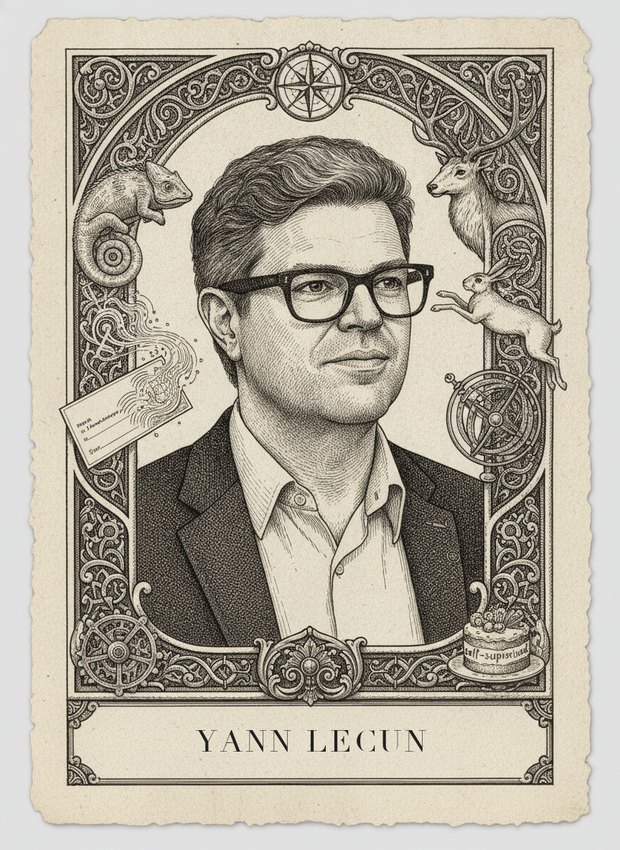
This is LeCun's problem in the most literal sense available to history: he co-created the MNIST dataset, and the benchmark's framing — postal codes, bank checks, learned features beating hand-engineering — describes his actual career at Bell Labs. LeNet (1989-1998) combined convolution, weight sharing, subsampling, and end-to-end backpropagation training into the architecture that won this contest and defined the template for modern vision; his check-reading system was deployed commercially, processing a significant fraction of U.S. checks in the late 1990s — the exact millions-of-documents stakes the problem describes. The 1998 'Gradient-Based Learning Applied to Document Recognition' paper is simultaneously this benchmark's founding document and its answer key, systematically comparing his convnets against SVMs, boosting, and nearest neighbor. Every other competitor here is playing on his field, by his rules, against his machine. Near-perfect applicability.
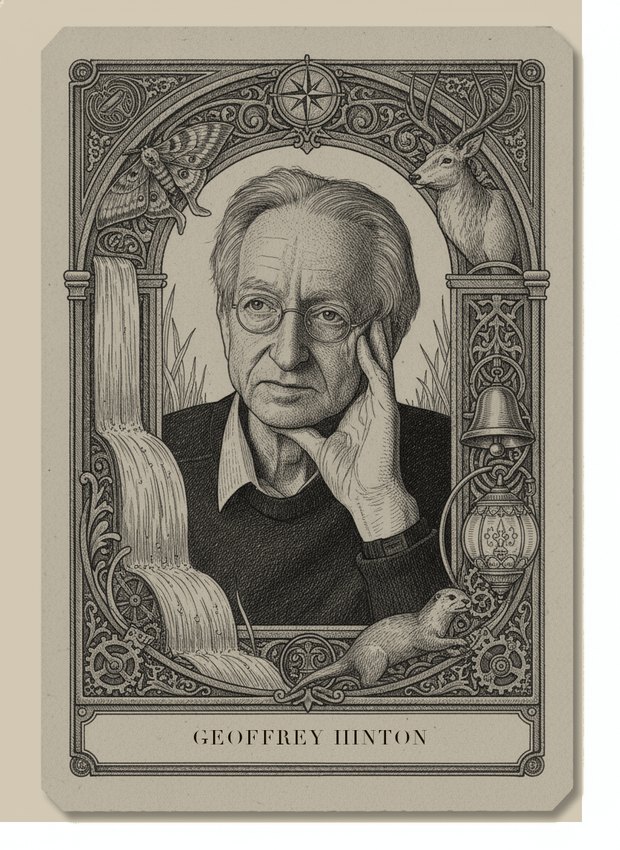
Hinton's fingerprints are on nearly every method that made this benchmark famous. He co-popularized backpropagation (1986), the algorithm that trains every competitive MNIST network; his students and collaborators drove learned features from curiosity to dominance; and MNIST itself was his lab's favorite test tube — deep belief networks (2006) staged the deep-learning revival on these very digits, and dropout (2012) was demonstrated on them too. Given this problem he would do what he actually did: train multilayer networks with distributed representations, use unsupervised pretraining or stochastic regularization to squeeze generalization from 60,000 examples, and reach the top tier of the leaderboard. The only reason he sits a hair below LeCun is specificity: convolutional weight-sharing, the single strongest architectural prior for this task, is his colleague's signature rather than his own.
In the mind map
The same ideas, as concepts rather than history — in John's ML knowledge map.
71 figures are scored on this problem. Draw it in a battle to see where you land.