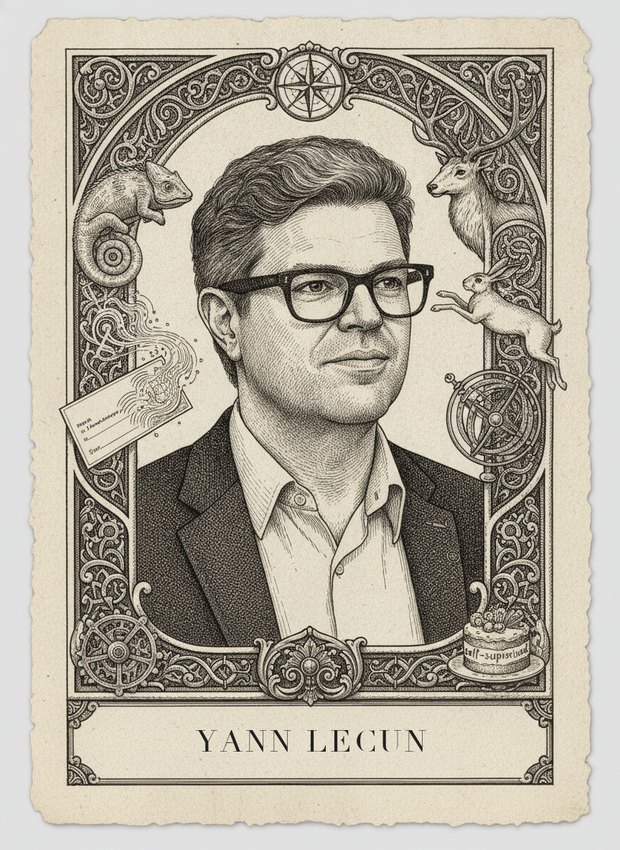
Yann LeCun
Convolutional networks; MNIST; energy-based models
Played by Sophie
Strongest on
Battles
Predict, or explain? L Judea Pearl
The odds of default L Frances Allen
Rebuild the city from vacation photos L Robert Nowak
Which of five models?
In the mind map
The same ideas, as concepts rather than history — in John's ML knowledge map.
Life and career
In the mid-1990s, a substantial share of all paper checks deposited in the United States were read by a neural network. That system was built at Bell Labs by a French engineer who had spent his doctorate on an idea most of his field considered dead.
Yann LeCun was born near Paris in 1960 and trained as an engineer at ESIEE, then took his PhD at the Université Pierre et Marie Curie in 1987 on connectionist learning models. He had encountered the perceptron literature — and the 1969 critique that supposedly buried it — as a student, and drew the opposite conclusion from most readers: the objection was about *training* multilayer networks, and training was an engineering problem, not an impossibility. His thesis work included a variant of backpropagation developed largely independently, and it brought him to the attention of Geoffrey Hinton, with whom he did a postdoc in Toronto in 1987–88.
Then came Bell Labs at Holmdel, New Jersey, from 1988, and the most productive stretch of applied neural network research anyone had yet managed. LeCun had a real problem — read handwritten digits and cursive words off scanned documents, at industrial scale, with an error rate a bank will accept — and an unusual set of colleagues, including Léon Bottou, Yoshua Bengio, Patrick Haffner, Corinna Cortes and Vladimir Vapnik. Out of it came LeNet, developed across roughly a decade of versions, and the MNIST dataset assembled from NIST's handwritten character collections. The 1998 paper "Gradient-Based Learning Applied to Document Recognition" is the summary document: it presents the convolutional architecture, compares it head to head against support vector machines, boosting and nearest neighbors, and — a detail often forgotten — describes graph transformer networks, an end-to-end trainable pipeline in which segmentation, recognition and language modeling are all differentiable and trained jointly. That is a structured-prediction architecture written twenty years before the phrase became fashionable. The check-reading system built on it went into commercial deployment.
The reward for this was a decade in the wilderness. Through the late 1990s and 2000s the field consolidated around kernel methods and probabilistic graphical models, whose theoretical guarantees were far cleaner than anything neural networks could offer, and convolutional networks were regarded as a curiosity that happened to work on digits. LeCun kept going, moved to NYU in 2003 as a professor at the Courant Institute and the Center for Neural Science, helped found NYU's Center for Data Science, and worked on energy-based learning as a unifying framework. In 2013 Facebook recruited him to build FAIR, its research organization, and he became the company's chief AI scientist, splitting time with NYU. He shared the 2018 Turing Award with Hinton and Bengio.
He has since become the field's most prominent internal skeptic of its own dominant paradigm, arguing that autoregressive text prediction cannot on its own produce planning, reasoning, or a usable model of the physical world, and pushing instead for self-supervised world models that predict in a learned representation space rather than in the space of raw observations. He is characteristically willing to say this loudly and to be wrong in public.
Key contributions
**Convolutional networks, made trainable.** Fukushima had supplied the architecture — local receptive fields, weight sharing, pooling. LeCun's contribution was to train the whole stack end to end by backpropagation against a task loss, and to make the resulting system work on real data at production scale. That is a much larger step than it sounds: it required careful initialization, a workable nonlinearity, subsampling that preserves gradient flow, and a great deal of empirical craft, much of which he wrote down in "Efficient BackProp." The result is the template every modern vision system still follows.
**Weight sharing as a statistical argument.** The graduate-level way to state the convolutional prior is as a constraint on the hypothesis class motivated by a symmetry: image statistics are approximately stationary under translation, so the parameters should be tied across position. This cuts the parameter count by orders of magnitude relative to a fully connected layer, which is a variance reduction, and it enforces equivariance, which is a bias you actually want. Convnets work not because they are deep but because their inductive bias matches the symmetry group of the data.
**Second-order methods and pruning.** With Denker and Solla he introduced Optimal Brain Damage, which uses the diagonal of the Hessian to estimate the increase in loss from deleting each weight and prunes the cheapest ones. Modern network compression and sparsification descend directly from it.
**Energy-based models.** LeCun's unifying framework replaces the requirement of a normalized probability distribution with a scalar energy function E(x, y) that scores compatibility between inputs and outputs. Inference is minimization over y; learning is shaping the energy so that correct pairs sit lower than incorrect ones. The point is that the intractable normalizing constant — the thing that makes probabilistic training hard — is often unnecessary, provided the loss you choose actively pushes down on correct answers and up on competitors. Contrastive learning, ranking losses, and structured prediction all fall out of this view.
**Graph and non-Euclidean deep learning.** With Bruna, Zaremba and Szlam he published early work generalizing convolution to graphs via the spectrum of the graph Laplacian, which is a founding paper of the graph neural network literature.
**Self-supervised learning and JEPA.** His current program argues that the bulk of learning must come from prediction on unlabeled data, and that predicting raw pixels is the wrong objective because it wastes capacity on unpredictable detail. Joint embedding predictive architectures instead predict the *representation* of a masked or future portion of the input from the representation of the visible portion, which requires solving the collapse problem — preventing the encoder from mapping everything to a constant — through architectural or regularization means rather than through negative sampling.
In battle
LeCun's profile is a specialist's: mean 28.1, median 19, fifty-three problems at or below 20, but six above 80 and a peak of 99. Within his domain he is close to unbeatable; a step outside it and he falls off a cliff.
"Sixty thousand digits" at 99 is the highest-confidence pairing in his sheet, and the game's explanation is unusually direct: he co-created the dataset, the 1998 paper is simultaneously the benchmark's founding document and its answer key, and the commercial check-reading deployment supplies exactly the millions-of-documents stakes the problem describes. Everyone else on that problem is playing on his field. From there the convolutional family follows: "A thousand categories" (90) and "A thousand categories, one bet" (82), where he supplies the architecture that won even though Hinton's lab ran the winning experiment; "Find every face" (88); "The pattern survives the shift" (85), where he shares the podium with Fukushima; and "The tilted scan" (84), the rotation-and-deformation robustness question that convolution plus pooling was designed for. His perception average of 48.9 across thirteen problems and classification average of 39.1 across seventeen are where he makes his living. "Learning on the molecule graph" at 70 is the one that will surprise students — it is not a stretch but a citation, resting on his spectral graph convolution work.
The losses divide into two kinds and both are worth studying. The first is classical statistics, where he is simply absent: "The first randomized trial" at 3 is his floor, "Three species of iris" at 5, and "Count the fish you cannot see" at 5 — capture-recapture estimation, a small-sample inference problem where a convolutional prior buys nothing. His experimental-design average of 4.5 and small-sample average of 12.2 are the lowest numbers on his sheet, and the reason is structural rather than personal: his entire methodology presumes abundant labeled data and a differentiable objective.
The second kind is more interesting because it looks like it should be his: "The corner that sparsity loves" at 6 is the L1/lasso geometry — an optimization and statistics result about why the ℓ1 ball's corners produce exact zeros — and despite his own pruning work he has no claim on it. His optimization average of 15.7 is genuinely low for someone who spent thirty years running gradient descent, and the lesson is that *using* an optimizer well is not the same as contributing to optimization theory. "The scratch on the disc" (6) is error-correcting codes, and "Just look at the neighbors" (6) is the nonparametric baseline that his own 1998 paper benchmarked against and beat — but beating a method is not the same as having invented its theory.
Play LeCun on anything with spatial or graph structure and plenty of data. Bench him when the sample is small, the question is inferential, or the answer is a bound rather than a system.