perception
The pattern survives the shift
It is 1980 at NHK's research laboratories in Tokyo, and the perceptron's obituary has been accepted nearly everywhere — but the neurophysiology of Hubel and Wiesel points somewhere the critics never looked: a hierarchy of simple cells detecting local features and complex cells pooling them, alternating, layer by layer. Build the network: a character recognizer whose response survives shifts and distortions of the input pattern because tolerance is constructed into the architecture itself, stage by stage, rather than learned from astronomical data. Training must be feasible with the era's methods; the design carries the load. Get it wrong and translation invariance waits for brute force decades later; get it right and this architecture — unheralded for years — becomes the direct ancestor of every convolutional network.
Who this problem belongs to
The two figures whose methods fit it best, out of 58 in contention.
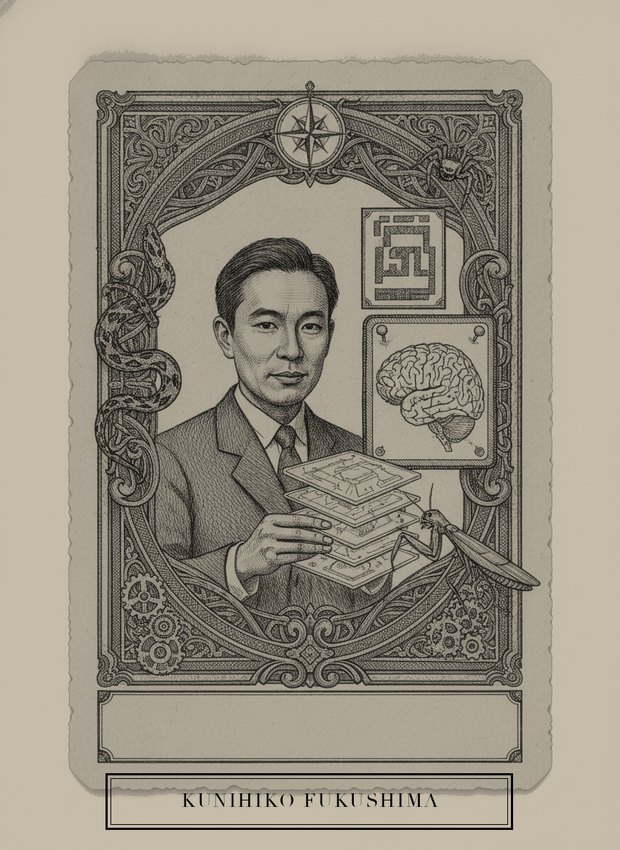
Fukushima is not analogous to this problem, he is its subject: working at NHK's research laboratories in Tokyo, he built the neocognitron in 1979-80, a hierarchical network alternating simple, feature-detecting cells with complex, pooling cells, directly modeled on Hubel and Wiesel's neurophysiology, precisely the architecture this problem asks to be designed. His network achieved translation-invariant character recognition by constructing tolerance into the architecture layer by layer rather than learning it from astronomical data, and he trained it with the era's feasible unsupervised, layer-by-layer methods rather than end-to-end backpropagation, which did not yet exist as a practical tool. Yann LeCun and others later explicitly credited the neocognitron as the direct architectural ancestor of the convolutional network, making Fukushima the closest possible match to this exact historical problem.
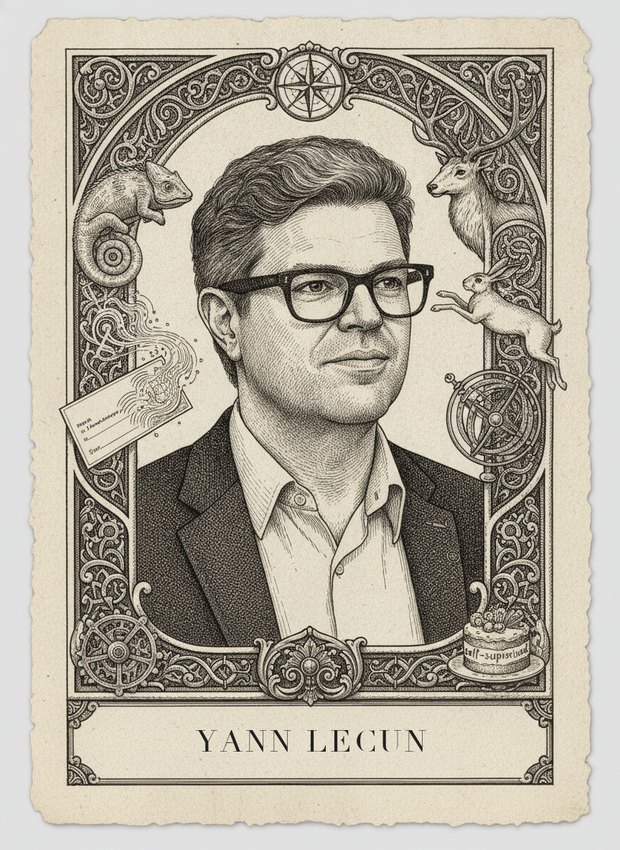
LeCun's convolutional networks, developed through the late 1980s and matured with LeNet in the 1990s, are the direct engineering heir to the architecture this problem asks for, explicitly building on the neocognitron's hierarchy of local feature detection and spatial pooling while adding the crucial ingredient Fukushima's era lacked, end-to-end training via backpropagation through the shared-weight convolutional layers. His MNIST results proved that a translation-tolerant architecture, learned rather than fully hand-specified, could achieve practical accuracy, vindicating the neocognitron's design bet. Where the fit falls short of a perfect score is chronology and method: this problem is set in 1980, before backpropagation was practical, and LeCun's own major results came a decade later, using a training regime the neocognitron's own era could not yet support.
In the mind map
The same ideas, as concepts rather than history — in John's ML knowledge map.
58 figures are scored on this problem. Draw it in a battle to see where you land.