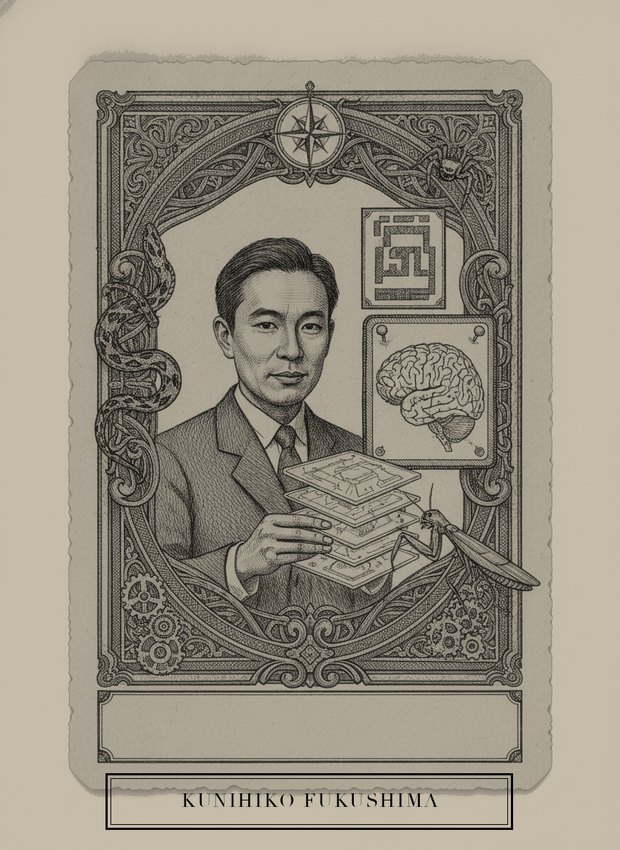
Kunihiko Fukushima
The neocognitron: ancestor of the CNN
Strongest on
In the mind map
The same ideas, as concepts rather than history — in John's ML knowledge map.
Life and career
Every convolutional network in production today is a descendant of a machine built in a broadcasting company's research lab in Tokyo, by an engineer who was mostly interested in how the brain sees.
Kunihiko Fukushima was born in 1936 and trained in electronics engineering at Kyoto University, graduating in 1958. He joined NHK, the Japanese public broadcaster, and worked at its Broadcasting Science Research Laboratories — an institution with a practical mandate (television, transmission, image handling) that nonetheless gave him room to pursue the question that occupied him for fifty years: what is the actual mechanism by which a visual system recognizes a pattern regardless of where it falls on the retina? He later held professorships at Osaka University's Faculty of Engineering Science, the University of Electro-Communications, and Tokyo University of Technology, and continued publishing on his architecture well into his eighties.
The intellectual trigger was neurophysiology, not computer science. Hubel and Wiesel's recordings from cat visual cortex, through the 1960s, had described a hierarchy: *simple cells* responding to oriented edges at specific retinal positions, and *complex cells* responding to the same orientation but tolerating a shift in position. Fukushima read this as an architectural blueprint rather than a biological curiosity. If tolerance to position is built by alternating detection with pooling, then a machine that alternates detection with pooling should inherit the tolerance — not learn it, not be taught it by examples, but *have* it, structurally, by construction.
He built the Cognitron in the mid-1970s, a self-organizing multilayer network, and then in 1979–80 the Neocognitron, published in English in *Biological Cybernetics* under a title that says exactly what it does: a self-organizing neural network model for a mechanism of pattern recognition unaffected by shift in position. It recognized handwritten characters. It did so with alternating layers of S-cells (feature detectors with local receptive fields, replicated across the visual field so that all copies at a given layer share the same feature) and C-cells (which pooled over a local neighborhood of S-cells, blurring away exact position while preserving the fact that a feature was present). Stack these and receptive fields grow, features become more abstract, and position information is discarded gradually rather than all at once.
That is a convolutional network. The weight sharing is there, the local receptive fields are there, the pooling is there, the deep hierarchy is there. What is not there is end-to-end backpropagation — in 1980 it did not yet exist as a practical tool anyone in the field was using. Fukushima trained his network with the methods available: unsupervised competitive learning applied layer by layer, and later supervised variants in which a teacher designated which cell should learn a given feature. Yann LeCun and others have consistently and explicitly credited the neocognitron as the direct architectural ancestor of the convolutional network, and Fukushima was honored late in life for precisely that lineage.
He also worked on a selective attention model, in which top-down signals from the recognition layers back to the input allow a cluttered or overlapping scene to be segmented one object at a time — an idea that reads today as remarkably prescient about attention and recurrent top-down processing, and which was largely ignored at the time.
Key contributions
For a graduate audience, the neocognitron is best understood as an argument about where invariance comes from. There are broadly two answers. One is *learn it*: show the network enough shifted, rotated, and scaled examples and it will discover that these are the same object. That answer requires enormous data and enormous compute, and it is the answer the field eventually adopted, augmented with data augmentation to fake the data you don't have. The other answer is *build it in*: choose an architecture whose function class is invariant (or equivariant) by construction, so that the shifted input is guaranteed to produce the same output no matter what the weights are. Fukushima chose the second, and he was right in a way that turned out to matter enormously — modern CNNs use *both* answers, but the architectural one is what makes them tractable at all.
Concretely, the neocognitron supplies three mechanisms that survive intact:
*Local receptive fields.* A unit sees a small patch, not the whole image. This is a hard prior that visual structure is local, and it cuts parameter count by orders of magnitude relative to a fully connected layer.
*Weight sharing across position.* All S-cells in a given "cell-plane" detect the same feature at different locations. The layer is therefore translation-equivariant: shift the input, and the response map shifts identically. This is the single most important structural idea in computer vision architecture, and it is a statement about symmetry, not about optimization.
*Pooling over a spatial neighborhood.* C-cells aggregate over nearby S-cells of the same type, converting equivariance into local invariance. Alternate the two operations and small deformations are absorbed progressively at each stage rather than needing to be handled globally.
The hierarchy that results has the property that a graduate student can now state as a slogan: early layers respond to oriented edges, middle layers to combinations of edges into curves and corners, late layers to whole object categories, with receptive field size and abstraction growing together. Fukushima demonstrated this in 1980. What he lacked was a credit-assignment algorithm strong enough to train the whole stack against a global objective, and the compute to do it at scale. Backpropagation supplied the first; GPUs supplied the second; the architecture never needed changing.
In battle
Fukushima is the sharpest spike on the roster and one of the narrowest players in the game. His mean is 17.9 and his median 12 — he is below 20 on seventy-nine of a hundred problems — but he owns four problems at 80 or above, and one of them at 99.
That 99 is "The pattern survives the shift," and it is not an analogy. The game's explanation states flatly that he is the problem's subject: the neocognitron *is* the requested design, built layer by layer from Hubel and Wiesel's neurophysiology, achieving translation-invariant character recognition by architecture rather than by data. Around it clusters everything that inherits the architecture: "Sixty thousand digits" at 90 (handwritten character recognition is literally what he built the machine for), "Edges before objects" at 85 (his hierarchy is an explicit commitment to that ordering), "Let the images choose the basis" at 82 (his S-cells self-organize their own feature detectors instead of receiving a hand-designed filter bank), "XOR" at 74 (multilayer networks with hidden units, which he was building while the field said they were untrainable), "Find every face" at 66, and "A thousand categories" at 65 — where he supplies the architecture that won but neither the training algorithm nor the hardware. His perception average of 34.6 across nineteen problems and classification average of 24.6 are the only categories where he consistently shows up.
Everything else collapses, and the collapse is unusually pure. His optimization average is 4.5, the lowest category floor of anyone in his cohort, and "Cool it slowly" at 4 shows why: simulated annealing is about escaping local minima in a search landscape, and Fukushima's contribution contains no optimization theory at all — the architecture is the idea, and the learning rule was always the weak part. Classical statistics is equally hopeless: "Three species of iris" (3), "The therapy the trial reversed" (3), "How high must the dike be?" (2) — discriminant analysis, causal inference from trials, and extreme-value extrapolation are not merely outside his era, they are outside his mode of thought, which is constructive and architectural rather than inferential. "Just look at the neighbors" at 3 is the cleanest lesson of all: nearest-neighbor classification achieves generality with no architecture whatsoever, which is the exact opposite of everything he believed.
Play Fukushima on any problem where the right answer is a *structure* that makes the hard part unnecessary. Bench him whenever the hard part is fitting, inferring, searching, or proving.