high-dim
Let the images choose the basis
It is 1996, and two literatures are converging on one question from opposite ends. Harmonic analysts have spent a decade hand-crafting optimal bases — wavelets with provable approximation rates for piecewise-smooth signals. Neuroscientists, meanwhile, ask why the primary visual cortex has the receptive fields it has. The bridge: learn the basis from data — find the overcomplete dictionary in which patches of natural images admit maximally sparse codes, and see what emerges. If the learned atoms are oriented, localized, bandpass — Gabor-like — then sparse coding is simultaneously an account of V1 and an engineering principle. Establish when dictionary learning is well-posed and when the learned atoms are identifiable rather than artifacts. Get it wrong and both fields over-read a rotation of noise as the brain's code.
Who this problem belongs to
The two figures whose methods fit it best, out of 64 in contention.
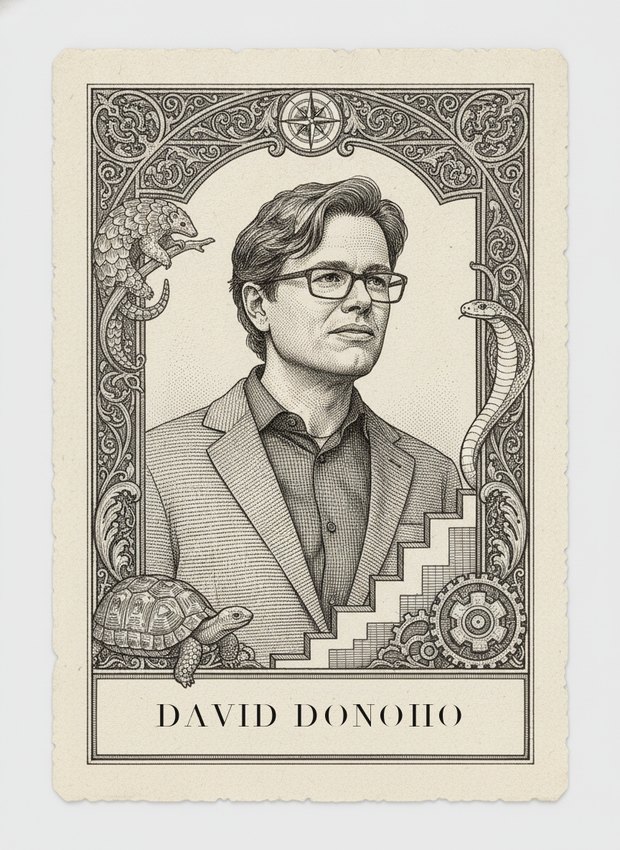
Donoho's career-defining program on sparse representation, wavelets, and later compressed sensing is the direct mathematical foundation this problem's dictionary-learning task rests on: his rigorous treatment of when a signal admits a maximally sparse representation in some basis, and when that sparse representation is unique and identifiable rather than an artifact, is exactly this problem's demand to 'establish when dictionary learning is well-posed and when the learned atoms are identifiable rather than artifacts.' His decades-long collaboration with harmonic analysts on optimal sparse bases for piecewise-smooth signals is precisely the 'hand-crafted optimal bases' side of this problem's bridge, giving him unique authority to evaluate whether a learned, data-driven dictionary actually improves on or merely rediscovers known constructions. His score reflects primary, foundational authorship of this problem's core mathematical apparatus.
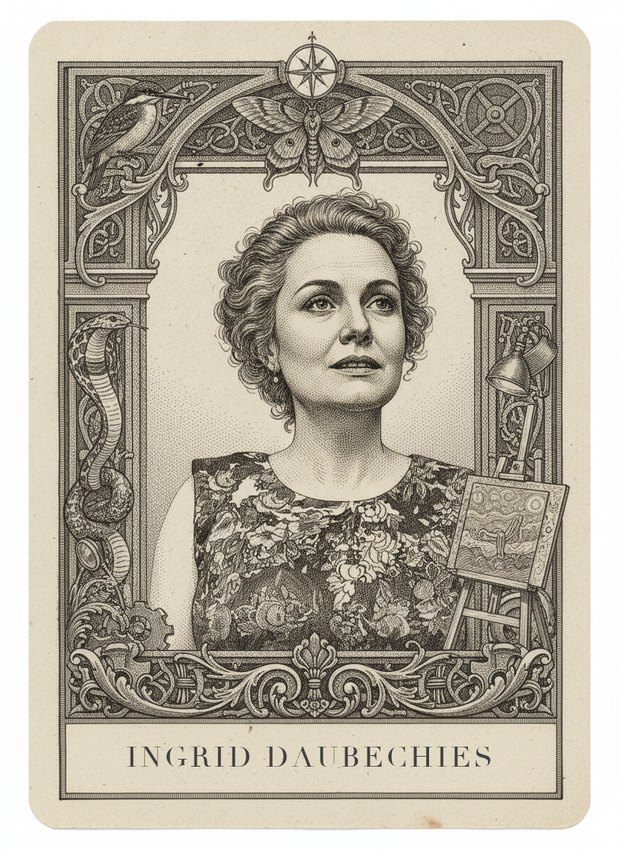
Daubechies's construction of compactly supported orthonormal wavelet bases with provable approximation rates for piecewise-smooth signals is, quite literally, this problem's opening premise: 'harmonic analysts have spent a decade hand-crafting optimal bases,' and her wavelets are the single most celebrated instance of exactly that hand-crafted optimal-basis program the 1996 dictionary-learning breakthrough was implicitly competing against and complementing. Her rigor about when a chosen basis provably captures a signal class's structure, and under what conditions such optimality can be proven rather than merely observed empirically, gives her deep authority on this problem's well-posedness and identifiability demands. Her score falls just short of Donoho's only because her own flagship results are hand-crafted rather than learned bases, the side of this problem's bridge that the learned-dictionary breakthrough was reaching beyond.
In the mind map
The same ideas, as concepts rather than history — in John's ML knowledge map.
64 figures are scored on this problem. Draw it in a battle to see where you land.