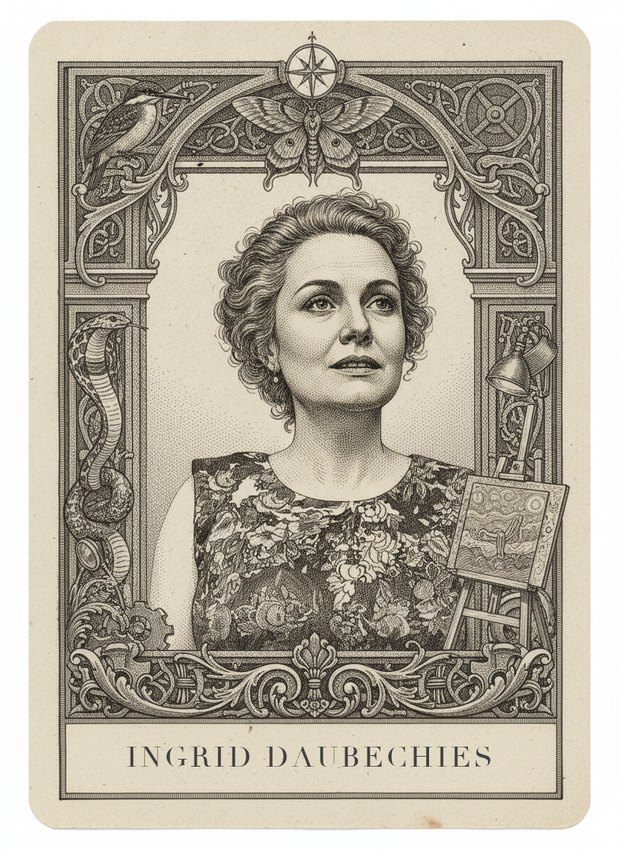
Ingrid Daubechies
Wavelets that work: compactly supported orthonormal bases
Strongest on
In the mind map
The same ideas, as concepts rather than history — in John's ML knowledge map.
Life and career
Ingrid Daubechies was born in 1954 in Houthalen, in the Flemish coal-mining region of Belgium, the daughter of a mining engineer. She has described a childhood fascination with how things were made and why mathematical objects behaved as they did — the kind of curiosity that, in her case, never separated the abstract from the physical. She studied at the Vrije Universiteit Brussel, taking her undergraduate degree and then, in 1980, a doctorate in theoretical physics. Her early research was in mathematical physics: coherent states, quantum mechanical phase-space representations, and the general problem of how to represent a function simultaneously in position and momentum. That background is the direct ancestor of everything she is famous for. Wavelets, in the end, are a solution to a physicist's problem — you cannot localize perfectly in both time and frequency, so how do you make the best available compromise?
She remained at the VUB as a research professor into the 1980s while spending increasing time in the United States, and in 1987 joined AT&T Bell Laboratories in New Jersey. The year is significant: her landmark construction of compactly supported orthonormal wavelets was published in 1988, and Bell Labs was full of signal-processing engineers who understood immediately what it was worth. She had entered a rare and productive situation — a deep mathematical result landing in a room of people with real signals to compress.
In 1994 she moved to Princeton, becoming the first woman appointed a full professor of mathematics there, and in 2011 to Duke University as James B. Duke Professor of Mathematics and Electrical and Computer Engineering. From 2011 to 2014 she served as president of the International Mathematical Union, the first woman to hold the office.
What distinguishes her from most mathematicians of comparable stature is where she has pointed the machinery. Her later work includes collaborations with art historians and conservators, applying multiresolution analysis to problems of authentication, to the digital removal of cradling artifacts from X-rays of panel paintings, and to the analysis of brushstroke structure. She has also worked with evolutionary biologists on the comparison of anatomical surfaces — teeth, bones — developing distances between shapes that do not require a biologist to hand-place landmarks. She has been an unusually active advocate for mathematicians in the developing world and for women in mathematics.
Her honors include a MacArthur Fellowship in 1992, election to the National Academy of Sciences, the AMS Steele Prize for her book *Ten Lectures on Wavelets*, and, in 2023, the Wolf Prize in Mathematics.
Key contributions
**The problem wavelets solve.** A Fourier basis gives perfect frequency resolution and no time localization: a single sine wave tells you a frequency is present but not when. A windowed (short-time) Fourier transform localizes in time, but the window length is fixed, so it resolves low and high frequencies equally badly. Real signals — images with edges, audio with transients, seismic traces — are not stationary; their interesting content is precisely the parts that are localized. What is wanted is a basis whose elements are short at high frequencies and long at low ones: a **multiresolution** representation.
**Multiresolution analysis and the 1988 construction.** Mallat and Meyer had formalized multiresolution analysis — a nested sequence of approximation spaces V_j, each generated by dilates and translates of a single scaling function φ, with wavelet spaces W_j as the orthogonal complements. Orthonormal wavelet bases existed, but the known ones (Meyer's, the Littlewood–Paley type) had infinite support, which is fatal for a fast algorithm. Daubechies's 1988 paper in *Communications on Pure and Applied Mathematics* constructed **compactly supported orthonormal wavelets with an arbitrary prescribed number of vanishing moments**. The construction proceeds through the filter: design a finite-length low-pass filter h satisfying the orthogonality (conjugate quadrature) condition and having a zero of prescribed order at frequency π, then obtain φ as the fixed point of the refinement equation φ(t) = √2 Σ h_k φ(2t − k), and prove — this is the hard analytic part — that the cascade converges to a function of the required regularity. The family is indexed by N: support width 2N − 1, N vanishing moments, and smoothness increasing with N.
Why vanishing moments matter is the point graduate students should carry away. If a wavelet has N vanishing moments, it is orthogonal to all polynomials of degree < N, so wherever the signal is locally smooth the wavelet coefficients are *tiny*. Coefficients are large only near singularities — edges, transients, discontinuities. A piecewise-smooth signal therefore has a **sparse** wavelet representation, with energy concentrated in a small number of coefficients. Compression, denoising, and sparse recovery all follow from that single fact.
**The fast wavelet transform.** Because the wavelets are generated by a finite filter, the transform is a cascade of filter-and-downsample operations: O(n) time, exactly invertible, no boundary of approximation error. This is what made wavelets an engineering technology rather than a theoretical curiosity. Wavelet-based compression became the basis of the FBI's fingerprint image standard, and the biorthogonal Cohen–Daubechies–Feauveau 9/7 filter bank is the transform inside JPEG2000. The biorthogonal construction is itself a Daubechies contribution, trading strict orthogonality for symmetry and linear phase, which matters because the human visual system is sensitive to the asymmetric ringing that non-symmetric filters produce at edges.
**Frames and time-frequency analysis.** With Grossmann and Meyer she developed the theory of non-orthogonal expansions with stable reconstruction — frames — which generalize bases and are now standard in sampling theory and sparse representation. Her work on the Balian–Low theorem and on Wilson bases sharpened understanding of the fundamental limits on simultaneous time-frequency localization.
**Iterative soft thresholding.** With Defrise and De Mol (2004), she gave an algorithm for linear inverse problems with sparsity constraints: alternate a gradient step on the data-fidelity term with soft-thresholding of the coefficients, and prove convergence. This is ISTA, the algorithm at the base of the entire proximal-gradient family that modern sparse optimization and compressed sensing reconstruction rely on.
In battle
Daubechies has the narrowest computed profile in this cohort, and it is worth understanding rather than apologizing for: mean 22.2 across 100 problems, median 16, **sixty problems at 20 or below**, and three dominant scores. She is a mathematician of a specific representation, and when the problem is about that representation nobody touches her.
Her peak is **P095 — The wavelet decomposition** at 98. The judge's assessment is that she is not analogous to the problem, she is its author: the 1988 compactly supported construction resolves exactly the Fourier-versus-windowed-transform dilemma the problem poses, and the applications the problem names — image compression, denoising, the FBI fingerprint archive — were realized using her constructions. **P288 — Let the images choose the basis** (90) is adaptive representation, where her multiresolution framework and its data-driven successors are the natural machinery. **P167 — How few bits for a good-enough picture** (85) is lossy compression, where sparse wavelet coefficients plus quantization is the answer that shipped in JPEG2000.
Below the peaks her profile thins quickly but not arbitrarily. **P094 — Reconstruct from too few measurements** (70) is compressed sensing — she supplies the sparsity-in-a-basis premise and the ISTA solver, but the recovery theorems belong to Donoho, Candès, and Tao, which is why she sits at 70 while Donoho takes 95. **P044 — Sketch the enormous matrix** (61) and **P182 — The corner that sparsity loves** (45) reward the same sparse-representation instincts at one remove. **P042 — Prove the descent** (60) is her iterative thresholding convergence proof. Her one substantial category is high-dimensional at 43.6 across fifteen problems, which is where sparsity lives.
The losses are near-total and they cluster in a revealing place: economics, games, and engineering coordination. She scores 5 on **P205 — Auction the airwaves** and 5 on **P206 — The exchange with no prices** — mechanism design and market clearing, where the objects are strategic agents rather than signals. She scores 5 on **P200 — Beat the world champion** (Deep Blue) and 5 on **P181 — Optimize for the worst case**, and her games category sits at 7.9 across twelve problems, the lowest category number of anyone in this cohort. She scores 4 on **P183 — Cool it slowly** (simulated annealing) and 4 on **P185 — Optimize across the datacenter**, where the judge notes bluntly that she would have essentially nothing specific to contribute beyond general computational literacy. Systems (8) and computability (11.9) round out the floor.
The strategic read is simple and stark. Daubechies is a lottery ticket with an enormous payoff: if the battle lands on signal representation, compression, denoising, or sparse structure in a transform domain, she wins decisively. If it lands anywhere else — adversaries, markets, algorithms, systems — she contributes nothing. Her own battle identity says it exactly: she wins localized time-frequency representation of real signals, and loses to learned representations on tasks with no harmonic structure at all.