high-dim
The wavelet decomposition
It is 1987, and signal analysis is caught between two bad options: Fourier's sinusoids know frequency perfectly and location not at all — a spike and a smear are indistinguishable in phase — while windowed fixes force one resolution on every scale. The dream circulating between Bell Labs and the mathematicians is a basis that localizes both space and frequency at once, zooming like a microscope across scales. Construct it properly: orthonormal wavelets with compact support, smoothness you can dial, and fast exact transforms — linear-time analysis and perfect reconstruction, or engineers will never touch it. The stakes arrive quickly and concretely: image compression standards, denoising, and the FBI's fingerprint archive — hundreds of millions of cards — will be stored in whatever basis wins this argument.
Who this problem belongs to
The two figures whose methods fit it best, out of 56 in contention.
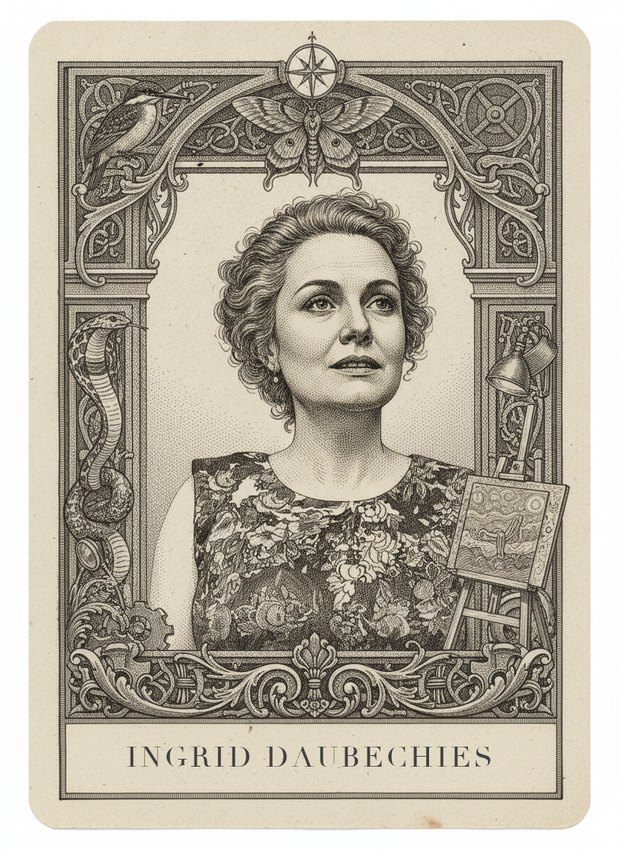
Daubechies is the direct author of this problem: her 1988 construction of compactly supported orthonormal wavelets with tunable smoothness, building on Mallat's multiresolution analysis, solved exactly the Fourier-versus-windowed-transform dilemma this problem describes, and her wavelets enabled the fast, linear-time, perfectly reconstructing transforms that made the technology practical for engineers. The application stakes named in the problem — image compression, denoising, and the FBI's fingerprint archive — were realized using her specific construction (the FBI adopted a wavelet-based standard). There is no better-matched carrier in this or almost any pool: this problem is a description of her own landmark result.
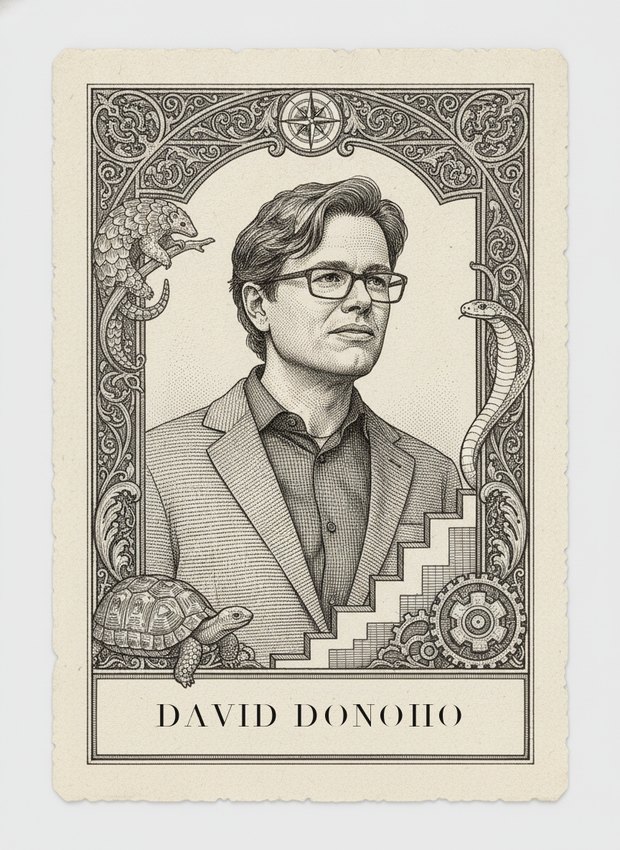
Donoho's career is deeply intertwined with wavelet theory from its earliest days: his work on wavelet shrinkage for denoising, minimax estimation in wavelet bases, and the broader statistical exploitation of sparse representations built directly on the compactly supported orthonormal bases this problem asks to be constructed. He was a close contemporary and collaborator-adjacent figure to Daubechies during exactly this period, applying and extending the mathematical object this problem is about to statistics and signal processing. He did not himself construct the Daubechies wavelets, but his command of their properties and applications is second only to their inventor's.
In the mind map
The same ideas, as concepts rather than history — in John's ML knowledge map.
56 figures are scored on this problem. Draw it in a battle to see where you land.