perception
Edges before objects
It is 1976 at MIT, and computer vision is a pile of programs that each work on ten images and fail on the eleventh — because nobody has asked what vision is computing before asking how. Design the earliest stages of a vision system: what should be computed from raw intensities first — edges, blobs, orientations, the primitive sketch of a scene — and, crucially, what theory says so? The demand is for three levels of explanation: the computational problem, the algorithm, the implementation — with the neuroscience of the primate retina as a constraint, not decoration. Get the foundations wrong and the field builds upward from sand for a generation, mistaking programs that happen to work for an understanding of sight.
Who this problem belongs to
The two figures whose methods fit it best, out of 54 in contention.
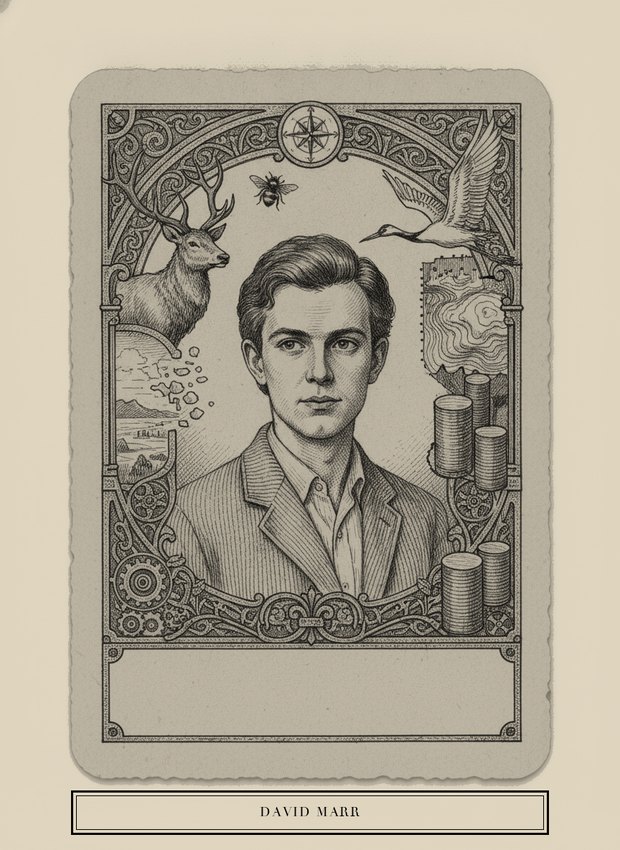
This is Marr's own program, stated in his own words. Working at MIT's AI Lab in exactly this period (his book Vision was drafted 1976-1979, published posthumously 1982), he argued that vision must be understood at three levels: the computational theory (what is computed and why), the algorithm, and the implementation. His primal sketch, zero-crossings of Laplacian-of-Gaussian filters for edge detection, and the 2.5-D sketch are the literal answer this problem demands, and he tied them to retinal ganglion and cortical simple cells as constraint, not decoration. No carrier here matches the problem more exactly. The only reason to withhold a perfect 100 is that the framework's neuroscience was partly speculative and his early-vision priority over top-down reasoning was later contested. Everything the prompt asks for, Marr wrote.
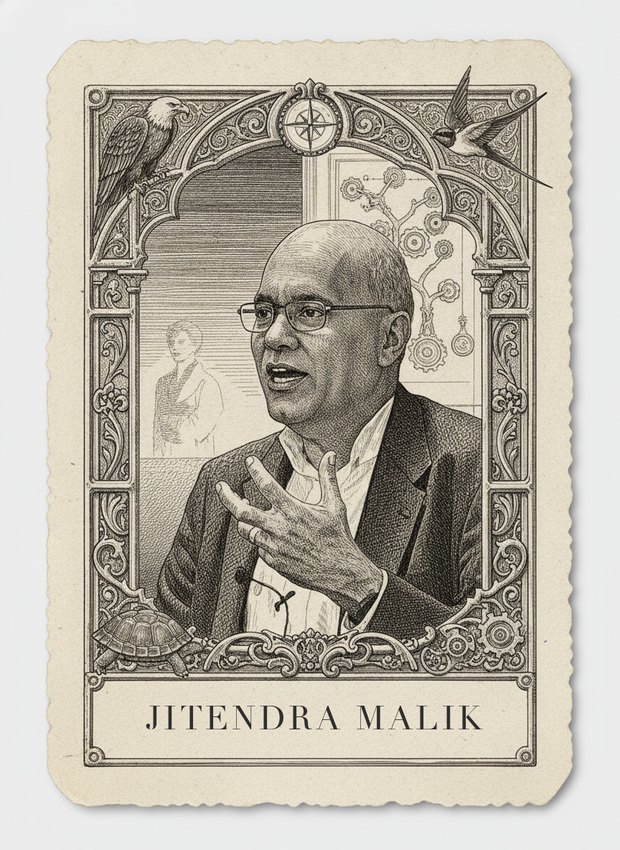
Malik is Marr's most direct intellectual heir in computational vision. His Berkeley work on edge and boundary detection, perceptual organization, texture, and normalized-cuts segmentation is precisely the early-vision program this problem describes, and he explicitly carried Marr's levels-of-analysis discipline forward, asking what is computed before how. Working from the 1980s onward he had tools Marr lacked, filter banks, spectral clustering, learned boundary detectors trained on human-marked ground truth (the BSDS dataset), which let him test the primal-sketch idea empirically rather than by introspection. The era gap runs backward here: transported to 1976 he would recognize the question immediately but would miss the training data and compute his mature methods assume. Still, on the theory of what early vision should compute, few people alive have thought harder.
In the mind map
The same ideas, as concepts rather than history — in John's ML knowledge map.
54 figures are scored on this problem. Draw it in a battle to see where you land.