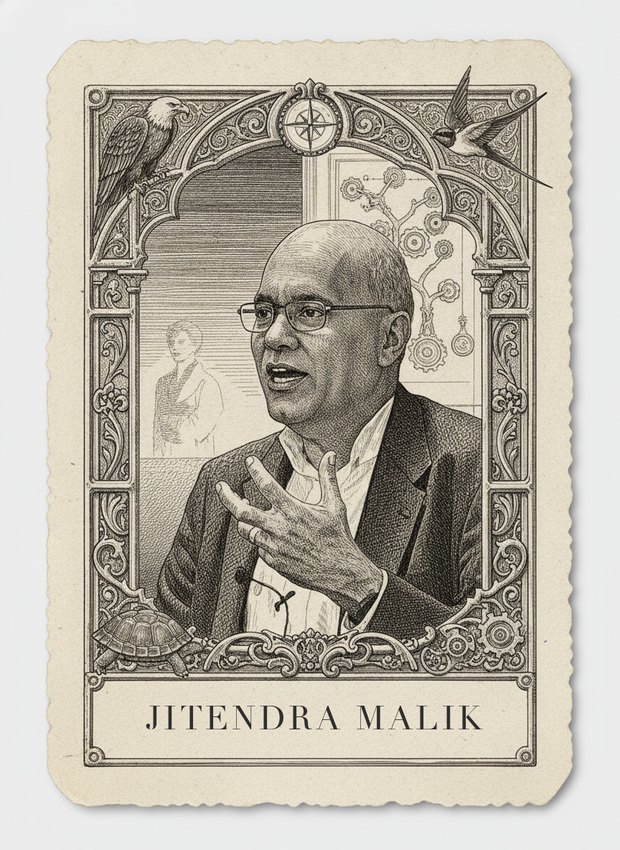
Jitendra Malik
Computer vision: segmentation, perceptual organization
Strongest on
In the mind map
The same ideas, as concepts rather than history — in John's ML knowledge map.
Life and career
If you trace the academic genealogy of computer vision in the United States, an implausible number of branches pass through one office in Soda Hall.
Jitendra Malik was born in 1960 in India and took his B.Tech at IIT Kanpur in 1980, then went to Stanford for his PhD, finishing in 1985 under Thomas Binford in an AI lab still oriented around geometric, model-based interpretation of scenes. He joined the faculty at UC Berkeley in 1986 and never left, eventually chairing the computer science division and the EECS department and holding an endowed chair. Over four decades he has produced a research group whose alumni populate the leadership of the field: the people who built segmentation benchmarks, shape descriptors, object detectors, and later the deep-learning vision systems that reorganized everything.
His intellectual position, sustained through several changes of fashion, is that vision is fundamentally a problem of *perceptual organization*. The hard part is not labeling a picture; it is that a retinal image or a pixel array does not arrive pre-divided into objects. Something has to decide which pixels belong together, where a surface ends, what is figure and what is ground — and Gestalt psychology had catalogued these grouping phenomena decades before anyone could compute them. Malik spent his career turning those qualitative observations into algorithms with defensible mathematics behind them, and then, unusually for a theorist of his generation, into benchmarks that let the community measure whether the algorithms actually worked. The Berkeley Segmentation Dataset, with its human-drawn boundary annotations and its careful evaluation protocol, forced the field to be honest about a problem that had previously been assessed by eyeballing figures in papers.
The last act of the story is the one that makes him a genuinely interesting figure rather than merely an eminent one. Malik was, by his own account, a skeptic of end-to-end deep learning when it arrived — his program was built on carefully designed, interpretable intermediate representations, and the new systems threw all of them away. When ImageNet settled the argument in 2012, his lab did not dig in. Within eighteen months his group produced R-CNN, with Ross Girshick, Jeff Donahue and Trevor Darrell — the paper that showed how to convert a whole-image classifier into an object detector by proposing regions and classifying each with a convolutional network, and which triggered the detection lineage that runs through Fast R-CNN, Faster R-CNN and Mask R-CNN. He also took a research leadership role at Facebook AI Research alongside his Berkeley appointment. He has received the field's major honors, including the ACM–AAAI Allen Newell Award and election to the national academies.
Key contributions
**Anisotropic diffusion (Perona–Malik, 1990).** The classical way to suppress image noise is Gaussian smoothing, which is the heat equation run for a fixed time — and which destroys exactly the edges you were trying to find. Perona and Malik replaced the constant diffusion coefficient with one that depends on the local gradient magnitude: diffusion proceeds freely within homogeneous regions and is choked off across strong gradients. The result is a nonlinear PDE that denoises the interiors of regions while sharpening rather than blurring their boundaries. It launched a whole subfield of PDE methods in image processing and is still the reference point for edge-preserving smoothing.
**Normalized cuts (Shi–Malik, 1997).** Represent the image as a weighted graph: pixels are nodes, edge weights encode affinity from brightness, texture and contour cues. Segmentation is then graph partitioning. The naive objective — minimize the total weight of cut edges — has a fatal bias: slicing off a single isolated pixel is nearly free. The normalized cut fixes this by dividing the cut weight by the total connectivity of each side, so a good partition must be both weakly connected across the boundary and *substantial* on both sides. Optimizing this exactly is NP-hard, but relaxing the indicator vector to real values yields a generalized eigenvalue problem on the graph Laplacian, and the second-smallest eigenvector gives the partition. This is the paper that connected spectral graph theory to perception, and it is a direct ancestor of spectral clustering as a general-purpose machine learning method.
**Textons and texture-based grouping.** Malik's group argued that the primitive unit of texture perception is not a pixel but a *texton* — a vocabulary element obtained by clustering the responses of a filter bank. Comparing texton histograms across a candidate boundary gives a texture gradient, which combined with brightness and color gradients produced the globalized probability-of-boundary detector that dominated boundary detection for a decade.
**Shape contexts (Belongie–Malik–Puzicha, 2002).** For each point on a shape's contour, build a log-polar histogram of the relative positions of all other points. This descriptor is rich, is naturally invariant to translation and can be made invariant to scale and rotation, and turns shape matching into a bipartite assignment problem followed by a thin-plate-spline warp. It was the state of the art for handwritten digit and object matching before deep features.
**Motion and 3D.** Sustained work on optical flow — including large-displacement variants that combine descriptor matching with variational flow estimation — and on recovering three-dimensional structure and human pose from images, connecting the grouping program to the geometry that generated the image in the first place.
**R-CNN and the transition.** The detection architecture that grafted learned convolutional features onto the region-proposal pipeline his own tradition had developed, and in doing so gave the deep-learning era its object detectors.
In battle
Malik has the most sharply bimodal profile among the vision figures: mean 28.3 but median only 16, with ten problems at 80 or above and fifty-six at or below 20. He wins his own subject overwhelmingly and contributes almost nothing outside it.
The twin peaks are both 99. "Cut the image into things" and "Cut the image, weight the graph" are normalized cuts stated twice from different angles, and the game's explanation notes every component — the affinity graph, the normalization that makes isolating a stray pixel expensive, the NP-hardness, the eigenvector relaxation of the Laplacian, and his honesty about the relaxation gap. Around them clusters the entire perceptual organization program: "Segment anything" (90), "Edges before objects" (88) — the claim that boundary detection precedes and enables recognition, which is the thesis of his career — "Where did every pixel go?" (88) for optical flow, "The tilted scan" (85) for deformation-robust matching, which is shape contexts, and "Rebuild the city from vacation photos" (85) for multi-view geometric reconstruction. "Drive through the intersection" at 88 is the applied payoff: an autonomous driving scene is a perceptual organization problem with a deadline. His perception average of 53.3 across nineteen problems is the highest perception number on the roster, and it is broad rather than spiky — he is strong across essentially the whole category.
Then the floor drops out, and the pattern of losses is unusually clean. His worst category by a wide margin is causality at 5.0, and "The first randomized trial" at 2 is his single lowest score: nothing in a career spent extracting structure from abundant pixel data engages randomization, treatment assignment, or counterfactual reasoning. Experimental design (7.0) and testing (8.2) fail for the same reason. "The spam in the inbox" at 5 is instructive in a different way — it is a classification problem, which sounds like his territory, but it is a *generative probabilistic* solution over discrete tokens with no spatial structure at all, and every one of his tools presumes a geometry to organize.
The third cluster of losses is systems and mathematics: "Small tools, loosely joined" (5) and "What happened first?" (5) are software architecture and distributed clock ordering, giving him a systems average of 8.3; "Roll the dice at Los Alamos" (4) is Monte Carlo simulation and "Calculus for a jagged path" (4) is analysis on irregular objects — both are mathematical machinery he consumes rather than creates.
Play Malik on any problem where the difficulty is *what belongs with what* in a spatial signal. Bench him the instant the data stops being an image, or the question becomes why rather than what.