perception
Cut the image into things
It is 1997 at Berkeley, and segmentation keeps failing the same way: methods that grow regions from local pixel similarity fragment every textured surface and leak across every soft boundary, because grouping is a global judgment being made with local evidence. Recast the image as a graph — pixels as nodes, affinities as weighted edges — and partition it by a criterion that charges a cut not by raw weight but by its share of each side's total association, so carving off one stray pixel stops being free. The optimum is NP-hard; show the relaxation that lands in the eigenvectors of a graph Laplacian, computable, principled, honest about its gap. Get it wrong and grouping remains hand-tuned heuristics; get it right and spectral methods enter vision's bloodstream.
Who this problem belongs to
The two figures whose methods fit it best, out of 59 in contention.
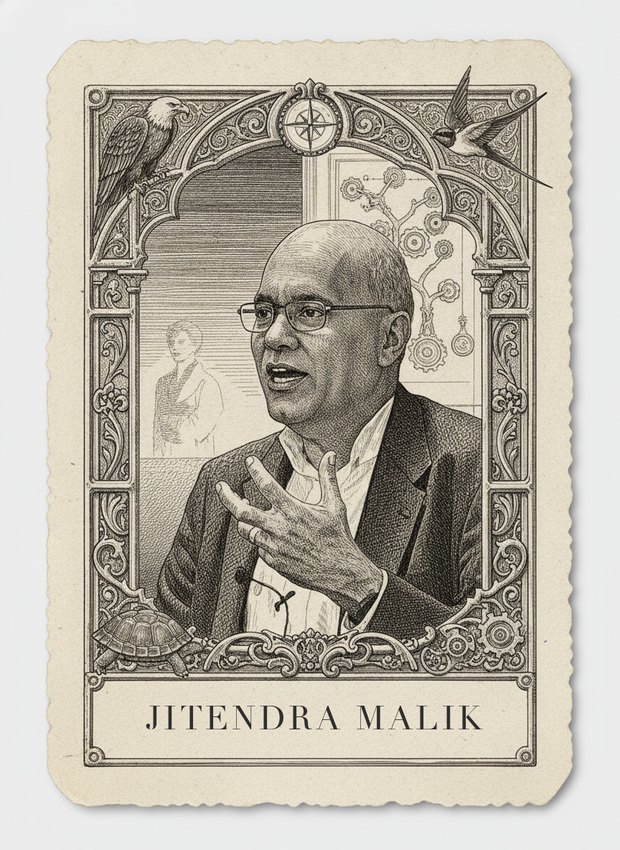
This problem is Malik's own desk. With his student Jianbo Shi, he developed exactly this solution at Berkeley, published as "Normalized Cuts and Image Segmentation" in 1997 and expanded in a 2000 journal paper: recast an image as a graph with pixels as nodes and weighted affinities as edges, then partition it by a criterion — the normalized cut — that charges a cut by its association to the total connectivity of each side rather than raw edge weight, precisely so that isolating one stray pixel is not free. Their key result showed the NP-hard optimum has a tractable relaxation computable from the eigenvectors of the graph Laplacian, exactly what this problem specifies, and they were honest about the relaxation's approximation gap. He conceived, derived, and validated this exact method himself.
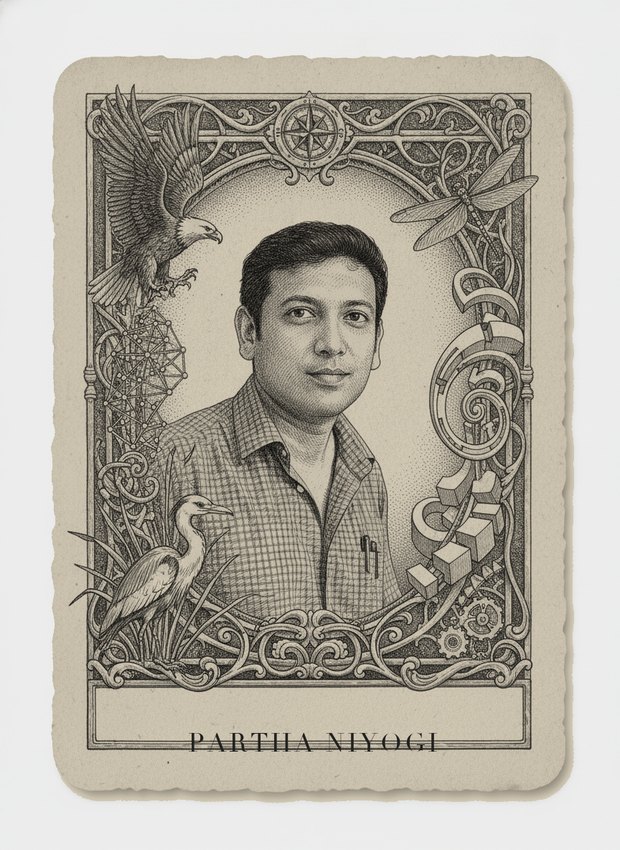
Niyogi's work on manifold learning and Laplacian eigenmaps, developed with Belkin in the early 2000s, is the direct mathematical descendant of this problem's core technique: using the eigenvectors of a graph Laplacian, built from local affinities between data points, to recover a global low-dimensional structure — exactly the "eigenvectors of a graph Laplacian" this problem specifies as the answer, generalized from image pixels to arbitrary data. His learning-theoretic rigor about why this spectral relaxation is principled and what its approximation gap means gives him genuine standing to derive or explain this problem's solution. He arrives a few years after Shi and Malik's original 1997 paper and worked on general manifold learning rather than image segmentation specifically, so the concrete perceptual-organization deliverable belongs to the vision researchers who solved it first.
Fought here
In the mind map
The same ideas, as concepts rather than history — in John's ML knowledge map.
59 figures are scored on this problem. Draw it in a battle to see where you land.