networks
Cut the image, weight the graph
It is 1997 at Berkeley, and image segmentation is a pile of heuristics: region growing here, edge linking there, each working until it doesn't, none saying what a "good" segmentation is. Recast the problem as a graph: pixels as nodes, affinities as weighted edges, segmentation as partition — and face the first trap, that minimum cut favors slicing off single pixels. Fix the objective by normalization, then pay the price: the normalized criterion is NP-complete, and the escape is spectral — the eigenvectors of the graph Laplacian relax the discrete problem into one linear algebra can solve, with a principled story for why the relaxation is meaningful. Get it wrong and vision keeps its folklore; get it right and the Laplacian becomes a load-bearing object across clustering, manifolds, and learning.
Who this problem belongs to
The two figures whose methods fit it best, out of 53 in contention.
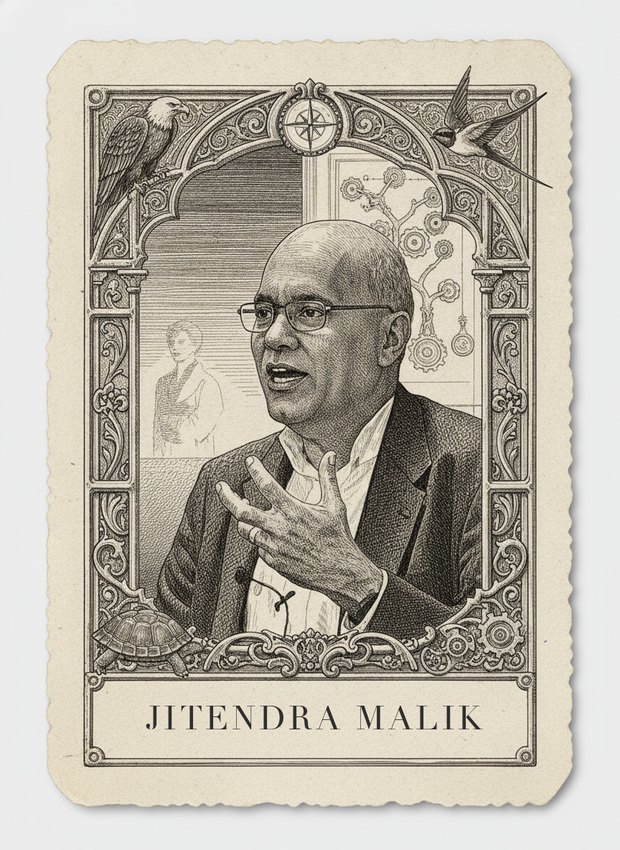
Malik co-authored, with Jianbo Shi, 'Normalized Cuts and Image Segmentation' (1997/2000) at Berkeley, the paper that is not analogous to this problem, it is its direct historical origin: recasting image segmentation as graph partitioning with pixels as nodes and affinities as weighted edges, diagnosing minimum cut's bias toward isolating single pixels, and fixing the objective with the normalized-cut criterion whose NP-complete discrete optimization is relaxed via the eigenvectors of the graph Laplacian. Every element of this problem's scenario, the 1997 Berkeley setting, the minimum-cut trap, the normalization fix, the spectral relaxation, matches his actual published work precisely. His broader career in perceptual organization and segmentation gives him unmatched authority on why this framework became foundational across vision. No other career on this card maps this exactly onto the problem's history, which is why his score sits at the maximum.
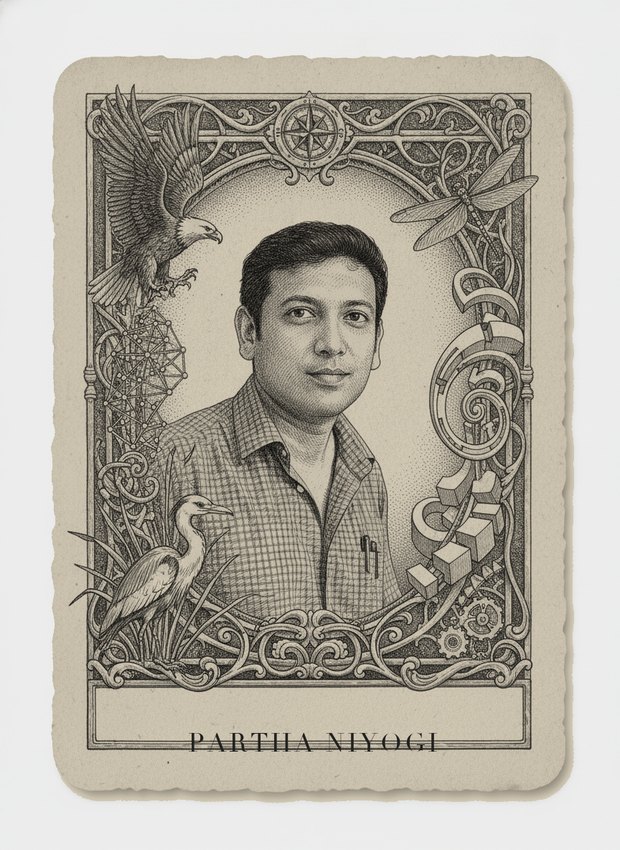
Niyogi's work on Laplacian eigenmaps and manifold learning, developed with Mikhail Belkin, directly generalizes the spectral-relaxation mathematics this problem's normalized-cut solution depends on: using the eigenvectors of a graph Laplacian to embed data in a lower-dimensional space that preserves meaningful structure, the exact mathematical machinery this problem asks to be shown as 'a load-bearing object across clustering, manifolds, and learning.' His rigorous theoretical treatment of why the Laplacian's spectral properties meaningfully capture a dataset's geometric and combinatorial structure gives him deep authority over the principled justification this problem's relaxation demands. He did not personally develop normalized cuts or apply this machinery to image segmentation specifically, his contributions generalized it to manifold learning broadly. His score reflects extremely strong, technically precise, directly relevant spectral theory, just short of the problem's founding vision-specific literature.
In the mind map
The same ideas, as concepts rather than history — in John's ML knowledge map.
53 figures are scored on this problem. Draw it in a battle to see where you land.