It is 1969, and four points in the plane — two labeled one class, two the other, arranged as exclusive-or — are about to reshape the funding of an entire field. No straight line separates them; the single-layer perceptron, the great hope of machine intelligence, provably cannot solve this toy. Solve it — by transforming the representation until the classes come apart — and explain what the public demonstration of this failure did: it helped freeze neural-network research for the better part of two decades. The stakes here are historical, not just technical. Get the lesson wrong and you either overclaim for a method that has a hard wall, or abandon a whole paradigm over a limitation that richer representations dissolve. Four points decided who got money for twenty years.
Chose The random-wired network — right call.
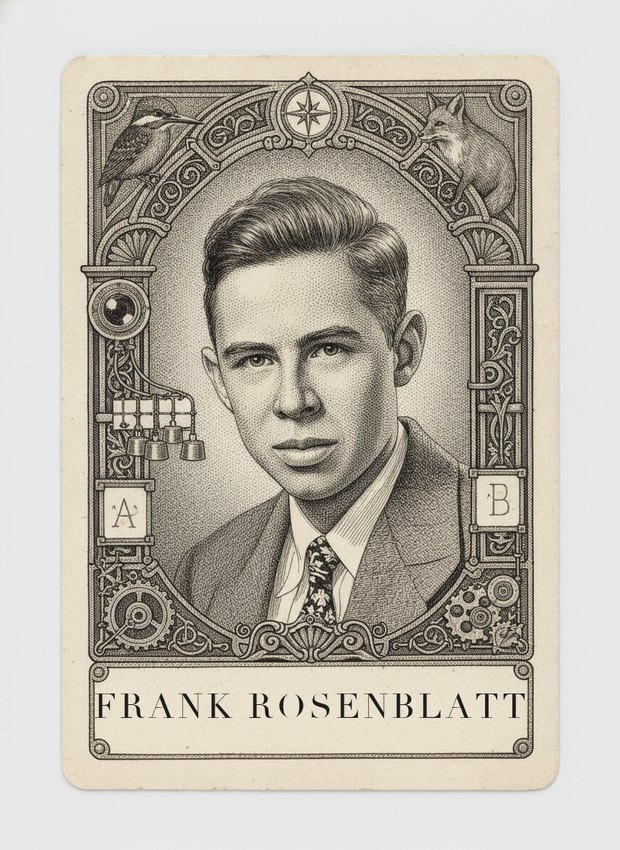
Rosenblatt is the tragic center of this problem, and the spec's floor for a reason: the perceptron (1958) and its convergence theorem are his, the overclaiming press coverage was partly his, and the machine that provably cannot solve XOR is his machine. To his credit — often forgotten — his 1962 book 'Principles of Neurodynamics' discussed multilayer perceptrons and knew single layers were limited; what he lacked was any algorithm to train the hidden layer, and he died in 1971 before backpropagation reached the field. So he possessed the right architecture and the wrong (absent) learning rule. Judged on methods applicable to this problem: his convergence theorem is vacuous here since no separating line exists, and his elementary perceptron is the demonstrated failure. The pedagogical anchor of the lesson, not its solver.
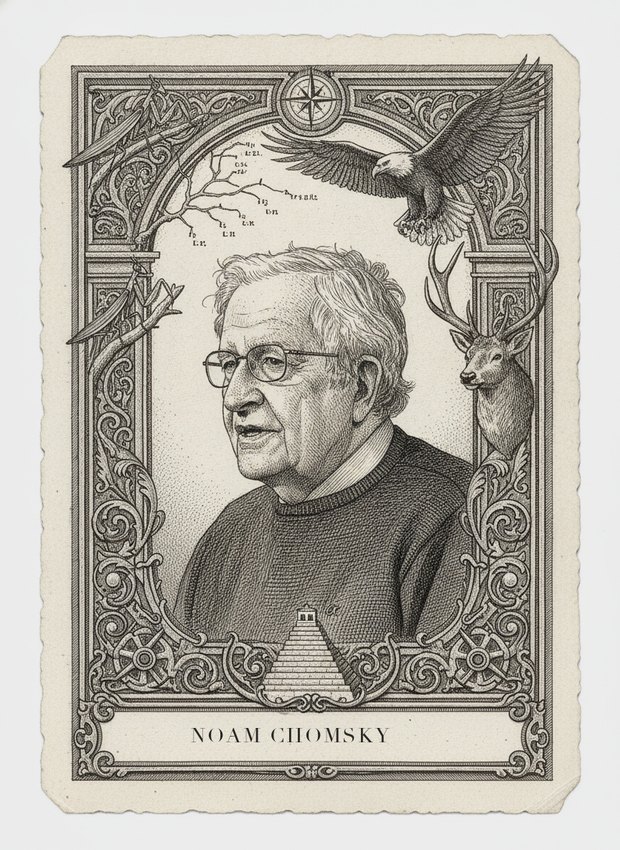
Chomsky's formal-language hierarchy (1956) is the great precedent for the XOR result's genre: a mathematical proof that a machine class — finite-state automata — cannot capture a phenomenon, deployed to devastating rhetorical effect against an empiricist paradigm. His review of Skinner (1959) did to behaviorism roughly what Perceptrons did to neural networks, so he is arguably the inventor of the argumentative form this problem examines, and Minsky-Papert's capacity proof is Chomskyan in spirit. But the parallel is the whole of his claim. He built no learning machines, contributed nothing to statistical classification, and has spent decades arguing that the statistical-learning paradigm this problem vindicates cannot explain language — the freeze's logic extended, many would say, past its warrant. Master of impossibility rhetoric; no methods that touch four labeled points.
Battle #166 · 8/10/2026, 11:41:29 AM · this result is deterministic: the same two personas on this problem always resolve the same way.