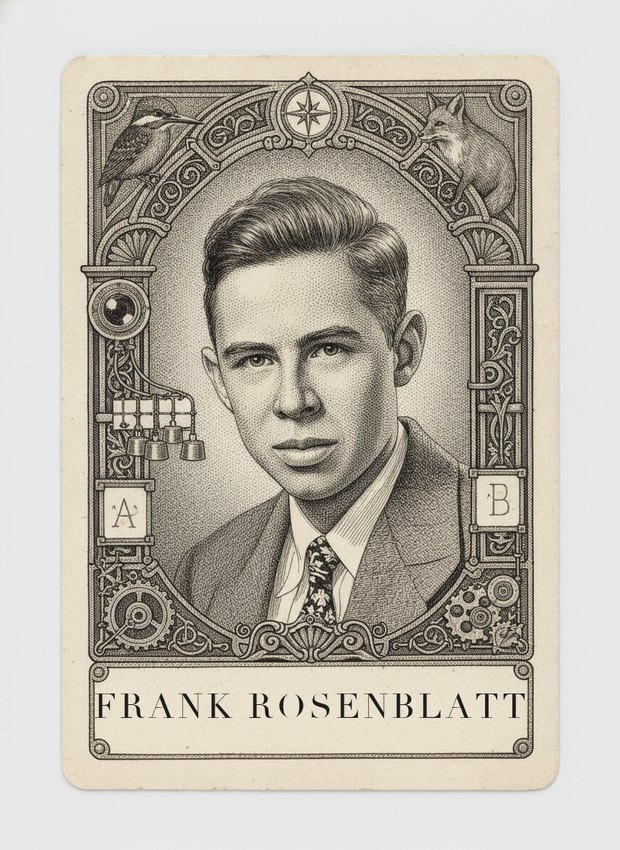
Frank Rosenblatt
The perceptron: the first trainable neural classifier
Played by Tom Dobbs
Strongest on
Battles
One test or twenty? W Noam Chomsky
XOR W Leo Breiman
The tilted scan L Leo Breiman
Find the lost submarine W Noam Chomsky
Which examples deserve labels? W Bernhard Scholkopf
The memory that completes the pattern L Leo Breiman
The spam in the inbox L Richard Karp
Color the map, meet the constraints L Bernhard Scholkopf
The line between two clouds W Bernhard Scholkopf
The spam in the inbox
In the mind map
The same ideas, as concepts rather than history — in John's ML knowledge map.
Life and career
In July 1958 the United States Navy held a press conference to announce a machine that, in the reporting that followed, would be able to walk, talk, see, write, reproduce itself, and be conscious of its existence. The machine was the Perceptron, and the man behind it was a thirty-year-old Cornell psychologist named Frank Rosenblatt. He had, in fact, built something genuinely new — a device that learned to classify patterns from examples, with a proof that its learning rule would converge. The gap between that achievement and the press coverage is a large part of why his story ends the way it does.
Rosenblatt was born in New Rochelle, New York, in 1928, and did all his degrees at Cornell, taking his PhD in psychology in 1956. His dissertation work involved multivariate analysis of psychological data — he wrote software for an early computer to do factor analysis — and this matters, because it means he came to neural networks as a quantitatively trained *psychologist* interested in how brains actually recognize things, not as an engineer looking for a classifier. He joined the Cornell Aeronautical Laboratory in Buffalo, where the Office of Naval Research funded his work, and later returned to Ithaca as a professor in the Cornell psychology department and its neurobiology and behavior section.
The Mark I Perceptron, completed around 1960, was physical: a 20×20 array of photocells forming an artificial retina, wired to association units by a randomized patch panel, with weights implemented as motor-driven potentiometers that physically turned as the machine learned. It is now in the Smithsonian. Rosenblatt's 1962 book *Principles of Neurodynamics* laid out the broader theory, including multi-layer architectures he called cross-coupled and back-coupled perceptrons, and was far more careful than the press had been.
He was, by accounts, a man of wide enthusiasms — he taught astronomy, kept a private observatory, sailed, and in the late 1960s did serious experimental work on memory transfer in rats, injecting brain extracts from trained animals into untrained ones, a line of research that was fashionable then and did not survive replication. He was also a public and somewhat combative advocate for his approach, which sharpened the conflict with Marvin Minsky. The two had been at the Bronx High School of Science a year apart, and their disagreement in the 1960s was reportedly personal as well as technical.
*Perceptrons*, by Minsky and Papert, appeared in 1969. Funding for neural network research contracted sharply in the years that followed. In July 1971, on his forty-third birthday, Rosenblatt died in a boating accident on Chesapeake Bay. He did not live to see backpropagation, or the resurgence of the 1980s, or the vindication that came fully only in the 2010s. When Hinton, Bengio, and LeCun received the Turing Award in 2018, the lineage they were extending was his.
Key contributions
**The perceptron algorithm (1958).** Strip away the hardware and the perceptron is startlingly simple, which is the point. You have a weight vector *w*. For each incoming example *x* with true label *y* ∈ {+1, −1}, predict sign(*w*·*x*). If the prediction is correct, do nothing. If it is wrong, update *w* ← *w* + *y x*. That is the entire algorithm. It is an error-driven, online, additive correction rule with no learning rate to tune, no objective function stated in advance, and no requirement that you ever store the data.
**The perceptron convergence theorem.** Rosenblatt proved, and Novikoff sharpened in 1962, that if the training data are linearly separable with margin γ and the examples have norm bounded by R, then the algorithm makes at most (R/γ)² mistakes before it stops erring, *regardless of the order in which examples arrive and regardless of how many there are*. This is worth pausing on for a graduate audience: it is a **mistake bound**, not a generalization bound, and it is one of the first finite-sample guarantees in the history of machine learning. The quantity R/γ is the same margin-to-radius ratio that reappears twenty-five years later in the analysis of support vector machines and in Rademacher-complexity bounds. The perceptron is where the margin enters learning theory.
**The architecture.** The Mark I had three layers: sensory units (S), association units (A) with fixed, randomly wired connections, and response units (R) with adjustable weights. Only the last layer learned. In modern terms, the random A-layer is a fixed nonlinear feature map and the perceptron learns a linear separator in that induced feature space — which makes the Mark I a direct ancestor of random-features methods, extreme learning machines, and, through the kernel view, of the whole business of separating in a lifted space. Rosenblatt understood the multi-layer question and discussed deeper architectures in *Principles of Neurodynamics*; what he did not have was a credit-assignment rule for training hidden layers.
**The methodological stance.** Rosenblatt argued explicitly against the symbolic program that dominated AI: intelligence, he held, would come from statistical learning in networks of simple units with initially random connectivity, shaped by experience, not from hand-coded logical rules. He framed the perceptron as a probabilistic model of brain organization — the 1958 paper is titled "The Perceptron: A Probabilistic Model for Information Storage and Organization in the Brain," and appeared in *Psychological Review*, not an engineering journal. Every argument the field has had since about learned versus engineered representations is a continuation of the one he started.
In battle
Rosenblatt's profile is narrow and honest: mean 16.1, median 12, seventy-nine of a hundred problems at or below 20, and exactly one dominant score. He is a one-idea figure, and the idea is powerful in precisely the places it applies.
The peak is **Learn from the stream, one at a time** (P150) at 90 — online learning. This is the problem the perceptron was born for. The algorithm has no notion of a fixed training set at all; it predicts, observes the truth, and updates, exactly as the problem describes. The convergence theorem is among the earliest mistake-bound guarantees anywhere. What keeps him from a higher score is a specific and instructive gap: he predates the adversarial, worst-case-ordering framing of modern online learning, and he had no concept of regret against the best fixed predictor in hindsight. The people who formalized that — the online convex optimization tradition — score above him on the harder version of his own problem.
**The line between two clouds** (P023) at 78 is linear separation, his native question, though the margin-maximizing answer belongs to Vapnik. Below that his scores fall into a middling band where the perceptron is *relevant but insufficient*: **Sixty thousand digits** (P025) at 55 — MNIST, where a linear classifier on raw pixels is a real baseline and nothing more; **Teach the machine checkers** (P053) at 50, where Samuel's learned evaluation function is a cousin of his weight updates; **The pattern survives the shift** (P232) at 48, translation invariance, which his random association layer gestures at without solving; **Arrested by a false match** (P292) at 45 and **The inbox under siege** (P258) at 44, both real-world linear classification problems; and **The memory that completes the pattern** (P242) at 44, associative memory, adjacent to but not identical with his machinery.
His category means confirm the shape. `classification` at 30.2 over seventeen problems is his broadest strength and the highest classification mean of any midcentury AI figure. `perception` 28.5 and `nlp` 37.0 follow, since pattern recognition from raw input is exactly what he built for.
Then the collapse. He scores 3 on **Roll the dice at Los Alamos** (P211) — Monte Carlo — 3 on **Sample from the impossible posterior** (P212), 3 on **The paradox in the admissions data** (P214) and **The therapy the trial reversed** (P215), 3 on **Calculus for a jagged path** (P216), and 2 on **How high must the dike be?** (P217), his absolute floor. His `information` mean is 5.5, `regression` 6.5, `computability` 7.2. The perceptron is not a probabilistic model in any operational sense despite the title of its paper: it has no likelihood, no posterior, no sampling, no variance estimate, and no way to say how confident it is. Nor does it have anything to say about causation, computation theory, or games — his `search` mean of 11.7 across sixteen problems and `games` at 15.5 are among the lowest in the roster.
Two absences are worth naming explicitly because students will look for them. Rosenblatt does *not* dominate XOR — Minsky scores 96 there and Pitts 72, while Rosenblatt is the figure the problem is about but not the figure who resolved it. And he does not dominate deep learning problems, because the credit-assignment rule that made depth trainable was not his. He is the origin of the tradition and, in the game as in history, is repeatedly beaten on his own territory by people who came after him with the tools he lacked.