It is the same labels-are-expensive world, but now you hold the pen: you may choose which thirty of the thirty thousand points get sent to the expert for labeling, and you may choose them adaptively, each new label informing the next request. A point deep inside a cluster teaches you little; a point near the uncertain boundary can be worth dozens of random ones. Design the querying strategy and prove it beats labeling thirty points at random. The guarantee must be provable, not merely plausible. Get it wrong and you spend your tiny, precious label budget on redundant points and learn no faster than blind sampling — when every label costs an expert's hour, choosing the right questions is the entire game, and 'provably better than random' is the bar.
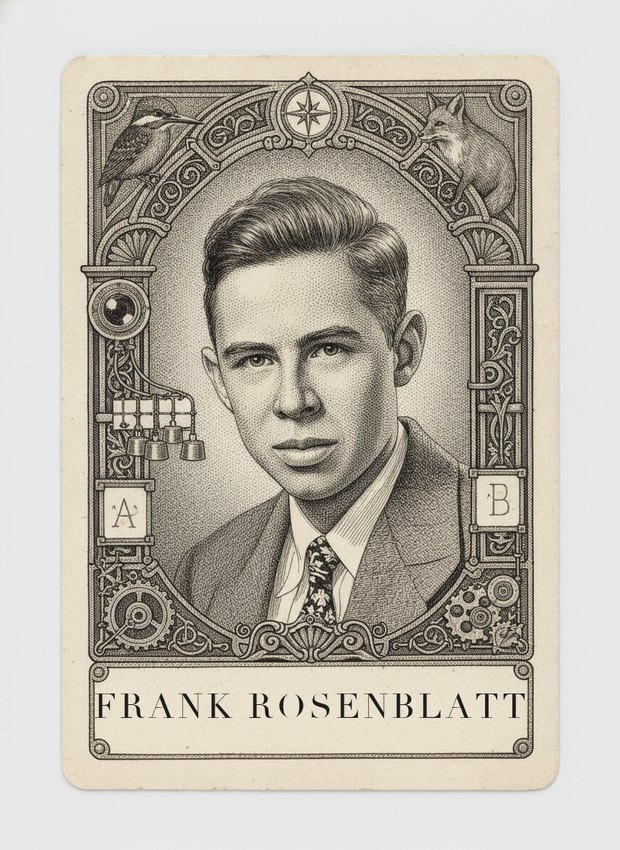
Chose The error-correcting update — right call.
Rosenblatt's perceptron (1957-1962) is the ancestor of the linear classifiers on which 2000s active learning ran, and his error-driven update rule contains a germ of the key idea: only points the current hypothesis gets wrong change the model, so informative examples are the ones near or across the boundary. The perceptron convergence theorem also shows he operated in a prove-it culture — a real guarantee, if about mistake bounds on given data rather than label complexity. But Rosenblatt never chose his data; examples arrived, and the perceptron reacted. He had no statistical framework for comparing sampling strategies, no version-space formalism, and no notion of a label budget — concepts three decades away. He supplies the base learner and a compatible spirit, not the querying strategy or its proof.
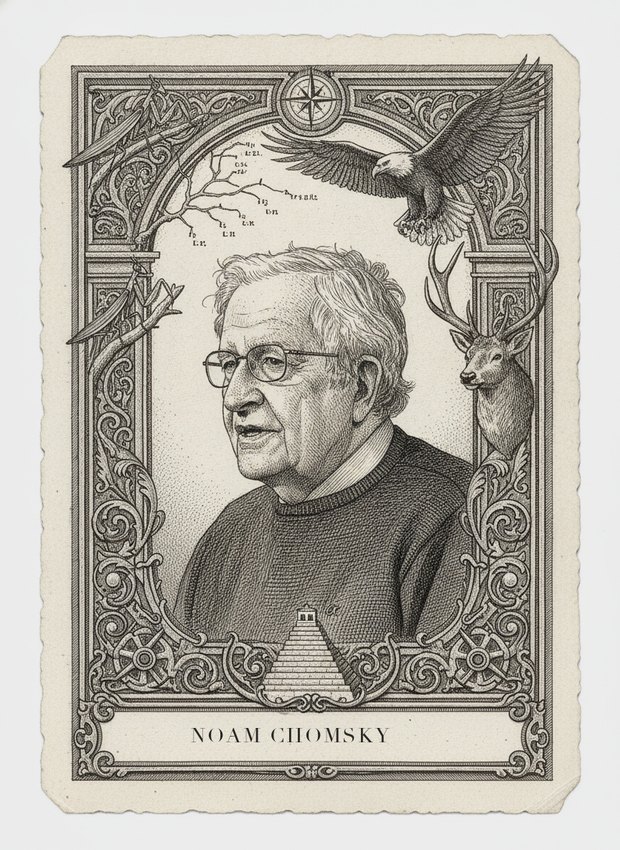
Chomsky's poverty-of-the-stimulus argument is, structurally, the deepest early statement of this problem's premise: learners receive far too little labeled evidence to pin down the target, so something else — for him, innate constraint; here, the unlabeled cloud's geometry — must shrink the hypothesis space. Formal-language theory descending from his hierarchy also seeded Gold's 1967 learnability results, an ancestor of the learning-theoretic tradition whose proofs the problem demands, and query-based learning of automata (Angluin) lives on that land. But Chomsky's own methods — competence grammars, argumentation from linguistic judgment — involve no statistics, no algorithms, and famously reject the probabilistic framing outright; he would deny that boundary-querying over a data cloud is the right picture of learning at all. Conceptual grandfather of the label-scarcity premise; methodological contribution to the task, nearly nil.
Battle #122 · 8/10/2026, 11:38:54 AM · this result is deterministic: the same two personas on this problem always resolve the same way.