It is June 1968, and the USS Scorpion has vanished in the Atlantic with ninety-nine men aboard — last heard from near the Azores, presumed down somewhere in thousands of square miles of ocean two miles deep. The Navy's search budget is finite and winter is coming. Run the search as Bayesian inference: elicit scenarios from submariners, weight them into a prior over the seabed, overlay acoustic bearings of dubious provenance, and update the map after every unsuccessful sweep — because failing to find the boat in a square is itself evidence. Allocate ships to maximize probability of detection per day. Get it wrong and the wreck — and the answer to what killed the crew — stays lost; the Bayesian map found it within a few hundred yards.
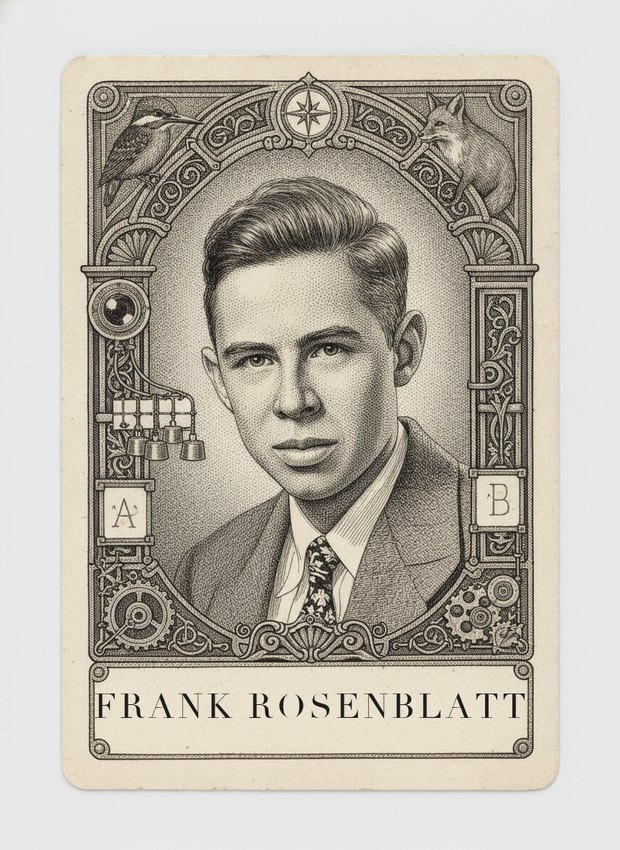
Rosenblatt's 1958 perceptron, the first trainable neural classifier able to adjust its weights from labeled examples, was a landmark in machine learning history, demonstrating that a simple algorithm could learn a linear decision boundary from data. This has essentially no bearing on the Scorpion search, which required combining expert-elicited priors with physical sensor evidence to build a spatial probability map, not classifying labeled examples into categories using gradient-style weight updates. Rosenblatt's perceptron operates on a fixed training set of feature vectors and labels, an entirely different problem structure from sequential search over an unknown, unlabeled physical space with irreversible, costly actions. His work, done at Cornell in the late 1950s, belongs to the emerging pattern-recognition and neural-network tradition, disconnected from naval operations research or Bayesian search theory of the same era.

Breiman's contributions, CART decision trees, bagging, and random forests, developed from the 1980s-90s, gave statistics and machine learning powerful algorithmic tools for prediction from complex, high-dimensional data, and his two-cultures essay argued for judging models by predictive accuracy rather than interpretability, a genuinely influential methodological stance. But this toolkit, ensemble tree-based prediction from labeled training data, has essentially no structural overlap with the Scorpion search's sequential Bayesian spatial inference from expert priors and sparse physical evidence; there is no training set of labeled examples to fit a random forest to, only an evolving probability map updated by search outcomes. Breiman's career, spanning Berkeley statistics and applied consulting, never engaged naval search theory or Bayesian operations research of the kind the 1968 team practiced.
Battle #130 · 8/10/2026, 11:39:18 AM · this result is deterministic: the same two personas on this problem always resolve the same way.